Double Adjustable Control Arm Install Tips

tomtaylz

LJR Addict
Original poster
Supporting Member
Ride of the Month Winner
Joined
Feb 18, 2018
Messages
2,499
Location
San Francisco, CA, USA
So I’ll be installing savvy control arms soon, I’ve read this thread that was full of good info:

https://bit.ly/2s708lV

One piece info it’s missing is what should the angles be at?

Any other tips you’ve found especially with double adjustable that make it easier? Seems like a good part of a day.

Also, is this correct for torque specs?
Upper control arms: 55 ft lbs
Lower control arms: 130 ft lbs, except front at axle is 120 ft lbs

 
What angles should what be at? The pinion and the driveshaft?

If that's what you mean, those angles should be equal. No one can tell you an exact angle, you just need to use a digital angle finder and align them both until they have the same angle.

I've gotten good enough at it that I don't even need an angle finder, I can just eyeball it. However, some vehicles seem to be more sensitive to the pinion / driveshaft angles than other for whatever reason.
 
What angles should what be at? The pinion and the driveshaft?

If that's what you mean, those angles should be equal. No one can tell you an exact angle, you just need to use a digital angle finder and align them both until they have the same angle.

I've gotten good enough at it that I don't even need an angle finder, I can just eyeball it. However, some vehicles seem to be more sensitive to the pinion / driveshaft angles than other for whatever reason.

Yeah I guess I meant pinion, driveshaft and caster. What is the pinion angle in relation to caster? I know as one changes it effects the other? Or just leave them about what they are and worry about pinion vs driveshaft?
 
Last edited:
With the front driveshaft, don't worry whatsoever about the pinion angle. The caster angle is what's important in the front, and the driveshaft / pinion angle will be fine wherever it ends up.

That being said, don't bother with the angle of the front driveshaft in relation to the front axle pinion. The caster angle takes precedence over that.

You can measure the caster using this guide:
http://www.savagesun4x4.com/enter/t...technical_discus/caster_adjustment_on_tj.html

In regards to caster angle, I'd need to look at my alignment specs the shop printed out. I believe you want to be somewhere around 6 degrees for a 4" lift and 33s, though I don't want to swear by that.

@Jerry Bransford will know for sure.
 
  • Like
Reactions: tomtaylz
Also, to follow-up on that, here's a post from @Jerry Bransford as well:
https://wranglertjforum.com/threads/how-to-adjust-caster.580/#post-5488

I agree with him on that. I've never actually set my own caster angle. I will do the toe-in myself any day of the week. However, I prefer to take it to a shop with an actual alignment rack to set the caster, as they can dial in things much more accurate than I can, since they have the rack with the lasers.

So my suggestion is to get everything installed, get the rear pinion angle set, and then take it into a shop to have them set the caster. They may as well just set the toe-in as well. Even though you can do it yourself, it will already be on a rack, so it's not like they'll charge more for it.
 
Ah that’s the missing piece I think needed. So I just need to make sure everything is centered at flex (doing the above linked strategy of basically bump stop test), get the pinion and driveshafts at the same angle and then take it to get aligned.
 
Yep, that's what I do.

And with the control arms, like that article says, don't pay any attention whatsoever to length. It's absolutely irrelevant. You're main focus is that the control arms aren't fighting against each other, and that the pinion angles are correct.

I always install one upper and use that one upper to set the pinion angle length. Once it's adjusted, dialed in, and tightened in place, I then install the upper on the opposite side. I lengthen it to the exact point that it moves about freely without any bind. It's easy to tell when this happens, because you'll be able to very easily lengthen it. The moment that you aren't able to easily lengthen it and it starts to get difficult, that's when you know it's binding up and you need to back-off.

Once upon a time I was dead-set on control arm lengths. It took messing around with it once or twice to realize that they didn't matter at all, and all those stupid charts you see online with control arm lengths for different height of lifts are absolutely pointless.
 
Thanks sounds good!

Oh I love taking out and putting in springs lol. Who would have thought you have to do it so many times :D
 
Thanks sounds good!

Oh I love taking out and putting in springs lol. Who would have thought you have to do it so many times :D

The rear springs are always easy to get out. It's the front ones that drive me nuts. They're so damn long!

It really makes you appreciate a coilover!
 
And, I had some time to check...Pinion angle does take priority over Caster

1546610237537.webp
 
  • Like
Reactions: ElectricWizard
Yep, that's what I do.

And with the control arms, like that article says, don't pay any attention whatsoever to length. It's absolutely irrelevant. You're main focus is that the control arms aren't fighting against each other, and that the pinion angles are correct.

I always install one upper and use that one upper to set the pinion angle length. Once it's adjusted, dialed in, and tightened in place, I then install the upper on the opposite side. I lengthen it to the exact point that it moves about freely without any bind. It's easy to tell when this happens, because you'll be able to very easily lengthen it. The moment that you aren't able to easily lengthen it and it starts to get difficult, that's when you know it's binding up and you need to back-off.

Once upon a time I was dead-set on control arm lengths. It took messing around with it once or twice to realize that they didn't matter at all, and all those stupid charts you see online with control arm lengths for different height of lifts are absolutely pointless.
You still have them fighting each other unless you take a floor jack and raise the front of the axle up until you can freely spin the bolt in the control arm. The springs overhang the front and keep the uppers in tension at rest. You need to relieve that tension so you know both arms are seeing the same load. Also must be done are fairly level ground side to side and reasonably so front to back.

Put the floor jack under the tie rod near the driver's side knuckle.
 
  • Like
Reactions: Chris
So I’ll be installing savvy control arms soon, I’ve read this thread that was full of good info:

https://bit.ly/2s708lV

One piece info it’s missing is what should the angles be at?

Any other tips you’ve found especially with double adjustable that make it easier? Seems like a good part of a day.

Also, is this correct for torque specs?
Upper control arms: 55 ft lbs
Lower control arms: 130 ft lbs, except front at axle is 120 ft lbs
A few rules of thumb just in case.
Rig needs to be reasonably level front to back, side to side.
Axle needs to be centered before you dial in the uppers.
Start with lowers set the same length. Lower mounts are more robust and rarely vary much.
Install a single upper to dial in angles. Only when that is done should the remaining upper be floated to length.
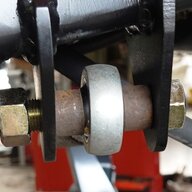
To tighten a DA arm- figure out which way you will be tightening. Rotate the barrels of the joints until the top is away from the tightening direction so it will bind against the side of the mount. Grab the arm with one hand so you can feel it turning or watch it. Snug one jam nut down until you just feel or see it start to turn the arm. Do the other end the same. Alternate back and forth until the jam nuts are tight enough that the arm quits trying to turn at which point you can heave on each jam nut to fully tighten it.

The control arm bolts need to be tightened before you do all of the jam nuts.
 
  • Like
Reactions: Chris and tomtaylz
Well, I may have screwed up when I was adjusting my rear UCA/LCA, I didn't remove my springs and put the axle at full bump. Both of my LCA are the same length. Guess, I know what I'll be doing this weekend. No wonder why my Jeep is vibrating/driving like crap.
 
  • Like
Reactions: Chris
How is it steering now? take some before measurements and angles. This little unit comes in handy.

https://www.amazon.com/dp/B00H7HVGES/?tag=wranglerorg-20

Shoot to get the front pinion angle as close to parallel to the ds as you can. Caster will be what it will be. If your return to center suffers then adjust it. If you get vibes as a result then your pinion angle needs to be in it's happy place and caster will be what it is.
 
How is it steering now? take some before measurements and angles. This little unit comes in handy.

https://www.amazon.com/dp/B00H7HVGES/?tag=wranglerorg-20

Shoot to get the front pinion angle as close to parallel to the ds as you can. Caster will be what it will be. If your return to center suffers then adjust it. If you get vibes as a result then your pinion angle needs to be in it's happy place and caster will be what it is.

Return to center is fine right now but steering feels a bit looser than I’d like it and I’m pulling slightly to the left which I still need to properly diagnose
 
Last edited:
Those DA arms are going to be super easy to install brah. Park the jeep on level, flat ground, set the park brake, and replace one arm at a time. adjust the new arms same length as the old ones to start off, then after you have them torqued to spec, do your fine tuning adjustments for your pinion angles. Blaine's method of tightening the jamb nuts sounds like a great way to assure that the jj's don't get misaligned against each other. You don't want one jj misaligned one way and the other misaligned the opposite way. It's ok for them to be misaligned at static, as long as both joints are angling the same way.
 
Those DA arms are going to be super easy to install brah. Park the jeep on level, flat ground, set the park brake, and replace one arm at a time. adjust the new arms same length as the old ones to start off, then after you have them torqued to spec, do your fine tuning adjustments for your pinion angles. Blaine's method of tightening the jamb nuts sounds like a great way to assure that the jj's don't get misaligned against each other. You don't want one jj misaligned one way and the other misaligned the opposite way. It's ok for them to be misaligned at static, as long as both joints are angling the same way.

Would you worry about the LCAs centering without removing the springs and all that?
 
Not sure I understand the question.

So the first link with the lower control arms it says to take out the springs and ensuring that the bump stop is centered at full flex to get your LCA lengths correct.

I’m guessing the above is still necessary just your approach would work for UCAs?