Trying to wrap my head around alignment geometry for the front of our TJ's. Right now it's making my head hurt more than anything.
Caster, Camber, Scrub Radius... What happens to the geometry when we lift, change tire and wheel sizes, wheel offset and pinion angle. What do we have to live with and what can we adjust / fix.
Messing about with this stuff effects drive-ability and safety.
Anyone want to try to explain this stuff to me (us)?
I can start out with what I think I know and go from there.
Toe in. The front of the wheels are set so that the fronts is slightly closer together that the back.1/16" to 1/8" of toe in is good, and we can set this in the drive way. Jerry has a good write up on this.
Caster. The steering axis angle in relation to the center of the tire...it would seem that changing the pinion angle would change this.

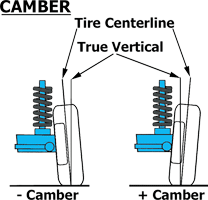
Camber. The lean of the tires in or out. It is what it is...
Scrub radius. The distance in or out of the center of the tire contact patch from the line where the kingpin angle intersects the road. It seems that tire size and wheel width / offset would effect this. Can we use this to compensate for lost caster? It seems that when the scrub radius gets extremly negative, the TJ wants to "wander" going down the road.

Pinion angle. The angle of the front pinion in relation to the driveshaft / transfer case. We know this matters for driveshaft type and alignment.
Edited to add: Then there's bump (roll) steer and roll center, though roll center seems to be a rear suspension geometry thing. Bump steer (both front wheels go up) doesn't seem to effect solid front axles though roll steer (one front wheel goes up and one goes down) does.
Caster, Camber, Scrub Radius... What happens to the geometry when we lift, change tire and wheel sizes, wheel offset and pinion angle. What do we have to live with and what can we adjust / fix.
Messing about with this stuff effects drive-ability and safety.
Anyone want to try to explain this stuff to me (us)?
I can start out with what I think I know and go from there.
Toe in. The front of the wheels are set so that the fronts is slightly closer together that the back.1/16" to 1/8" of toe in is good, and we can set this in the drive way. Jerry has a good write up on this.
Caster. The steering axis angle in relation to the center of the tire...it would seem that changing the pinion angle would change this.
Camber. The lean of the tires in or out. It is what it is...
Scrub radius. The distance in or out of the center of the tire contact patch from the line where the kingpin angle intersects the road. It seems that tire size and wheel width / offset would effect this. Can we use this to compensate for lost caster? It seems that when the scrub radius gets extremly negative, the TJ wants to "wander" going down the road.
Pinion angle. The angle of the front pinion in relation to the driveshaft / transfer case. We know this matters for driveshaft type and alignment.
Edited to add: Then there's bump (roll) steer and roll center, though roll center seems to be a rear suspension geometry thing. Bump steer (both front wheels go up) doesn't seem to effect solid front axles though roll steer (one front wheel goes up and one goes down) does.
Last edited: