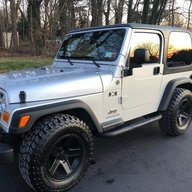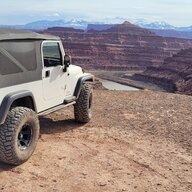
I think I'm ready to talk about this

@InOmaha and @Xposure , speed was reportedly 35 mph (I'm guessing over 40 when things started to get squirelly, less when they hit the ditch). Whatever dynamic pulled apart the new Rancho shock, probably did the frame damage. I'm not sure how much force is required to pull apart a shock, but that load would have been leveraged through the spring tower. Visually, you can't see any frame damage, no kinks or twists, the frame shop couldn't point to anything specifically. I should be able to get a better idea once I remove the fenders. What's a safety cap?

FL-EtYdegbfv4-fFo3Ehtt9crA=w469-h625-no?authuser=0.webp
 
  • Like
Reactions: Xposure
My kid did the same thing one month after learning to drive the Jeep. County road took her out. She over corrected and rolled it about 4 times. First frame shop said it was fine but it just didn’t look right to me. Second shop confirmed that while it was straight from the windshield back, the front portion of the frame was 3/4” out. Both sides had a curve to them. They put it on a straightener and fixed it up. Been driving it for two years now and it drives truer than before.
 
  • Like
Reactions: Xposure
My kid did the same thing one month after learning to drive the Jeep. County road took her out. She over corrected and rolled it about 4 times. First frame shop said it was fine but it just didn’t look right to me. Second shop confirmed that while it was straight from the windshield back, the front portion of the frame was 3/4” out. Both sides had a curve to them. They put it on a straightener and fixed it up. Been driving it for two years now and it drives truer than before.
Encouraging! What did they charge, if you don't mind me asking.
 
Great if your floor is LEVEL ;)
Why not swap out the frame, might not be cheaper, but prob much faster, easier, less headaches & no guessing on correct measurements !1
 
Glad to hear your daughters and her friends are all okay and that the Jeep did His job and protected them real well!

My son is just fixing to get his license and has been driving the Jeep while having his permit. I think the Jeep is easy to drive....up until the point that is starts to get squirrelly and then I think it's a VERY difficult vehicle to correct. Most cars are much easier to correct than a Jeep. My son drives the Jeep great but I worry about what will happen if someone pulls out in front of him and he swerves out of the way or something similar.

So glad they were okay.

Also....I think a come along and some heat would straighten that frame right out. My brother and I have done it a couple times. He got a wrecked 2010 Toyota Corolla Sport traded to him for installing a transmission in their truck. The front bumper cover was messed up and the frame didnt line up with the front core support anymore. We found a paint matching bumper cover at a salvage yard. Heated up the frame and used a come along (attached to a tree) and ratched it right back into place. 5lb hammer straightened the tabs on the core support and it all bolted back up smooth as butter. Youd never know it was wrecked.

Good luck with it!
CAR FAX 😁
 
So glad everyone came out unscathed, that's terrifying. The account of what happened is something I'm not familiar with--for my own reference and safety, could anyone explain why letting off the gas without clutching is dangerous on a surface like this?
 
So glad everyone came out unscathed, that's terrifying. The account of what happened is something I'm not familiar with--for my own reference and safety, could anyone explain why letting off the gas without clutching is dangerous on a surface like this?
Engine braking on the rear wheels only. When you suddenly close the throttle by lifting off the accelerator, the driven (rear) wheels go from providing acceleration (+) torque to braking (-) torque. This is because the engine wants to be at idle speed, but the rear wheels are still spinning it at whatever RPM you lifted. The effects are worse with a manual transmission (no torque converter) and higher RPM. Performance/ race drivers refer to the dynamic as trailing throttle oversteer, which can be helpful in pivoting a car at turn entry.
Most modern vehicles now have a feature to prevent this (MSR, or German translation Motor Slip Reduction) - if the ABS/ESC brake module detects driven wheel slip, it requests positive torque from the engine PCM. Similar to ABS control, but instead of reducing brake pressure to control slip, it adds engine torque. Without this, drivers just need to be aware of what's happening and how to react.
 
Last edited:
  • Like
Reactions: Squatch
Engine braking on the rear wheels only. When you suddenly close the throttle by lifting off the accelerator, the driven (rear) wheels go from providing acceleration (+) torque to braking (-) torque. This is because the engine wants to be at idle speed, but the rear wheels are still spinning it at whatever RPM you lifted. The effects are worse with a manual transmission (no torque converter) and higher RPM. Performance/ race drivers refer to the dynamic as trailing throttle oversteer, which can be helpful in pivoting a car at turn entry.
Most modern vehicles now have a feature to prevent this - if the ABS/ESC brake module detects driven wheel slip, it requests positive torque from the engine PCM. Similar to ABS control, but instead of reducing brake pressure to control slip, it adds engine torque. Without this, drivers just need to be aware of what's happening and how to react.

Ah, that makes total sense. But never even occurred to me. The TJ is my first RWD vehicle so this type of stuff is still only finding its way onto my radar. Thanks for the intel
 
  • Like
Reactions: Squatch
I realize that I didn't really describe why rear wheel slip causes instability. When a tire is in longitudinal slip (straight ahead partial skid), it also loses lateral traction, or side to side grip. So any minor steering input can cause the rear to slip/skid sideways. Short wheelbase Jeeps are some of the worst behaving vehicles for lateral instability. A novice driver will try to correct the skid, but it usually over corrects and goes into an opposite skid. Then another correction makes things worse. It really takes a skilled driver who understands throttle modulation in relation to steering angle to get things back into control. Sorry if this is too Captain Obvious, but t00th's question made me think that some Jeep drivers may not be aware and maybe this would be helpful. I'd recommend finding a safe, flat gravel area (without ditches!) and practicing skid control until you feel comfortable. I obviously need to educate my kids better...
 
I grew up driving rear wheel drive vehicles on country roads. I may not be able to describe it but I probably can recognize what to do and do it without thinking.

Of course, a lot of those cars were boats too. But we sailed them.
 
  • Like
Reactions: John Cooper