
I found this article on autoblog.com and thought this was pretty cool!
The upcoming Infiniti QX50 does not get our pulse racing, no matter how shapely its preview, the QX Sport concept, may be. No mid-size SUV does, to be fair. But it has something special under the hood - the world's first production variable compression ratio engine. That means the QX50's 2.0 liter turbo four, which makes 268 horsepower and 288 pound-feet of torque, will have up to 27 percent better fuel economy. Here's how it works.
The trend of moving to smaller, turbocharged engines carries with it one big falsehood. Under low load when the turbo isn't needed, these engines are less efficient than an equivalent engine without a turbo. That is, if you never need the extra power, you're wasting fuel.
Turbocharged (and supercharged) engines use a lower compression ratio to prevent detonation. When you force extra air in a cylinder and mix it with fuel, it's more likely to prematurely go boom. Lowering the compression ratio prevents this problem, but it's less efficient. Infiniti's VC-T promises the best of both worlds, with a compression ratio that ranges from 8.0:1 for high-power turbo needs to a 14.0:1 ratio for fuel-sipping efficiency.
At its heart the VC-T engine is a simple idea but it's complicated to explain. Consider yourself warned. The photo below from Infiniti serves as a good visual overview. For the truly nerdy, this patent applicationcovers the mechanical concept.
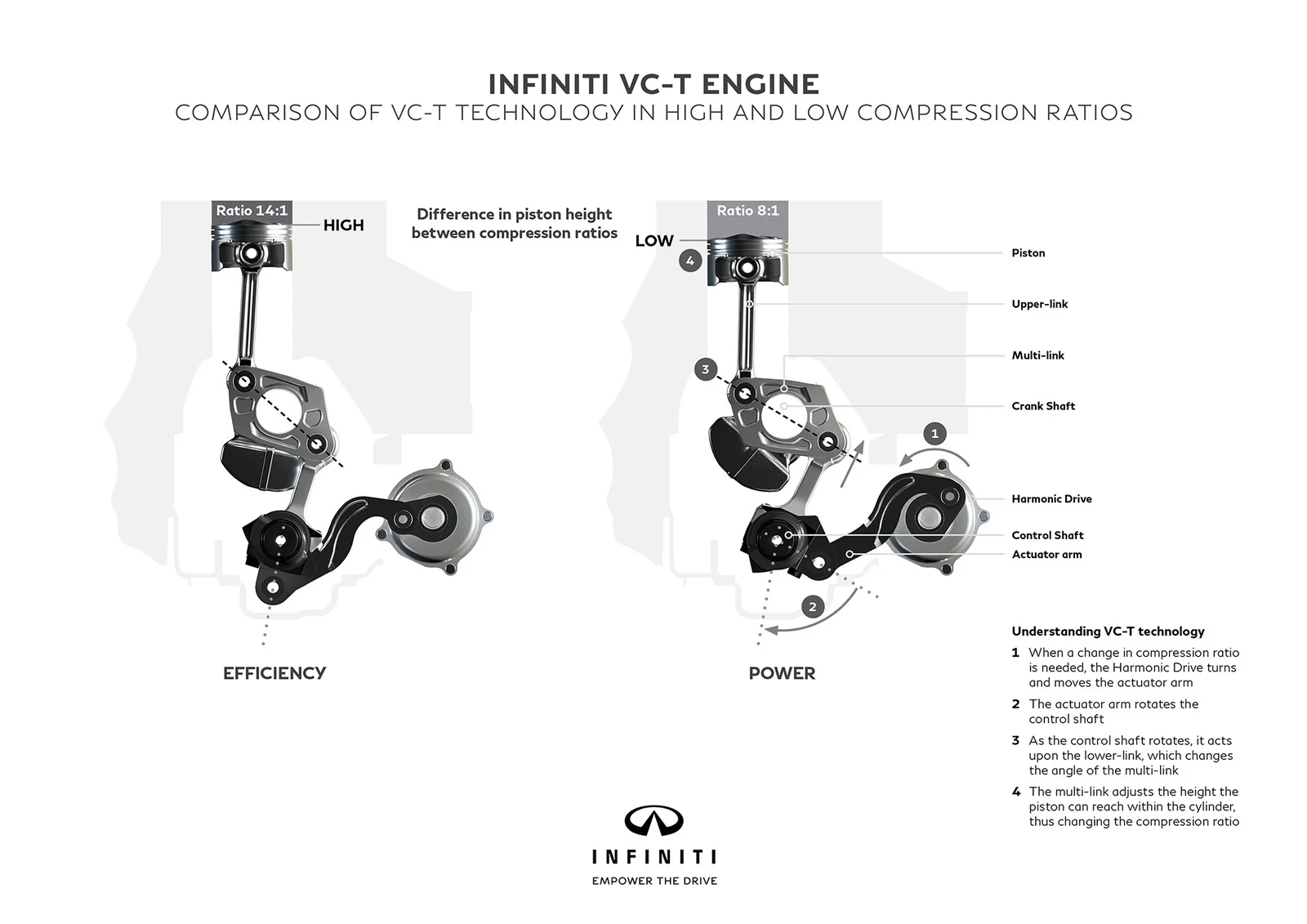
Instead of having the pistons connected to the crankshaft, Infiniti's engine has a pivot arm with a connection on each end. One end connects to the piston, the other end connects to a second lower shaft, which is controlled by an actuator arm. At any given time the engine's pistons move up and down according to the lobes on the crankshaft. But the actuator arm can change the angle of the pivot arm up and down. That is, the pistons still move in the same motion with the same stroke, but phase the entire stroke up or down. Move the pivot up and there's less room at the top, which means a higher compression ratio. Move the pivot down and compression ratio goes down too. As an added bonus, the lower shaft eliminates the need for counter-rotating balance shafts.
Infiniti say this system works constantly and can vary the compression ratio to any number between 8:1 and 14:1. It also uses an electronic variable valve timing on the intake valves to switch into Atkinson-cycle combustion for greater efficiency. The exhaust valve uses a more common oil pressure-based cam phaser. Other nifty features include a cylinder head with integrated exhaust manifold, electronic wastegate control for the turbo, and a variable-displacement oil pump. Both port and direct fuel injection are used as well.
Compared to the lot of 2.0-liter turbos from other luxury brands, the VC-T engine offers more power and torque than the standard offerings from Audi, BMW, and Mercedes-Benz. It also beats the 2.0-liter in the Chinese-market Cadillac XT5 on horsepower. There are 2.0-liters with more power found under the hood of cars the Honda Civic Type R, Mercedes-Benz CLA45 AMG and GLA45 AMG, and Subaru Impreza WRX and STI (to name a few). But Infiniti's claim here is a better combination of efficiency and power. Expect the VC-T to be paired with a CVT in the QX50.
Infiniti says that the variable compression ratio technology can be scaled to other sizes of four-cylinder engines, but is impractical for V6 and V8s. Speaking of the V6, the power and torque of the VC-T is right in line with the 3.5-liter VQ used in the QX60 and various front-wheel-drive Nissans. Like those vehicles, the VC-T in the QX50 will be mounted transverse but offer some form of all-wheel-drive. It's easy to see this engine taking over from the VQ as Infiniti's parent company spreads the VC-T into other applications.
For the near future the VC-T will be exclusive to the QX50, which starts production in 2017. Dropping this engine in the rear-drive Q60 might have been more buzz-worthy, but Nissan (and Infiniti) chose a more pragmatic plan. The transverse setup guarantees more widespread adoption, spreading the cost and corporate fuel economy benefits over a wider net. Putting all that aside, the VC-T is an amazing piece of groundbreaking technology. Amazing enough that yes, Infiniti has us excited for a mid-size SUV.
The upcoming Infiniti QX50 does not get our pulse racing, no matter how shapely its preview, the QX Sport concept, may be. No mid-size SUV does, to be fair. But it has something special under the hood - the world's first production variable compression ratio engine. That means the QX50's 2.0 liter turbo four, which makes 268 horsepower and 288 pound-feet of torque, will have up to 27 percent better fuel economy. Here's how it works.
The trend of moving to smaller, turbocharged engines carries with it one big falsehood. Under low load when the turbo isn't needed, these engines are less efficient than an equivalent engine without a turbo. That is, if you never need the extra power, you're wasting fuel.
Turbocharged (and supercharged) engines use a lower compression ratio to prevent detonation. When you force extra air in a cylinder and mix it with fuel, it's more likely to prematurely go boom. Lowering the compression ratio prevents this problem, but it's less efficient. Infiniti's VC-T promises the best of both worlds, with a compression ratio that ranges from 8.0:1 for high-power turbo needs to a 14.0:1 ratio for fuel-sipping efficiency.
At its heart the VC-T engine is a simple idea but it's complicated to explain. Consider yourself warned. The photo below from Infiniti serves as a good visual overview. For the truly nerdy, this patent applicationcovers the mechanical concept.
Instead of having the pistons connected to the crankshaft, Infiniti's engine has a pivot arm with a connection on each end. One end connects to the piston, the other end connects to a second lower shaft, which is controlled by an actuator arm. At any given time the engine's pistons move up and down according to the lobes on the crankshaft. But the actuator arm can change the angle of the pivot arm up and down. That is, the pistons still move in the same motion with the same stroke, but phase the entire stroke up or down. Move the pivot up and there's less room at the top, which means a higher compression ratio. Move the pivot down and compression ratio goes down too. As an added bonus, the lower shaft eliminates the need for counter-rotating balance shafts.
Infiniti say this system works constantly and can vary the compression ratio to any number between 8:1 and 14:1. It also uses an electronic variable valve timing on the intake valves to switch into Atkinson-cycle combustion for greater efficiency. The exhaust valve uses a more common oil pressure-based cam phaser. Other nifty features include a cylinder head with integrated exhaust manifold, electronic wastegate control for the turbo, and a variable-displacement oil pump. Both port and direct fuel injection are used as well.
Compared to the lot of 2.0-liter turbos from other luxury brands, the VC-T engine offers more power and torque than the standard offerings from Audi, BMW, and Mercedes-Benz. It also beats the 2.0-liter in the Chinese-market Cadillac XT5 on horsepower. There are 2.0-liters with more power found under the hood of cars the Honda Civic Type R, Mercedes-Benz CLA45 AMG and GLA45 AMG, and Subaru Impreza WRX and STI (to name a few). But Infiniti's claim here is a better combination of efficiency and power. Expect the VC-T to be paired with a CVT in the QX50.
Infiniti says that the variable compression ratio technology can be scaled to other sizes of four-cylinder engines, but is impractical for V6 and V8s. Speaking of the V6, the power and torque of the VC-T is right in line with the 3.5-liter VQ used in the QX60 and various front-wheel-drive Nissans. Like those vehicles, the VC-T in the QX50 will be mounted transverse but offer some form of all-wheel-drive. It's easy to see this engine taking over from the VQ as Infiniti's parent company spreads the VC-T into other applications.
For the near future the VC-T will be exclusive to the QX50, which starts production in 2017. Dropping this engine in the rear-drive Q60 might have been more buzz-worthy, but Nissan (and Infiniti) chose a more pragmatic plan. The transverse setup guarantees more widespread adoption, spreading the cost and corporate fuel economy benefits over a wider net. Putting all that aside, the VC-T is an amazing piece of groundbreaking technology. Amazing enough that yes, Infiniti has us excited for a mid-size SUV.