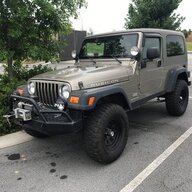
I'm curious how much weight this setup is compared to stock, but I don't have a stock skid because I bought my LJ with a Rubicon Express long arm kit on it. Does anyone know the exact weight of the stock skid and mounting bolts?



This afternoon, I cut the DOM tubing for the end pieces, cut the holes for them in the ends, and cut each end to length, and I only have a picture of the end result:
View attachment 568248
And with the tube in place:
View attachment 568249
Next, I fixtured it up for welding. I thought I took a picture of the fixturing, but I did not, so I'll try to describe how I did it. I wanted the tubes parallel to each other and perpendicular to the cross-member. Since the tubes had nicely squared ends, I took two pieces of flat stock, stacked them on top each other, and drilled two 3/8" diameter holes (the mounting bolt diameter) 32.06" on center, which is the desired spacing between the frame rails. That kept them parallel to each other. To get them perpendicular to the cross-member, I placed some .25" spacers between the flat stock and the side of the cross-member. Then, I tacked the tubes in place, removed the fixturing, and finished the welds:
View attachment 568250
And here it is mounted above the skid:
View attachment 568251
Tomorrow, I'll figure out the mounting tabs to be welded to the frame rails. Stay tuned!
No, it's not.Looks awesome.Is it going to be screwed to the skid?
I'm curious how much weight this setup is compared to stock, but I don't have a stock skid because I bought my LJ with a Rubicon Express long arm kit on it. Does anyone know the exact weight of the stock skid and mounting bolts?
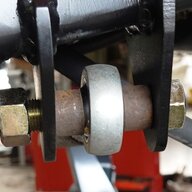
One thing that I do that really helps is I don't build in a gap. I want the inside faces of the tabs perfectly butted up against the ends of my tube sleeve. I tack heavy with it all clamped in place where it goes, remove the crossmember, and then weld inside and outside. Outside first because that will pull the tab outward slightly and then finish the inside welds. That typically leaves me with a very slightly undersize width between the tabs that I smack open slightly with a hammer to slide the tube sleeve in.Today's Task: Designing and Building Cross-member Mounting Tabs
The mounting tabs for the cross member are simply a piece of flat stock with a hole in it. Oh, I'll put a semi-circle on the hole end for aesthetics, but they don't get any simpler than that. However, when it comes to the engineering, they are anything but simple. Here's what I'm considering when determining their size:
I had already picked Grade 8 3/8-24 bolts to mount the cross-member to the frame. The 3/8" diameter Grade 8 bolts have a maximum shear load at tensile failure of 13,200 lb. With two of them combined, it's 26,400 lb. I expect my loaded LJ to weigh about 5,000 lb, so I could come down directly on the cross-member (assuming the skid is missing) with over 5 g in an impact situation before the bolts would break. I went with fine threads mainly because they are more resistant to loosening under flexing loads because the flexing loads want to unscrew the nut, and the fine threads, due to their reduced pitch, unscrew less with a given twist. In this case, I find this resistance to loosening to be a more compelling reason to use UNF fasteners than for the slightly increased shear area.
- Shear strength when the LJ drops with all its weight onto the skid, and the skid transfers that load to the cross-member
- Mounting bolt clamp load vs. the force to deflect the mounting tabs ("pinching" the cross-member end tubes between the mounting tabs with the bolt), since having a bit of clearance between the tabs for assembly is a good idea
- Remaining bolt clamp load after deflecting the mounting tabs, which is required to keep the joint rigid
So, with the bolt size already determined, this morning I looked at the mounting tab design. My gut was telling me to go with 3/16" flat stock, but I wondered if 1/4" would be a better choice. To compare the two, I created a spreadsheet to help me evaluate the three bullet points above. Here's the 3/16" option analyzed:
View attachment 568315
The "Mounting Tab Shear Analysis" section shows that the tab can withstand a 10g drop before failing in shear - so the bolt will be the weak point in a shear loading failure. More than adequate, especially since this analysis again assumes no help from the skid. In the "Mounting Tab Deflection Analysis" section, the .5 inches at the top is the distance from the center of the cross-member mounting hole, where the clamping force is effectively applied, to the edge of the weld at the frame (assuming a 1/4" weld bead), since the weld bead will not deflect much at all during bolt tightening. I assumed .008 inches of deflection because I used one of my wife's tools (she's a metal and glass artist) to make some .004" thick aluminum washers out of a soda can to use for shims during welding:
View attachment 568314
Of course, I expect some warping during welding, too, so I'll deal with that by "tweaking" the width between the mounts after welding to control the amount of clearance. In the "Bolt Clamp Load Analysis" section, there is a lot going on. Assuming the bolt is stretched to 75% of the proof load, the clamping force, torque, and bolt stretch are calculated. The final calculation is the "Remaining Clamp Load." As the bolt is tightened, the clearance is first taken up by bending the mounting tabs, and it takes some force to do that because the mounting tabs are like springs. Once the clearance is gone, the remaining clamping force beyond that is what actually holds the joint rigid. I want to see as much force here as possible, and if it's negative, that's not good - it means the bolt can't get the joint rigid. There is one calculation I omitted. I didn't bother to analyze the bending stress on the mounts during a drop, relying on "engineering judgment" that they'll be more than up to the task.
So, the 3/16" thick tabs pass all the tests. How about 1/4" thick tabs? Here's the analysis:
View attachment 568318
Shear resistance is better, as expected. However, at 75% of the proof load on the bolt, the joint is still not rigid. I don't show the results here, but if I tightened the bolts to 49 ft-lb, which puts them right at the proof load, the joint would be rigid, but I'd only have about 400 lb of remaining clamp load. So, the 1/4" tabs fail the tests. Using 3/16" tabs is a good choice.
Oh, yeah - I made one other decision this morning. This cross-member is rigidly mounted to the frame (no vibration isolation because that's why I used the stock transmission mount). The mount is a .375" diameter bolt in a .385" diameter steel tube. In my experience, even in dry climates as where Iive, those bolts can be impossible to remove five years down the road due to dirt and rust filling the .010" of clearance. In fact, when I removed the Rubicon Express stuff, I had to grind the head and nut off the frame-side rear track bar mount for that very reason. So, I'm going to put grease Zerk fittings on each tube. That way, I can use pressure to replace the dirt and rust with grease on a regular basis...
Now that my morning coffee is down the hatch, I'll take off my engineering cap and put on my fab'ing cap to go make these tabs...
Stay tuned!
That would be awesome - Thanks, Rick!I can try & weigh the stock skid I've got from the donor Jeep I got my Heim out of. But it didn't have the stock bolts for the skid, so it'll only be the skid weight.
I'll give my plan a bit more thought. Not saying I'm 100% on board with your method, but it's definitely worthy of consideration.One thing that I do that really helps is I don't build in a gap. I want the inside faces of the tabs perfectly butted up against the ends of my tube sleeve. I tack heavy with it all clamped in place where it goes, remove the crossmember, and then weld inside and outside. Outside first because that will pull the tab outward slightly and then finish the inside welds. That typically leaves me with a very slightly undersize width between the tabs that I smack open slightly with a hammer to slide the tube sleeve in.
If I'm understanding '1/4" on the inside of the frame' correctly (meaning, 1/4" thick tabs), then your experience and mine, along with the calculations I did, all match. Thanks!I never use 1/4" on the inside of the frame because I don't like how much they resist conforming squarely to the tube sleeve ends.
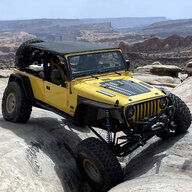
Might be a few lbs of grease and crud on it.

21.1kg = 46.51 lbs
Thanks, Rick! I just realized there's also a separate mounting plate that bolts to the stock skid for the transmission mount. Anyone have the ability to weigh that with the mounting hardware (together or separately)? Without that, I'm actually at a 5.7 lb weight loss with my parts, so I'm hoping it weighs less than that!
Correct, anything on the inside of the frame for holding up crossmembers and such. I do use 1/4" at the front for track bar mount tabs but only due to the potential for a rock strike with a tire at speed. You're gonna have a big enough expensive mess to deal with without adding mount repair on the frame to the list.I'll give my plan a bit more thought. Not saying I'm 100% on board with your method, but it's definitely worthy of consideration.
If I'm understanding '1/4" on the inside of the frame' correctly (meaning, 1/4" thick tabs), then your experience and mine, along with the calculations I did, all match. Thanks!
Not on the 03 and up. That is the mount adapter for the early skids when used with the auto. The later skids just have the integral crossmember, trans mount and then the trans mount adapter that bolts up to the transmission for the auto and manual.Thanks, Rick! I just realized there's also a separate mounting plate that bolts to the stock skid for the transmission mount. Anyone have the ability to weigh that with the mounting hardware (together or separately)? Without that, I'm actually at a 5.7 lb weight loss with my parts, so I'm hoping it weighs less than that!
21.1kg = 46.51 lbs
View attachment 568341
Just so you know this is the skid. Might be a few lbs of grease and crud on it.
View attachment 568342
View attachment 568343
Rick, I still appreciate the effort!
I have no idea, but I keep track of weight changes down to .01 lb. I learned in my racing days that the only way to have a competitively light vehicle is to look at every part. It's easier to take 10% off each part than it is to take 100% off a single part...Is there a big difference between them weight wise?





