Help diagnosing death wobble on 2004 Wrangler

I never had a chance today to really do any more than take the pics. It was crazy busy in the shop with customers. I will for sure tomorrow, hopefully early and I'll post the results. Thank you, again
I dislike this since I have posted it so many times but here goes yet one more time. The main problem with DW is there are many many things that can produce the issue. When asking about it, every person who has had one of the issues that caused it, now wholly pushes for that to be the answer since it was for them. The mortal sin of "fixing" DW is throwing parts at it hoping that will fix it. As a shop owner, you are familiar with parts changers instead of mechanics who diagnose and repair. Don't be a parts changer. Diagnose first and then repair.

Here is the second rule of DW. If someone tells you something is the problem, the inducing the change in a perfectly working stock TJ should produce the symptom. If that doesn't happen, then that isn't the problem.

Here is where the myth of toe out fixing DW comes from. The test I told you to perform involves toe out. If you do it and don't get DW, have you fixed the problem? No, you have changed the dynamic forces and moved them to a different level that no longer allows the problem to be exhibited, but you fixed nothing. Thus, alignment fixes DW.

I'm sure you have aligned a few TJ's. Do you run them toe out? Or, do you run them close to factory spec? If you do run them to factory spec, how many leave with DW? If toe out fixes DW, then toe in should cause it and it doesn't.

Andy, bless his heart, had an issue with your trackbar and it stung him terribly. You can tell that by how much he has been on your ass to fix yours even though you make no mention of untoward movement during the dry and power steering tests, right? Starting to see how it all works now?

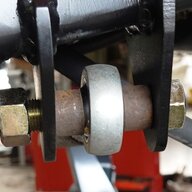
Unless that current trackbar is bad, don't swap it out until you do the other tests.

As for the pitman arm, be aware that there are few good ones (looks like you have one) and a lot of bad ones. The fit is a tapered spline. You CANNOT judge nor ascertain the tightness of the retaining nut by how many threads are showing below the nut. The crap versions are very soft and under use, wear the splines. When that happens, the owner tightens them up, more threads show. More wear, more tight, more threads. Eventually it will wear to the point that the lock washer bottoms out on the thread shoulder and it won't get the pitman tight. At that point it is junk and you need a new one. The OEM pitman is high quality and NEVER does that. The only time there is an issue is when it has been removed and not reinstalled correctly.

Diagnose, then repair.
 
That's a good post .

I'm all for not replacing parts , in most cases (not all, such as your wife's TJ with low tire pressure ) death wobble is a connection issue .

I really do agree a singular focused opinion can be monocular , but at the same time , outside input ...like the one from Texas the other night , can keep the person looking , looking in the right place possibly , and fix the problem. ..which is often no more than tightening a bolt .

I'm going to suggest anything I can think of , and if its not the issue , move on ..at least that rules out something..and that helps.

Good post.
 
  • Like
Reactions: Shawn B
That's a good post .

I'm all for not replacing parts , in most cases (not all, such as your wife's TJ with low tire pressure ) death wobble is a connection issue .

I really do agree a singular focused opinion can be monocular , but at the same time , outside input ...like the one from Texas the other night , can keep the person looking , looking in the right place possibly , and fix the problem. ..which is often no more than tightening a bolt .

Good post.
No, my wife's TJ was a perfect example of a fix that isn't. The higher tire pressure changed the spring rate of the tire which moved the harmonic resonant frequency to a level that didn't overpower the connections and links. I'm practically certain that I could have built a 3rd link upper with larger joints and killed it or switched to a different tire with a different spring rate at the same pressure and not subjected the system to that frequency.
 
No, my wife's TJ was a perfect example of a fix that isn't. The higher tire pressure changed the spring rate of the tire which moved the harmonic resonant frequency to a level that didn't overpower the connections and links. I'm practically certain that I could have built a 3rd link upper with larger joints and killed it or switched to a different tire with a different spring rate at the same pressure and not subjected the system to that frequency.
But was it a connection issue as we often see?
 
But was it a connection issue as we often see?
Of course. A connection doesn't consist of just a bolt and it being loose or tight. The connection is defined by all the parts that it consists of. The mount, joint, type of joint, viability, strength, and whether or not that is sufficient to stabilize the connection during the application of typical dynamic forces. If you overpower the connection, it can wobble.
 
Of course. A connection doesn't consist of just a bolt and it being loose or tight. The connection is defined by all the parts that it consists of. The mount, joint, type of joint, viability, strength, and whether or not that is sufficient to stabilize the connection during the application of typical dynamic forces. If you overpower the connection, it can wobble.
Cool, makes sense looking at it that way.

When DW discussions come up , I think loose/worn parts ..and that low tire.
 
But was it a connection issue as we often see?
The fallacy of DW diagnostics is that loose is bad and tight is good. Neither is true. What is true is that the forces delivered have to be handled or there has to be enough slop that they don't translate into out of control oscillations.

I have fixed a few things on rigs that had very sloppy handling but no DW and that slop removal now induced DW. If tight is good and loose is bad, how could that happen?
 
  • Like
Reactions: andy29847
Cool, makes sense looking at it that way.

When DW discussions come up , I think loose/worn parts ..and that low tire.
And a lot of times the connection isn't overpowered, the resonant frequencies of the connections in the system line up and get the wobble started. We have dealt with many cases that were on the edge of control. During the day with warm temps, the rubber is softer, the spring rate is lower. Going home after dark, temps are cooler, spring rate goes up, now DW starts. Next day with warm temps, no hint or symptoms whatsoever. I checked the vehicle several times, no worn or deficient parts and it has hydro assist for a steering stabilizer. The issue was ultimately resolved by going to a smaller tire. 35 instead of 37.

Think of it like inflating a basketball to different pressure levels and bouncing it. Higher pressure is going to bounce higher, lower is not going to bounce as high. The same thing happens in joints with isolation. (rubber or polymer isolation elements)
 
And a lot of times the connection isn't overpowered, the resonant frequencies of the connections in the system line up and get the wobble started. We have dealt with many cases that were on the edge of control. During the day with warm temps, the rubber is softer, the spring rate is lower. Going home after dark, temps are cooler, spring rate goes up, now DW starts. Next day with warm temps, no hint or symptoms whatsoever. I checked the vehicle several times, no worn or deficient parts and it has hydro assist for a steering stabilizer. The issue was ultimately resolved by going to a smaller tire. 35 instead of 37.

Think of it like inflating a basketball to different pressure levels and bouncing it. Higher pressure is going to bounce higher, lower is not going to bounce as high. The same thing happens in joints with isolation. (rubber or polymer isolation elements)
Amazing .

And I can believe it .
 
The fallacy of DW diagnostics is that loose is bad and tight is good. Neither is true. What is true is that the forces delivered have to be handled or there has to be enough slop that they don't translate into out of control oscillations.

I have fixed a few things on rigs that had very sloppy handling but no DW and that slop removal now induced DW. If tight is good and loose is bad, how could that happen?
There's my limitation...I can get about as far as obvious loose track bars , bad bushings , etc...and am glad to offer that .

I will bear in mind there can be far more complex things going on , at the same time ..considering the shape of most TJ's in North Alabama, it is hard to get past all the missing and bent parts to consider deeper issues . ..I'm not being sarcastic man when I say that , I genuinely mean it ...it is crazy how poorly maintained a lot of vehicles are , especially Jeeps ..for some reason people think they are indestructible and require no maintenance.
 
  • Like
Reactions: Shawn B
There's my limitation...I can get about as far as obvious loose track bars , bad bushings , etc...and am glad to offer that .

I will bear in mind there can be far more complex things going on , at the same time ..considering the shape of most TJ's in North Alabama, it is hard to get past all the missing and bent parts to consider deeper issues . ..I'm not being sarcastic man when I say that , I genuinely mean it ...it is crazy how poorly maintained a lot of vehicles are , especially Jeeps ..for some reason people think they are indestructible and require no maintenance.
Don't misinterpret the above to believe that the connection fasteners should not be properly tightened because they absolutely should be. The point was to illustrate that it isn't as simple as tight = good, loose = bad.
 
Don't misinterpret the above to believe that the connection fasteners should not be properly tightened because they absolutely should be. The point was to illustrate that it isn't as simple as tight = good, loose = bad.
Got ya . I was actually thinking (wrongly) earlier how tight things need to be to make a TJ behave.

I really don't even want my Avatar to say "TJ expert"..but more like "a guy that has one and is has a lot to learn"

I know you can smell that my knowledge is basic , I'm not ashamed of that ...I know enough to be somewhat helpful and that's always my intention.
 
  • Like
Reactions: Shawn B
Got ya . I was actually thinking (wrongly) earlier how tight things need to be to make a TJ behave.

I really don't even want my Avatar to say "TJ expert"..but more like "a guy that has one and is has a lot to learn"

I know you can smell that my knowledge is basic , I'm not ashamed of that ...I know enough to be somewhat helpful and that's always my intention.
I'm just trying to slow down the notion that when your only tool is a hammer, every solution is a nail.
 
  • Like
Reactions: AndyG
My thought is exhaustively rule out the most common ,and look for things that aren't obvious first , then move on from there .


I know that reveals my scope of understanding , but it's enough to get the job done in a lot of cases.

I hope we hear soon what was going on with this one , I like the way the OP approached it , but hated to see parts thrown at it .

To me , one of the best things in a profession is when you get where you know what you are looking for . I can't say I can do that with a TJ front end , but I know you can , and I can relate to that at least. It's powerful.

Derail-By the way , I fixed my persistent , alternating countersteering issue with my 03 TJ, my local Jeep shop noticed the lower shaft play ... I replaced the lower steering shaft and bearing . I was astonished at the difference , it feels like I put small street tires on it now , it drives so much better. I became convinced that bearing , if worn, just really messed with center a tad ...I may be wrong , but it made a big difference. I have a borgersen lower shaft on the shelf now of you want one , I'll send it your way if borgersen won't return it .
 
Last edited:
I dislike this since I have posted it so many times but here goes yet one more time. The main problem with DW is there are many many things that can produce the issue. When asking about it, every person who has had one of the issues that caused it, now wholly pushes for that to be the answer since it was for them. The mortal sin of "fixing" DW is throwing parts at it hoping that will fix it. As a shop owner, you are familiar with parts changers instead of mechanics who diagnose and repair. Don't be a parts changer. Diagnose first and then repair.

Here is the second rule of DW. If someone tells you something is the problem, the inducing the change in a perfectly working stock TJ should produce the symptom. If that doesn't happen, then that isn't the problem.

Here is where the myth of toe out fixing DW comes from. The test I told you to perform involves toe out. If you do it and don't get DW, have you fixed the problem? No, you have changed the dynamic forces and moved them to a different level that no longer allows the problem to be exhibited, but you fixed nothing. Thus, alignment fixes DW.

I'm sure you have aligned a few TJ's. Do you run them toe out? Or, do you run them close to factory spec? If you do run them to factory spec, how many leave with DW? If toe out fixes DW, then toe in should cause it and it doesn't.

Andy, bless his heart, had an issue with your trackbar and it stung him terribly. You can tell that by how much he has been on your ass to fix yours even though you make no mention of untoward movement during the dry and power steering tests, right? Starting to see how it all works now?

Unless that current trackbar is bad, don't swap it out until you do the other tests.

As for the pitman arm, be aware that there are few good ones (looks like you have one) and a lot of bad ones. The fit is a tapered spline. You CANNOT judge nor ascertain the tightness of the retaining nut by how many threads are showing below the nut. The crap versions are very soft and under use, wear the splines. When that happens, the owner tightens them up, more threads show. More wear, more tight, more threads. Eventually it will wear to the point that the lock washer bottoms out on the thread shoulder and it won't get the pitman tight. At that point it is junk and you need a new one. The OEM pitman is high quality and NEVER does that. The only time there is an issue is when it has been removed and not reinstalled correctly.

Diagnose, then repair.
The toe out test is the 1st thing we are going to try tomorrow.
 
My thought is exhaustively rule out the most common ,and look for things that aren't obvious first , then move on from there .


I know that reveals my scope of understanding , but it's enough to get the job done in a lot of cases.

I hope we hear soon what was going on with this one , I like the way the OP approached it , but hated to see parts thrown at it .

To me , one of the best things in a profession is when you get where you know what you are looking for . I can't say I can do that with a TJ front end , but I know you can , and I can relate to that at least. It's powerful.

Derail-By the way , I fixed my persistent , alternating countersteering issue with my 03 TJ, my local Jeep shop noticed the lower shaft play ... I replaced the lower steering shaft and bearing . I was astonished at the difference , it feels like I put small street tires on it now , it drives so much better. I became convinced that bearing , if worn, just really messed with center a tad ...I may be wrong , but it made a big difference. I have a borgersen lower shaft on the shelf now of you want one , I'll send it your way if borgersen won't return it .
Guessing the Borgensen ships sans bearing? I believe we discussed the fact that the steering wheel has to be perfectly centered or it can cause a pull to one side. The valve that is opened to provide assist does so when the steering wheel turns the box off of center. If you have something that lets it do that, you can get a pull.
 
@mrblaine I love your replies and agree with all of them. But Man does it seem that chasing down Death wobble can be a hopeless endeavor!

Question: Why does the Jeep 5 link front end seem to be so susceptible to DW? Is it a design flaw? Is it because we modify and change the OEM geometry with lifts and tires?

I had Death Wobble once in a leaf spring YJ. Ended up stopping the wobble by swapping tires front to back and getting them re-balanced. I still do not know the actual reason for the DW. But its the only DW I've seen on a Leaf spring Jeep.

And I never hear of DW on vehicles other than Jeeps. BUT, I also don't modify my non-jeep vehicles or frequent non-jeep message boards.
 
@mrblaine I love your replies and agree with all of them. But Man does it seem that chasing down Death wobble can be a hopeless endeavor!

Question: Why does the Jeep 5 link front end seem to be so susceptible to DW? Is it a design flaw? Is it because we modify and change the OEM geometry with lifts and tires?

It is less susceptible since it has the inverted Y link steering or Haltenberger linkage style steering. But you got it with the mods. There are very few instances of stock rigs with DW. It is only when we start changing stuff up and then asking the parts designed to handle smaller tires to do the job of much bigger parts that we start seeing issues.

The biggest problem with DW is all the repeated myths and fallacies. Very few actually understand that if a "solution" is offered up as a cure, then the opposite should also induce DW and that very rarely holds true. If more caster is the answer, then all rigs with less caster should have DW and they don't.

If toe out solves it, then all rigs with toe in should have DW and they don't.

If flattened angle steering is the answer, then all rigs without a drop pitman and a drop trackbar bracket should have DW and they don't.

If hole size versus fastener diameter is the answer, then no rig should be free of DW. There are no zero fit holes in the control links except the steering TRE's and one end of the front trackbar. The rest are sloppy fit holes with undersize fasteners.

Each case has to be diagnosed and then repaired but of utmost important is good tires kept balanced and true. That isn't a guarantee that you won't get DW, but if you don't have good tires, then your chances of diagnosing the issue go way down.

I had Death Wobble once in a leaf spring YJ. Ended up stopping the wobble by swapping tires front to back and getting them re-balanced. I still do not know the actual reason for the DW. But its the only DW I've seen on a Leaf spring Jeep.

And I never hear of DW on vehicles other than Jeeps. BUT, I also don't modify my non-jeep vehicles or frequent non-jeep message boards.
There are lots of cases of non Jeep DW out there. Just have to look for them.
 
That isn't a guarantee that you won't get DW, but if you don't have good tires, then your chances of diagnosing the issue go way down.

So would you say poor, unbalanced tires are the number one DW cause? Or just the Number 1 thing that causes death wobble to finally show its face?