A few weeks ago I asked about these plugs but nobody had ever used them. Somebody recommended that I try them and give a review, so I shall ... rather, I am.
Here is an image of the system from Amazon. The kits (there are many brands and presentations) average about a 4.5/5 star rating.
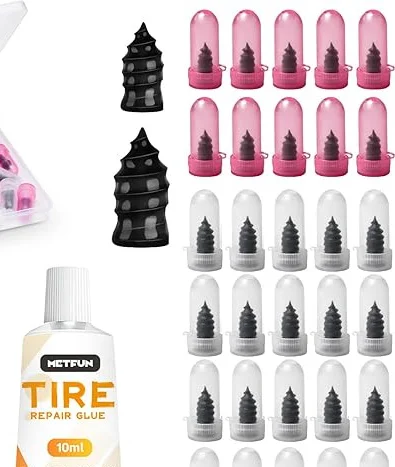
I was intrigued because you do not have to make the hole bigger to get the plug in as you would with string-type plugs. For a big hole that is not an issue, but when I have a tiny hole I hate making it bigger to patch it. Also, the overall process is quicker and easier. That would be a big plus on the road if, for example, you are in bad weather or in a hurry for any reason.
These are just a stubby little threaded screw with a rubbery coating. I'm not sure if the screw itself is metal or some kind of plastic. I'll have to see if I can strip one and let you all know in my Part 2 update in a couple of weeks. This package came with glue, though not all kits on Amazon had the glue.
I was able to plug the hole without taking the tire off of the vehicle.
This puncture was tiny. It shows up well in the video, but was hard to see with my old eyes. (I need some good work glasses.) Once I located it, though, I coated the plug with a bit of the glue and the plug screwed in easily. It seems to have plugged the leak. Of course, the proof is in if it holds after miles of service on rough roads. The puncture is right near the valve stem, so it'll be easy to keep track of. I'll watch it and check back in with part two in a couple of weeks.
If it does start to leak, I'll try to extricate the screw and put a string plug in its place. Or may just have to have it patched on the inside. I hope not, though. I have inserted many string plugs and never had them patched and they held forever.
Up to this point, it seems to have worked, but a couple of weeks down the road will tell us if it's worth the trouble.
Here is a video with a little bit of hands-on view.
View: https://www.youtube.com/watch?v=f11_oxarJcQ
Here is an image of the system from Amazon. The kits (there are many brands and presentations) average about a 4.5/5 star rating.
I was intrigued because you do not have to make the hole bigger to get the plug in as you would with string-type plugs. For a big hole that is not an issue, but when I have a tiny hole I hate making it bigger to patch it. Also, the overall process is quicker and easier. That would be a big plus on the road if, for example, you are in bad weather or in a hurry for any reason.
These are just a stubby little threaded screw with a rubbery coating. I'm not sure if the screw itself is metal or some kind of plastic. I'll have to see if I can strip one and let you all know in my Part 2 update in a couple of weeks. This package came with glue, though not all kits on Amazon had the glue.
I was able to plug the hole without taking the tire off of the vehicle.
This puncture was tiny. It shows up well in the video, but was hard to see with my old eyes. (I need some good work glasses.) Once I located it, though, I coated the plug with a bit of the glue and the plug screwed in easily. It seems to have plugged the leak. Of course, the proof is in if it holds after miles of service on rough roads. The puncture is right near the valve stem, so it'll be easy to keep track of. I'll watch it and check back in with part two in a couple of weeks.
If it does start to leak, I'll try to extricate the screw and put a string plug in its place. Or may just have to have it patched on the inside. I hope not, though. I have inserted many string plugs and never had them patched and they held forever.
Up to this point, it seems to have worked, but a couple of weeks down the road will tell us if it's worth the trouble.
Here is a video with a little bit of hands-on view.
View: https://www.youtube.com/watch?v=f11_oxarJcQ
Last edited: