Screw-type Tire Plug Review - Part 2

TJMexico

TJ Enthusiast
Original poster
Supporting Member
Joined
May 26, 2025
Messages
576
Location
NW Mexico
(Related to previous posts here and here regarding screw-type tire plugs...)

It's been two weeks since I plugged my rear left tire with one of those newfangled screw-type plugs.
692966-4aa117a0f37e19670f73e1ba6dccabdf.webp


I drove the TJ around town for several days and just took it out on an extended trip over some really bad road and the plug is holding. It has not lost any air, kept pressure steady.

I had initially pumped the tire up to about 40psi and left it there just to see if it'd hold. Before this trip I dropped it down to about 18psi and ran the 40 or so miles like that over big rocks, gullies, all kinds of stuff and it is holding.

So, they get a five-star rating from me. It was so much faster and easier to install than the string type plugs and, as I have said previously, I didn't have to ream the puncture out to make it fit. The hole was tiny and the smaller one fit perfectly. I'll carry both types (screw and string), and for a larger puncture would probably use the strings, but for a small hole this is excellent!

Get you some! Use the forum affiliate link to buy them. I asked Chris to pass on or post an affiliate link.
 
Last edited:
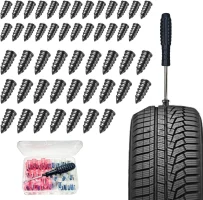
The kit that I purchased is linked below, but there are several other kits, as well. Some come with tools and glue, some with just the plugs. Again, I recommend them. If you follow the link below, the purchase will be credited to our affiliate link.

This is the one I purchased. It has 40 plugs and the glue. 4.5 out of 5 stars w/638 reviews...
https://www.amazon.com/dp/B0FWS29SG1?tag=wranglerorg-20

This one has screwdriver, extactor pliers, caps, valves, but no glue. 4.7/43
https://www.amazon.com/dp/B0GJ5N2TMY?tag=wranglerorg-20

80 piece kit with 4 different sizes, pliers, reamer, screwdriver bit, no glue. 4.4/42
https://www.amazon.com/dp/B0GJ5N2TMY?tag=wranglerorg-20
 
Last edited:
  • Like
Reactions: John Cooper
Thanks for the update. Not reaming the hole to get the string plug in would make the repair much easier. They hold well but take a lot of effort to install. I have to remove the wheel in order to get on top of the repair area and lean on the insertion tool to get the string plug in.
 
Last edited:
  • Like
Reactions: TJ Jim
Thanks for the update. Not reaming the hole to get the string plug in would make the reaper much easier. They hold well but take a lot of effort to install. I have to remove the wheel in order to get on top of the repair area and lean on the insertion tool to get the string plug in.

I have managed to do a few repairs with the string plugs without removing the tire. Just had to lie down on the ground behind the tire and give it a good shove to make it go in, and always after reaming the hole.

Yeah, these go in so much more easily and it's just like inserting a screw into wood. I do recommend the kits that come with the glue as I think that glue acts as a lubricant and makes insertion easier.
 
Thanks for the update. Not reaming the hole to get the string plug in would make the reaper much easier. They hold well but take a lot of effort to install. I have to remove the wheel in order to get on top of the repair area and lean on the insertion tool to get the string plug in.

I don't even use the reamer 90% of the time, but instead use my 12v drill. Out of the last 8 plugs I've put in, I think I pulled the wheel off for 2 of them. I can generally have a tire plugged in less than 5min from start to finish unless there's some craziness with whatever pierced the tire. For me, that's not worth digging out the jack & removing the wheel unless I just don't have a choice.

I'm intrigued by this screw type however, and just might have to buy a kit and try them out when the fiance inevitably decides to christen her new tires with whatever pointy, likely exotic object she finds next.
 
You’ve given me some new ideas. Most times I notice a screw or nail in the tire when the vehicle is at home, so rolling the floor jack over and removing the wheel isn’t much trouble.
 
  • Like
Reactions: John Cooper
You’ve given me some new ideas. Most times I notice a screw or nail in the tire when the vehicle is at home, so rolling the floor jack over and removing the wheel isn’t much trouble.

Most of my repairs happen on the road, so not having to remove the tire is a big plus. And being able to do it quickly, more so!
 
  • Like
Reactions: JeepRidge
Thanks for the update, now to learn the wife how to use them.......just in case for her route car!!!!!
 
  • Love
Reactions: TJ Jim
I wonder if the plug is used in the tread blocks, would the puncture start leaking again after the tire had worn down. That's the only potential downside I see. I'll be ordering a few of these kits, one for each vehicle and a few for friends and family.
 
  • Like
Reactions: John Cooper
I wonder if the plug is used in the tread blocks, would the puncture start leaking again after the tire had worn down. That's the only potential downside I see. I'll be ordering a few of these kits, one for each vehicle and a few for friends and family.

I would think that if you screw them in deep enough, that might not be a problem. They certainly don't go all the way through like a string plug would, but in such a case you could (should?) screw them in deeper.
 
  • Like
Reactions: matkal and TJ Jim
Thanks for the update, now to learn the wife how to use them.......just in case for her route car!!!!!

The hardest part can be finding the hole. I carry a few bottles of water in my Jeep and try to keep some soap and a spray bottle handy. If I can't see the hole right away, I'll roll the tire forward and spray about a 50 degree section of it until I see the bubbles.

Of course, having a good compressor handy is a must. Speaking of which ...

I bought one of those rechargeable brick-shaped compressors awhile back and a friend bought the same one on my advice. I found out that they are NOT a good idea. The rechargeable battery is not made for long-term storage at full capacity, but that is exactly what you need it to do. The batteries (like most rechargable lithium-ion batteries) will die if you leave them charged without cycling periodically. Between that and the temperature extremes that they will likely be exposed to vehicle trunk or cargo storage, they will die!

A trunk-stored compressor is NOT a good place for a li-ion supplied device that is only used occasionally. I have learned that it's best to stick to the old fashioned 12V plug-in compressors.

Now, I do carry a 6,000amp battery booster with an integrated air pump, but I make sure to discharge and re-charge that one regularly, and often when I charge it, I'll burn off a bit of the charge so that it isn't storing at 100%.

That device has served me on multiple occasions, getting myself and others out of a bind. The compressor overheats easily, so it is only a back-up or quick top-off tool for airing tires, but it serves it purpose well. I just make sure to cycle it through charging now and then.
 
  • Love
Reactions: John Cooper