I’m installing a rebuilt 4.0 engine in my 2001 Wrangler. After removing the motor, wondering if it’s easier to install the exhaust manifold and intake manifold on the engine before installing the engine in the jeep or would it be easier to install the manifolds after the engine is installed

You are using an out of date browser. It may not display this or other websites correctly.
You should upgrade or use an alternative browser.
You should upgrade or use an alternative browser.

Is it easier to install the engine with or without manifolds attached?
- Thread starter speedboater
- Start date
Easier before. Much easier and it gets in the way of nothing. That is under the assumption that the fenders are still on. If they aren't, then it is nearly the same.I’m installing a rebuilt 4.0 engine in my 2001 Wrangler. After removing the motor, wondering if it’s easier to install the exhaust manifold and intake manifold on the engine before installing the engine in the jeep or would it be easier to install the manifolds after the engine is installed

Easier before. Much easier and it gets in the way of nothing. That is under the assumption that the fenders are still on. If they aren't, then it is nearly the same.
Thank you, I was thinking the same, however, saw a couple YouTube videos where they installed the motor without having the intake bolted on, so I wanted to make sure I wasn’t missing something.
(they may not have had the fender bolted on, so that makes sense.)
Thanks again!
Ready to go in.Thank you, I was thinking the same, however, saw a couple YouTube videos where they installed the motor without having the intake bolted on, so I wanted to make sure I wasn’t missing something.
(they may not have had the fender bolted on, so that makes sense.)
Thanks again!


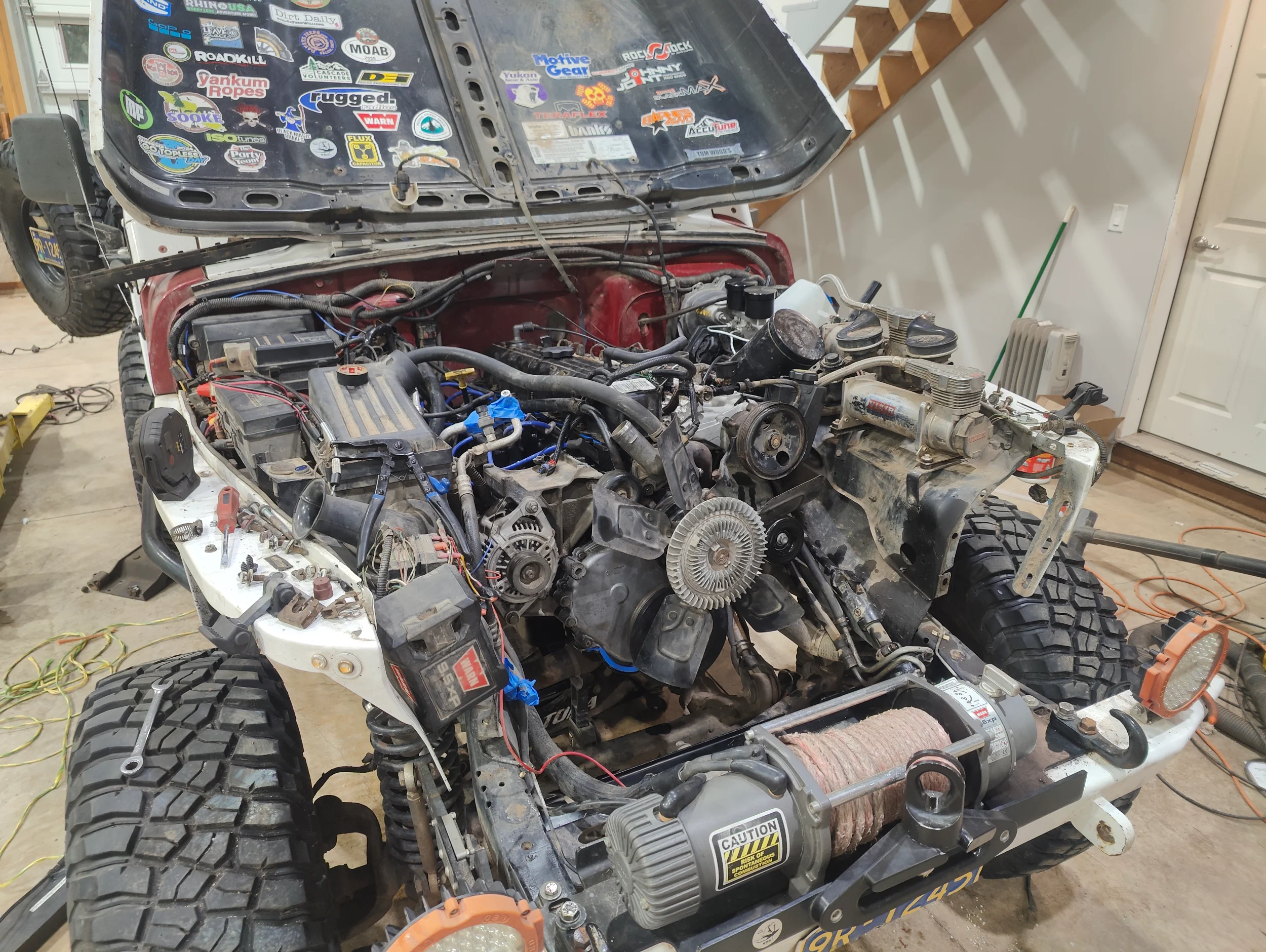
I installed mine with the intake and header installed. Much much easier to get proper torque. But mines a 97 and there's a little less crap in the way.
-Mac
-Mac
We have vastly different definitions of "less crap in the way".I installed mine with the intake and header installed. Much much easier to get proper torque. But mines a 97 and there's a little less crap in the way.
View attachment 705064
-Mac


Definitely install the maifolds before engine install. It's a very difficult with the engine installed unless the fender is removed. Even then it is more difficult.
Thank you everyone for your replies. The manifolds will be going on (and maybe a few more things after seeing mrblaine’s photo.. lol) before I put the motor back in.
No, just gave it a good scrub with a bristle brush for a parts cleaner with some Zep degreaser.Did you sand blast the intake?
I'd be very interested in anything that shows the intake manifold coatings are actually a benefit. The later intake manifolds are nothing but a heat trap for the exhaust mainfolds. They even added little wings on the ends to catch more heat unless they are trying to slow down heat transfer to the fuel rail.I had my intake and exhaust cerrokoted to help with heat transfer.
-Mac
edit- I do know of a perfect coating that will absolutely slow down large amounts of heat transfer and production but I'm not paying for it.I'd be very interested in anything that shows the intake manifold coatings are actually a benefit. The later intake manifolds are nothing but a heat trap for the exhaust mainfolds. They even added little wings on the ends to catch more heat unless they are trying to slow down heat transfer to the fuel rail.
No, just gave it a good scrub with a bristle brush for a parts cleaner with some Zep degreaser.
View attachment 705093
Looks great

edit- I do know of a perfect coating that will absolutely slow down large amounts of heat transfer and production but I'm not paying for it.
For Cerakote, they do have a special version of their standard coating called "Piston Coat" that is a low emissivity blend. It only comes in two colors (a sort of dull gold or dull red). As the name implies, it was designed for piston and valve heads. The idea being if you coat those, you reduce heat loss and also slightly improve power/efficiency by keeping more heat in the cylinder.
https://www.cerakote.com/shop/cerakote-coating/V-136/piston-coat-oven-cure
https://www.cerakote.com/shop/cerakote-coating/V-139/titanium-red-piston-coat
I've certainly not tried it on pistons, but I did have my exhaust header coated inside and out as well as the outside of my intake manifold with it. I also had the catalytic converter assembly coated on the exterior.
For the exhaust header and especially the catalytic converters, it definitely cuts down on radiant heat a lot. To the point I can run the engine hard, shut it off, and be able to stick my hand between the catalytic converters for a much longer time. (Still can't touch them of course.)
In terms of heat conduction through the pipe walls, the coating does little in that regard, as would any ceramic coating. However, at the higher temperatures we'd see in the catalytic converter assembly and in the exhaust manifold, radiant heat makes up a substantial fraction of the heat loss.
As for getting the exhaust header internally coated and the intake header externally coated, low emissivity also equals low absorptivity. So inside the exhaust header, radiant heat from the hot gases is more likely to be reflected than absorbed. Likewise, outside the intake manifold, radiant heat is also more likely to be reflected than absorbed.
I don't have any data on my scenario, but one thing to look up that does have a lot of data is Low IR Cerakote for firearms. It's a very similar product, just not quite as heat resistant as Piston Coat. Lots of side by side IR photos of uncoated and coated firearms. Very easy to see the difference.
https://www.cerakote.com/news/62/ce...reduced-weapons-visual-ir-signature-detection
Last edited:
I'd probably be inclined to go this route.For Cerakote, they do have a special version of their standard coating called "Piston Coat" that is a low emissivity blend. It only comes in two colors (a sort of dull gold or dull red). As the name implies, it was designed for piston and valve heads. The idea being if you coat those, you reduce heat loss and also slightly improve power/efficiency by keeping more heat in the cylinder.
https://www.cerakote.com/shop/cerakote-coating/V-136/piston-coat-oven-cure
https://www.cerakote.com/shop/cerakote-coating/V-139/titanium-red-piston-coat
I've certainly not tried it on pistons, but I did have my exhaust header coated inside and out as well as the outside of my intake manifold with it. I also had the catalytic converter assembly coated on the exterior.
For the exhaust header and especially the catalytic converters, it definitely cuts down on radiant heat a lot. To the point I can run the engine hard, shut it off, and be able to stick my hand between the catalytic converters for a much longer time. (Still can't touch them of course.)
In terms of heat conduction through the pipe walls, the coating does little in that regard, as would any ceramic coating. However, at the higher temperatures we'd see in the catalytic converter assembly and in the exhaust manifold, radiant heat makes up a substantial fraction of the heat loss.
As for getting the exhaust header internally coated and the intake header externally coated, low emissivity also equals low absorptivity. So inside the exhaust header, radiant heat from the hot gases is more likely to be reflected than absorbed. Likewise, outside the intake manifold, radiant heat is also more likely to be reflected than absorbed.
I don't have any data on my scenario, but one thing to look up that does have a lot of data is Low IR Cerakote for firearms. It's a very similar product, just not quite as heat resistant as Piston Coat. Lots of side by side IR photos of uncoated and coated firearms. Very easy to see the difference.
https://www.cerakote.com/news/62/ce...reduced-weapons-visual-ir-signature-detection
https://headershield.com/headershield-application-gallery/

I used the glacier version but unfortunately applied it in a time where the temps were climbing quickly and don't have a tight before/after measure. When we get back to cold fall temps I'll report back.For Cerakote, they do have a special version of their standard coating called "Piston Coat" that is a low emissivity blend.
I also changed over to the aluminum edelbrock head and increased the compression ratio almost a full point. And I changed my fuel rail to an aluminum NRT one so that I could run an electronic fuel pressure sender back to the HP Tuners Prolink later.
It's been hot this summer and hot under my hood and the first time I'd ever had any rough start when hot. It does clear up pretty quickly, so I'm sure it's fuel vapor. Is the Edelbrock head radiating a ton of heat? It the aluminum fuel rail just absorbing all the heat? Is the cerakote pointless? Will see when we get cooler temps.
Similar threads

- Replies
- 3
- Views
- 7,216

- Replies
- 2
- Views
- 881

- Replies
- 25
- Views
- 5,315
- Replies
- 0
- Views
- 560


