Down on power, up on heat?

The NGC PCM in my rig is known to be super aggressive with pulling timing.

And it doesn’t matter since 220-225* ECTs will not prevent your rig, my rig, or his rig from doing 55mph. Could you imagine how many posts there would be on this subject and how poor the 4.0’s reputation would be if that was the case.

Considering I couldn't do 50mph with the stock tune in 4th gear at Eisenhower tunnel regardless of temp when my jeep was new running really light 255/85R16 33s on the 4.10s... It wasn't that much better with the stock 245s for the short time I had them either, barely holding that speed. I know @k1n3k lives in the UT mountains, just not the elevation. My TJ has never seen anywhere close to the stock 190hp rating. I'm pretty sure I've never had it lower than 4000ft elevation, but the losses are much worse above 9000ft.

Our IAT is measured in the hot aluminum manifold, not the intake pipe and it's not uncommon to see intake at 149F when cruising on the highway for a bit until the WOT condition cools the sensor. Add in the aggressive part throttle fuel enrichment the 04 applies based on IAT, plus a couple degrees pulled for timing, from an already lagging part of the timing curve in the 04 PCM. The stock 04 PCM pulls -1 degree for ECT at 215 and depending on the IAT, between -1 and -3 when IAT is between 127 and 149. It's pretty easy to hit -4 degrees in those high load settings while also dumping fuel so that you're running too rich around 11:1 AFR. The JTEC logic is pretty convoluted, especially on the fueling calculation strategy and doesn't always do what's expected based on what we can see in HPTuners. I've logged a bunch of these drive conditions.

I'm not ruling out the cat and it is suspect for sure. I'm just saying it's not an automatic condemnation based on what was described.

When mine died it was a bit different. I did suddenly have lower power going up a specific hill from previous drives, then it blew out the center of the back precat and then it seemed more or less normal. I wasn't logging on that drive unfortunately as I was testing something else. It didn't throw a code for a few hundred miles at that point. I was definitely suspect of it at that point, but was leaving for trip and it seemed to be back to normal. It was all on a single 5 minute drive with no symptoms before.

If either of the S2 sensors are moving roughly in sync with the high frequency variance of the S1 sensor on that bank, then the precat is going or gone.

You need to be warmed up easy cruising in closed loop to test this, not wide open throttle, not part throttle fuel enrichment (high load) to log this.

This is a more normal pattern where S2 is pretty stable in a range while S1 is oscillating. (white line)
1787165740625.webp


This is a dead precat (white line)
1787166121681.webp


We can probably rule out misfires because they'll throw codes quickly.
 
Last edited:
Recommend separating the 2 issues:

For the elevated coolant temperature, inspect and test the entire system. Was it modified at all since running at normal temperature? Is the overflow tank staying steady?

For the lack of power on hills, how many miles are on the clutch? Does the clutch engage/disengage feel any different since it could pull the hills with more power? Did you teach someone how to drive stick recently? ;^)
 
Correct me if I am wrong but the reference voltage is 5 volts and drops as the O2 sensor heats up right? Ill look at the data again it was a couple of weeks ago and I may be misquoting. I've been chasing this for a couple of months now.

Yeah, this is an oddity of the Chrysler O2 sensor heater monitoring strategy. The PCM switches over to 1V after it confirms heater function. It's hard for me to capture that in the HPTuners logs as it happens in the first few seconds while I'm trying to get the connection initialized, but I see the tail of it every once in a while.

You can also see that the vehicle runs in open loop for a short time when it first starts and this is part of why.
 
Last edited:
Considering I couldn't do 50mph with the stock tune in 4th gear at Eisenhower tunnel regardless of temp when my jeep was new running really light 255/85R16 33s on the 4.10s... It wasn't that much better with the stock 245s for the short time I had them either, barely holding that speed. I know @k1n3k lives in the UT mountains, just not the elevation. My TJ has never seen anywhere close to the stock 190hp rating. I'm pretty sure I've never had it lower than 4000ft elevation, but the losses are much worse above 9000ft.

You are a bit of an anomaly for the purpose of sharing how a vehicle should perform. I'm surprised you didn't boost your engine since that would really help at your high elevations.

Our IAT is measured in the hot aluminum manifold, not the intake pipe and it's not uncommon to see intake at 149F when cruising on the highway for a bit until the WOT condition cools the sensor. Add in the aggressive part throttle fuel enrichment the 04 applies based on IAT, plus a couple degrees pulled for timing, from an already lagging part of the timing curve in the 04 PCM. The stock 04 PCM pulls -1 degree for ECT at 215 and depending on the IAT, between -1 and -3 when IAT is between 127 and 149. It's pretty easy to hit -4 degrees in those high load settings while also dumping fuel so that you're running too rich around 11:1 AFR. The JTEC logic is pretty convoluted, especially on the fueling calculation strategy and doesn't always do what's expected based on what we can see in HPTuners. I've logged a bunch of these drive conditions.

I'm not ruling out the cat and it is suspect for sure. I'm just saying it's not an automatic condemnation based on what was described.

When mine died it was a bit different. I did suddenly have lower power going up a specific hill from previous drives, then it blew out the center of the back precat and then it seemed more or less normal. I wasn't logging on that drive unfortunately as I was testing something else. It didn't throw a code for a few hundred miles at that point. I was definitely suspect of it at that point, but was leaving for trip and it seemed to be back to normal. It was all on a single 5 minute drive with no symptoms before.

If either of the S2 sensors are moving roughly in sync with the high frequency variance of the S1 sensor on that bank, then the precat is going or gone.

You need to be warmed up easy cruising in closed loop to test this, not wide open throttle, not part throttle fuel enrichment (high load) to log this.

This is a more normal pattern where S2 is pretty stable in a range while S1 is oscillating. (white line)
View attachment 705287

This is a dead precat (white line)
View attachment 705327

We can probably rule out misfires because they'll throw codes quickly.

What you shared makes sense, but OP told us this wasn't an issue in the past and it is now. Knowing this, it makes sense to logically distill things down a bit based on that info. The cats are low hanging fruit, so I'd rather verify that they are good than waste a bunch of time only to find out it was a bad cat all along.
 
Last edited:
  • Like
Reactions: tr21triton
We can probably rule out misfires because they'll throw codes quickly.
It has thrown a p0304 in the past, but has since cleared on its own. Possible it has low comp on #4 hence my thoughts on a comp test and a leakdown. To be clear the cylinder is firing and seems to have good contribution now. It threw that code on a cold morning and with 220k on the clock. I wouldn't be surprised if the injectors are shot and partially plugged. Good reason to do some datalogging.
 
  • Like
Reactions: MikeE024
Not to derail the convo, but.
You are basically an anomaly for the purpose of sharing how a vehicle should perform. I'm surprised you didn't boost your engine since that would really help at your high elevations.
I would, but I have to get emissions tests every 2 years until the jeep hits 32 years and my state adopted CARB EO requirements for parts installed a while back. By the time i decided to keep the TJ and address the lack of power, Banks lost their path to CARB EO and had pulled the product. Nobody else has tried. I'm not concerned that I couldn't make the turbo run clean, I just didn't want to have any extra complications with a visible add-on should the rulebook change. Turbo with an intercooler would be a much more efficient power adder at our elevation.

We don't do inspections here, just the sniffer test. The stroker setup will keep it simple with no risk of CARB EO issues down the road and produce power in a similar way. My head, headers and intake all have the certs and my new precats match the old non-CARB stats at the time of manufacture, so they're also fine here. They'll never see the crank, rods, pistons or cam. The low rpm torque gains from the higher compression stroker should be perfect. I took my time to figure out what would work while keeping life simple for future me. Should we ever go to CA style inspections, I'll be legal. Since Air Car Colorado recently signed a long extension, it'll probably never become an issue.

I know some people have really strong feelings against these rules, but I remember how often we had a brown cloud hanging over the front range when I was young. It still happens, but it's much less frequent today and I'm fine doing my part to be a good citizen.
 
  • Like
Reactions: be77solo
It has thrown a p0304 in the past, but has since cleared on its own. Possible it has low comp on #4 hence my thoughts on a comp test and a leakdown. To be clear the cylinder is firing and seems to have good contribution now. It threw that code on a cold morning and with 220k on the clock. I wouldn't be surprised if the injectors are shot and partially plugged. Good reason to do some datalogging.

That does significantly increase the probability of a recently killed cat. I missed that. It takes more than one misfire to trigger the code. And repeated full charges of unburnt fuel and oxygen are a death sentence for our pre-cats as recently mentioned in another thread by @sab or @Steel City 06.

Run some live data before pulling it apart.

You also need to get to the bottom of why it was misfiring because that can also kill the new cat. Compression is good to check. But I'd also look at the condition of the plugs now, injectors, and the O-rings at the manifold. The plugs also tell a story about the condition in the cylinder. You could misfire on a bad plug or coil, low compression, or a leaking O-ring causing the cylinder to misfire lean.
 
It takes more than one misfire to trigger the code.

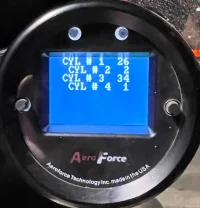
I learned that it takes x amount of misfires in a given period of time to pop a CEL. My gauge tracked the real-time misfires (from a bad PCM) that usually didn’t result in a misfire code. Pretty wild how many there were that physically went unnoticed. I haven’t seen numbers that high since installing a Wranglerfix pcm.

IMG_6585.webp
 
  • Like
Reactions: GoldenGorilla
Yeah, this is an oddity of the Chrysler O2 sensor heater monitoring strategy. The PCM switches over to 1V after it confirms heater function. It's hard for me to capture that in the HPTuners logs as it happens in the first few seconds while I'm trying to get the connection initialized, but I see the tail of it every once in a while.

You can also see that the vehicle runs in open loop for a short time when it first starts and this is part of why.

That makes sense. So if I am checking the circuit I unplug the O2 sensor and on pins 3&4 I should read 5 volts with the key on right? With an intermittent problem and the problem being exactly the same with or without anti foulers I am leaning towards a harness short or a pcm problem. I read somewhere and it wasn't this forum there was a problem with some of these PCMs shorting internally when they got hot and self clearing after a time. I'm dumbfounded how to test that but open to suggestions.
 
I found a good video on how it worked once and never could find it again. Should have saved that link