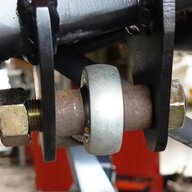
Novak Conversions Jeep Wrangler TJ radiator

1997 Jeep Wrangler Part Properties (See Description)

Duner

Doonigan
Original poster
Supporting Member
Joined
May 6, 2020
Messages
553
Location
Buffalo, New York
Hey all,

So I have been given a assignment from my professor which has tasked me to list 5 components of a vehicle that are major, or critical. I chose a 1997 Jeep wrangler because @JeepNWilly had an awesome thread that contained endless manufacturer's information on it.

These are the parts I selected:

1) Body (Tub) - Steel
2) Cylinder Block - Cast Iron
3) Pistons - Aluminum Alloy
4) Camshaft - Cast Nodular Iron
5) Master Cylinder - Aluminum (AC2A)

What I am struggling to find information on is why these materials were selected compared to other materials. My professor wants the specific alloy of the materials but I feel like this is a near impossible task.

I also need to list two reasons as to why the specific material was selected. Any help at all is greatly appreciated.

Thanks,

Strazi
 
You need an automotive engineer, and possibly a metallurgist.

If you will get on the phone or web, and I'm not kidding, you won't have any problem finding a consulting company in Michigan glad to help a young student. Be upfront , so they don't think you are an industrial spy.

Just call and ask...who can tell me how to find this information.

You will be surprised. People love to help people.

Also , the National Highway Traffic safety administration or whatever it's called or any automotive regulatory commission will have tons of information.
 
Who would be able to answer this? @mrblaine maybe? I'm trying to think of someone to tag who knows a lot about metallurgy.
 
  • Like
Reactions: AndyG
Hey all,

So I have been given a assignment from my professor which has tasked me to list 5 components of a vehicle that are major, or critical. I chose a 1997 Jeep wrangler because @JeepNWilly had an awesome thread that contained endless manufacturer's information on it.

These are the parts I selected:
1) Body (Tub) - Steel
Steel is used due to high levels of formability, ease of fastening in that you can weld conventionally and spot weld it. It has a very good strength to weight ratio.
2) Cylinder Block - Cast Iron
Cast iron is used because it can be cast into complex shapes with relative ease, it machines easily, it has great dimensional stability under heat loads. There are almost as many cast ferrous alloys as their are steel alloys so it can be compounded for stiffness, hardness, ductility, and elasticity among other things.
3) Pistons - Aluminum Alloy
Cost, weight, ease in manufacturing.

4) Camshaft - Cast Nodular Iron
Cost, ease of manufacturing and high amount of wear resistance to be able to crank the lifters up and down for millions of cycles.
5) Master Cylinder - Aluminum (AC2A)
Cost, ease of manufacture, easy to cast, easy to machine, high levels of durability with great weight reduction.

What I am struggling to find information on is why these materials were selected compared to other materials. My professor wants the specific alloy of the materials but I feel like this is a near impossible task.

I also need to list two reasons as to why the specific material was selected. Any help at all is greatly appreciated.

Thanks,

Strazi

1- Look up types of steel used in automotive manufacturing. There are lots of advances in steel and high strength steel to reduce weight and increase strength. Specifically look for cold rolled alloys.

2- Look up cast iron types and what properties they offer to make them desirable for a specific use.

3- Go to piston manufactures and dig around to see if they give an alloy comparison and why it matters.

4- Compare the rigidity and wear characteristics of a common 1018, 1020 steel alloy to gray and nodular irons to show why steel is less desirable.

5- That may be tougher. I don't know how to find the specific alloy used for a master. The move to aluminum was almost purely to cut weight.
 
Novak Conversions Jeep Wrangler TJ radiator