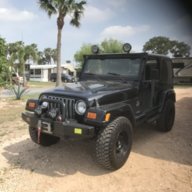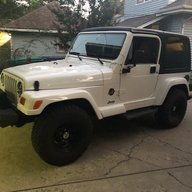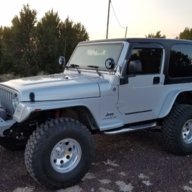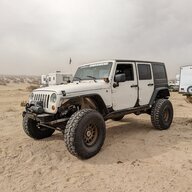
My equipment is a 2005 TJ Rubicon, 35" tires, 4 wheel stock disc brakes, LS motor
I was backing down my incline gravel driveway and my front tires locked up and the rear tires continued to roll. I did not think this was normal so I posted for help on the forum. I also contacted Blaine Johnson, Mr. Black Magic himself.
Blaine told me to bleed the brakes and put the rear axle on jack stands, accelerate to 30 mph and apply the brakes. If it stops the tires it is working.
As soon as I pressed the brakes and put it in drive the rear tires started turning. I couldn't even stop them without even applying the throttle. I went ahead and accelerated to 30 mph and hit the brakes and the tires stopped momentarily then started to roll again while I had the brakes depressed.
I called Blaine back and reported it. He said that I had air in my lines. I re-bled the brakes and repeated the test. No change. I called Blaine. He said that I need to repeat the test and without letting off the brake I needed to crack open the lines on the brake master cylinder and combination valve one by one and see if I fluid came out under pressure. We were trying to find where the pressure was dropping. He believed it maybe a bad master cylinder. I did, tested with the exact same result.
I called Blaine again. He said to remove the master cylinder, bench bleed, re-bleed the brakes and retest. I did. No change. Tires stop at 30 mph momentarily then begin rolling again. I then purchased a Dorman master cylinder (Blaine's choice), bench bled it, installed it, and re bled the brakes. Tested it. No change.
I called Blaine again. He said to remove the plunger our of the combination block and remove the rubber/plastic ring. I did, re bled the brakes, re tested and this time the tires stopped, then rolled over a couple of times then stopped again. But the brake pedal was extremely spongy, which Blaine warned me it might be.
He thought that maybe the combination block was bad. He told me to get a new combination block and retest. I asked him if I should get an adjustable proportional valve. He said absolutely not! That while it does allow you to put more towards the rear, it restricts fluid to the front brakes which is never a good thing.
I hung up, thought about everything he said and called him back. I told him that I had an LS motor and not the stock 4.0. I was wondering if the torque of the motor was pushing through the brakes. Blaine believed that maybe the vacuum going to the brake booster was too low. So I reinstalled the rubber/plastic ring back on the plunger in the combination block and retested and tested the vacuum pressure in the line going to the brake booster. What I found was that when I would increase the rpm the vacuum would go up to 20-22 inches. When I let off the accelerator and hit the brakes the vacuum would drop down to 13-15 then increase up to 17 inches while at an idle. We determined that when the vacuum was below 17 inches of mercury the brakes would not be enough to hold the tires at a stop. Blaine said that I had somewhat of an anomaly because in all of his experiences the vacuum decreased with higher rpm and increased with lower rpm and mine was just the opposite. He recommended that I research this vacuum issue.
Blaine told me that we are only trying to make the brakes stop the tires and hold. We are not trying to apply more pressure to the rear. He said that just stopping the rear tires is all that is expected from a Jeep. I don't understand that. Why would Jeeps be made this way. How can I drive it in 2wd if my rear brakes only have enough power to stop my tires when they are on jack stands? It would not be reasonable to put my Jeep in 4wd every time I started to back down my driveway.
Has anyone had this issue with their brakes and/or a low/inverted vacuum pressure?
BTW my plan is to install the VANCO Big Brake Kit, but Blaine said that we have to fix the rear brakes first.
I was backing down my incline gravel driveway and my front tires locked up and the rear tires continued to roll. I did not think this was normal so I posted for help on the forum. I also contacted Blaine Johnson, Mr. Black Magic himself.
Blaine told me to bleed the brakes and put the rear axle on jack stands, accelerate to 30 mph and apply the brakes. If it stops the tires it is working.
As soon as I pressed the brakes and put it in drive the rear tires started turning. I couldn't even stop them without even applying the throttle. I went ahead and accelerated to 30 mph and hit the brakes and the tires stopped momentarily then started to roll again while I had the brakes depressed.
I called Blaine back and reported it. He said that I had air in my lines. I re-bled the brakes and repeated the test. No change. I called Blaine. He said that I need to repeat the test and without letting off the brake I needed to crack open the lines on the brake master cylinder and combination valve one by one and see if I fluid came out under pressure. We were trying to find where the pressure was dropping. He believed it maybe a bad master cylinder. I did, tested with the exact same result.
I called Blaine again. He said to remove the master cylinder, bench bleed, re-bleed the brakes and retest. I did. No change. Tires stop at 30 mph momentarily then begin rolling again. I then purchased a Dorman master cylinder (Blaine's choice), bench bled it, installed it, and re bled the brakes. Tested it. No change.
I called Blaine again. He said to remove the plunger our of the combination block and remove the rubber/plastic ring. I did, re bled the brakes, re tested and this time the tires stopped, then rolled over a couple of times then stopped again. But the brake pedal was extremely spongy, which Blaine warned me it might be.
He thought that maybe the combination block was bad. He told me to get a new combination block and retest. I asked him if I should get an adjustable proportional valve. He said absolutely not! That while it does allow you to put more towards the rear, it restricts fluid to the front brakes which is never a good thing.
I hung up, thought about everything he said and called him back. I told him that I had an LS motor and not the stock 4.0. I was wondering if the torque of the motor was pushing through the brakes. Blaine believed that maybe the vacuum going to the brake booster was too low. So I reinstalled the rubber/plastic ring back on the plunger in the combination block and retested and tested the vacuum pressure in the line going to the brake booster. What I found was that when I would increase the rpm the vacuum would go up to 20-22 inches. When I let off the accelerator and hit the brakes the vacuum would drop down to 13-15 then increase up to 17 inches while at an idle. We determined that when the vacuum was below 17 inches of mercury the brakes would not be enough to hold the tires at a stop. Blaine said that I had somewhat of an anomaly because in all of his experiences the vacuum decreased with higher rpm and increased with lower rpm and mine was just the opposite. He recommended that I research this vacuum issue.
Blaine told me that we are only trying to make the brakes stop the tires and hold. We are not trying to apply more pressure to the rear. He said that just stopping the rear tires is all that is expected from a Jeep. I don't understand that. Why would Jeeps be made this way. How can I drive it in 2wd if my rear brakes only have enough power to stop my tires when they are on jack stands? It would not be reasonable to put my Jeep in 4wd every time I started to back down my driveway.
Has anyone had this issue with their brakes and/or a low/inverted vacuum pressure?
BTW my plan is to install the VANCO Big Brake Kit, but Blaine said that we have to fix the rear brakes first.