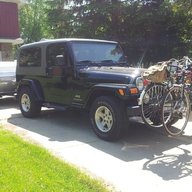
Novak Conversions Jeep Wrangler TJ engine mounts

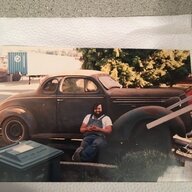
Car pics too cool not to share

The reason was that you could spit the blocks out under heavy braking in think 🤔.

Not suggesting that blocks are good on the front axle (or elsewhere), but aren't the spring assemblies through-bolted/doweled? I feel like there are locating dowels or bolts to keep everything aligned. I only used blocks once on an S-15 rear axle (for lowering), the blocks had corresponding dowels and receiver holes. Provided the u-bolts were properly installed and torqued, everything should have stayed together (in theory).
 
  • Like
Reactions: Daubie3
I wouldn't go that far. :sneaky:


That's where the Merc is at, all new and factory. The car is 80% stock but weighs a little more than it did from the factory, which isn't helping anything, and those brakes are ok at best. I know he's looked at a couple disc setups over the years, but hasn't committed to it yet.

Here's a blurry pic of it at our friend's shop back in April. He has since lost a hubcap. :LOL:
View attachment 566311


I have a '64 Chevy that I’ve been researching front disc on, and that $1,000 ballpark is where I keep landing, too. My Chevy is a manual brake car like your Ford, and I keep reading that disc setups need a booster, but I don't know anyone with a manual/disc setup, so I’ve never driven one. How is it? Guys online act like you can't safely drive a manual/disc setup.

Our 71 C-10 is factory manual disc , you have to stop like you mean it . But it's totally doable .
 
Not suggesting that blocks are good on the front axle (or elsewhere), but aren't the spring assemblies through-bolted/doweled? I feel like there are locating dowels or bolts to keep everything aligned. I only used blocks once on an S-15 rear axle (for lowering), the blocks had corresponding dowels and receiver holes. Provided the u-bolts were properly installed and torqued, everything should have stayed together (in theory).

There's locating pins on most blocks but very few that I've delt with ever had a bolt that went through the blocks and springs. Plus that bolt was 1/4" maybe?

I just know when I was a broke soldier and was trying to lift my pickup I was wanting to use blocks on the front and rear axle and the 4WD shop I was dealing with explicitly told me NO blocks on the front axle.

So if you go back to braking I don't remember the bias but even if the front is only doing 60% of the braking that's a lot of force.
On the rear axle I've seen guys spit blocks out when they'd stacked them instead of buy the one taller block. They did it when romping on the go pedal to hard and the tires hooked up after spinning.
 
Mostly for the "factory-correct" restoration guys. You should see prices for date coded NOS stuff, especially C1-C3 Corvette and B-body MoPar cars. Those spiral Delco shocks are selling at $500 a pair on one site I found, and I've seen my dad pay similar prices for date coded Corvette stuff. About 5 years ago, I watched a guy sell some 1970 date coded tires (display only) on a B-body site for like $1,000 per tire.


I know the bigger the block, the worse it is, leverage and whatnot. Lots of leaf spring cars are lowered with blocks too. I know factory 4x4 trucks seem to run 2-3 inch blocks, so that must be an acceptable range, but I've seen trucks lifted 4-8 inches via blocks.

How about doubled up? Is that a Ford oval on that spring? 🤔
View attachment 566478

Back in the '80s, I saw a mid-'70s Chevy 4X4 running around the Burien area with stacked wooden 2x4 blocks...
1729276453510.png
 
Back in the '80s, I saw a mid-'70s Chevy 4X4 running around the Burien area with stacked wooden 2x4 blocks...
View attachment 566490

Scrap job site wood = free. ;) I had a guy tell me wood blocks helped reduce vibrations, vs metal. IDK, maybe it did, maybe it didn't, but I’ve seen wood used on old mud toys quite often.

So if you go back to braking I don't remember the bias but even if the front is only doing 60% of the braking that's a lot of force.
On the rear axle I've seen guys spit blocks out when they'd stacked them instead of buy the one taller block. They did it when romping on the go pedal to hard and the tires hooked up after spinning.
I have. And once that happens, your steering input is nothing more than a suggestion. As for the rear, axle-wrap is the concern, as I understand it.


I haven't seen blocks spit out, but I have seen more than one driveshaft wadded up via axle wrap and forward movement due to large blocks. The blocks just give the axle too much leverage and movement. That same leverage and movement has to work with breaking, too.
 
Scrap job site wood = free. ;) I had a guy tell me wood blocks helped reduce vibrations, vs metal. IDK, maybe it did, maybe it didn't, but I’ve seen wood used on old mud toys quite often.

Oh, it most certainly did, he's not lying. :LOL: However...unless you're driving an old Morgan, wood (especially white wood framing lumber) has no place in the structural and suspension aspects of a vehicle....likely for the same reason we don't fashion brake discs from cheddar cheese...
 
...likely for the same reason we don't fashion brake discs from cheddar cheese...

Now you're just making stuff up, 'cause I know that's how we make powdered cheese.

Seriously? Any car guy worth his salt knows that Velveeta makes for the smoothest stops. Hell, it's in the name! ;)
 
To preface the following video:
  • I've been enjoying car reviews by Chris Harris for quite a long time now, he's a very good driver and I like the way he presents and talks about cars (this isn't a typical review of his)
  • I have no issue with nor any particular attachment to the Porsche brand
  • It is likely well know that I am not a fan of new vehicles, I don't care for the over-complication and computerization of them and many look like shit, however...
The new 992.2 GT3 Touring featured in this clip gave me a bit of a chubber at first sight...damn good looking car and the color....feck me... 🤪

 
1942 Chrysler Barrel Back Town and Country Estate Wagon
1729297026403.png

1729297060701.png

1729297100942.png

1729297138698.png

One of Only 849 Nine-Passenger Models Built for 1942

Estimated by Experts to Be One of 16 Survivors

Prior Owners Include Noted Authority Lloyd Mayes

Displayed at the 2001 Pebble Beach Concours d’Elegance

Reliably Driven on Multiple Long-Distance Motoring Events

Recognized as a CCCA Full Classic

Technical Specs

250 CID “Spitfire” L-Head Inline 6-Cylinder Engine

Single Carter 1-Barrel Downdraft Carburetor

120 BHP at 3,600 RPM

4-Speed “Vacamatic” Vacuum- Assisted Semi-Automatic Transmission

4-Wheel Hydraulic Drum Brakes

Independent Coil-Spring Front Suspension

Live Rear Axle with Semi-Elliptical Leaf Springs
 
Novak Conversions Jeep Wrangler TJ engine mounts