

You are using an out of date browser. It may not display this or other websites correctly.
You should upgrade or use an alternative browser.
You should upgrade or use an alternative browser.

EV thread
- Thread starter Apparition
- Start date

We were using 2.2 Farad caps at about a 1.2 voltage rating - since it was a "12 volt" system, we had to put them in series which reduces the overall capacitance (much like parallel resistors), but they worked spectacularly!
When I was in school, a 1 Farad capacitor would have been the size of a small room if I recall what my instructor told us at the time. It was a long ass time ago, it fades, it fades...

That I6 might be a perfect fit in my 2006 TJ when it comes to a swap. I could live with only 420 HP and 469 ft-lbs.
I read they will be avaiable in new Jeeps too. So that could help with a swap. Find a wrecked Jeep and fit the whole powertrain. Hmmmm
All it would take is dead presidents , lots and lots of dead presidents , and a untold amount of patients .


That I6 might be a perfect fit in my 2006 TJ when it comes to a swap. I could live with only 420 HP and 469 ft-lbs.
I read they will be avaiable in new Jeeps too. So that could help with a swap. Find a wrecked Jeep and fit the whole powertrain. Hmmmm
Having just spent 5 days in a 6200lb Wagoneer with this engine, I wholly endorse the performance. Who knows how they'll last but a TJ with that engine would fly.
I wouldn't even know where to start with getting a modern engine with modern controls swapped into an older vehicle. Doubt this engine would get the aftermarket treatment to make swaps easier, but I can't predict the future.

Saw this one on Facebook.
Battery replacement on a Chevy Volt @ 70k miles - $26,854 for the battery & $1200 to install.
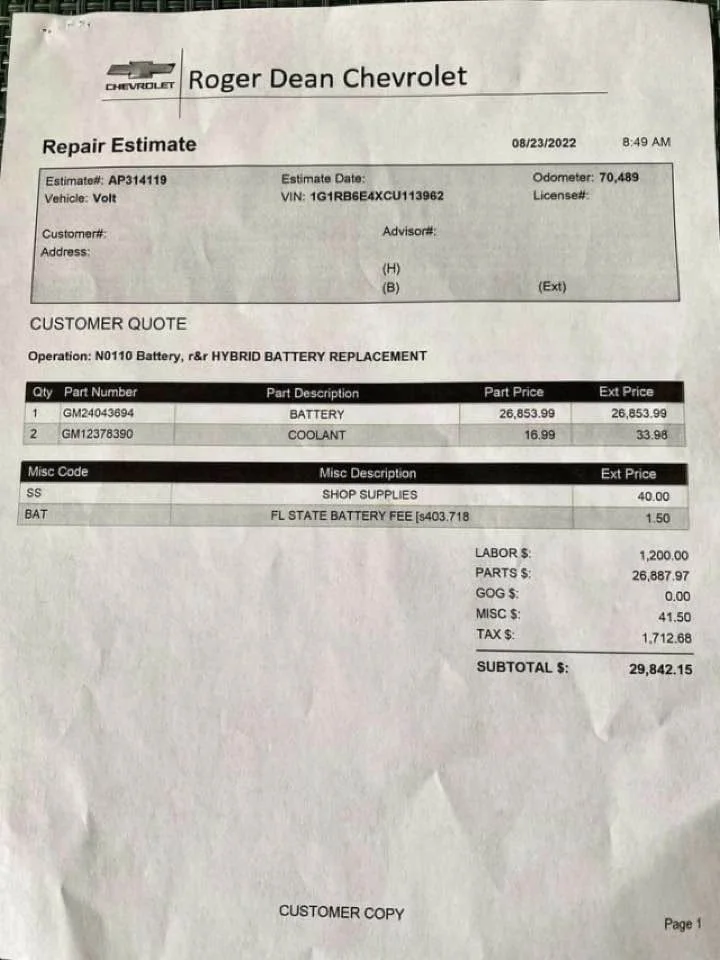
Battery replacement on a Chevy Volt @ 70k miles - $26,854 for the battery & $1200 to install.



Having just spent 5 days in a 6200lb Wagoneer with this engine, I wholly endorse the performance. Who knows how they'll last but a TJ with that engine would fly.
I wouldn't even know where to start with getting a modern engine with modern controls swapped into an older vehicle. Doubt this engine would get the aftermarket treatment to make swaps easier, but I can't predict the future.
Probably no different then the Hemi guys swaps. It's just engineering, cutting, welding and money. I suck at welding, but can do the rest.
I bet the I6 would fit better than the Hemis.

Apparition
Sand Hollow '26 beginner trails in the books
Original poster
Supporting Member
Ride of the Month Winner
Saw this one on Facebook.
Battery replacement on a Chevy Volt @ 70k miles - $26,854 for the battery & $1200 to install.
View attachment 473569
Roughly $35k new and well under that value for a used one. Why would anyone pay that much to replace a battery?

Roughly $35k new and well under that value for a used one. Why would anyone pay that much to replace a battery?
And that's why the vast majority of EVs will be short-lived, disposable appliances.
Probably no different then the Hemi guys swaps. It's just engineering, cutting, welding and money. I suck at welding, but can do the rest.
I bet the I6 would fit better than the Hemis.
Could be. I know just enough to know that there's probably a lot I don't know. Some things that crossed my mind were how does a 2022 PCM respond when it doesn't see the 47 other modules that were in the vehicle it originally came on? Or what shenanigans might be involved in getting a working gauge cluster, or defeating the anti theft immobilizer. Automotive tech has progressed a loooot between late 00s hemis and today.
I don't hear the same issues with hybrids. They seem to last like regular cars. Maybe the tech was more established and the design better.
Having a gas engine may optimize the batteries better.
Having a gas engine may optimize the batteries better.

You're going to see some serious shit.
Capacitor technology has come a LONG way since I was a pup - Philip Jose Farmer foresaw this in his SF writings - a device he called the "Battacitor" that would charge very quickly like a capacitor, but would dole it out slowly like a battery - in other words, a huge ass capacitor.
F1 and endurance racing has been developing this for a while. I don't know how much trickles down to production cars. Are solid state batteries the same as capacitors?
Roughly $35k new and well under that value for a used one. Why would anyone pay that much to replace a battery?
My thoughts exactly. Not sure if you can get insurance for the battery, but this would surely total the vehicle.
The EV movement is insuring that these cars will not be usable in 20 years. Great for the new car industry because people will have to dump more money. Though the used industry will become more risky and short lived. All of this is a great reason to avoid EV vehicles.
I don't hear the same issues with hybrids. They seem to last like regular cars. Maybe the tech was more established and the design better.
Having a gas engine may optimize the batteries better.
That would be a safer purchase as long as, if the battery dies, you can still use the gas engine. Just sold my wife's 2013 Prius plug in. At least according to her, if the battery died, you can no longer use the gas engine. It had 196K miles, so I was nervous about it and dumped it as soon as she would let me. Bought an 04 TJ with that money to use as a DD. Figure the 4.0 may last longer than an EV battery.
F1 and endurance racing has been developing this for a while. I don't know how much trickles down to production cars. Are solid state batteries the same as capacitors?
Apparently not from my limited understanding of the idea - but that was my first thought as well.
My thoughts exactly. Not sure if you can get insurance for the battery, but this would surely total the vehicle.
The EV movement is insuring that these cars will not be usable in 20 years. Great for the new car industry because people will have to dump more money. Though the used industry will become more risky and short lived. All of this is a great reason to avoid EV vehicles.
"Smartphone effect" - its what people have been trained to expect from "technology".
"Smartphone effect" - its what people have been trained to expect from "technology".
People buying the plug ins are either ignorant to long term cost, or just don't care. They want to save money at the gas pump, but don't realize they're losing money in the long run. More expensive to buy the EV version too. So figure out how much more you're paying + gas costs vs. electricity cost + depreciation + how long the battery will last and how that will effect depreciation.
People buying the plug ins are either ignorant to long term cost, or just don't care. They want to save money at the gas pump, but don't realize they're losing money in the long run. More expensive to buy the EV version too. So figure out how much more you're paying + gas costs vs. electricity cost + depreciation + how long the battery will last and how that will effect depreciation.
I'd venture to say "don't care", because they're mostly the type of people that that believe a cars usefulness expires with the factory warranty. The chances they still own it when the battery goes tits-up is precisely zero.
If they had the car knowledge required to deal with a car once the warranty expires, they wouldn't be buying an EV.
Obviously there are exceptions...the exceptions end up posting a $26k battery replacement invoice on a car enthusiast forum.
Ditto. People don't give a damn how much money things cost, and don't expect them to last. The smartphone taught them well.I'd venture to say "don't care", because they're mostly the type of people that that believe a cars usefulness expires with the factory warranty.
Ditto. People don't give a damn how much money things cost, and don't expect them to last. The smartphone taught them well.
We all know you don't like smartphones, but I think "consumerism" started a long time before smartphones, and that's what this really is. I'd say "consumerism" started well before cell phones, arguably as far back as certain trucks having particular V6 engines in them
 or earlier, and really took off with the boomer generation in general.
Certain trucks with particular V6 engines lasted 250K or more miles - which was really something back in the day. But with that said, you're completely correct - smartphones just made a bad situation far worse. I used my first cell phone for 18 years, and I'd still be using it today but for newer networks replacing older ones. Try buying so-called "Durable goods" these days - you're lucky to get 10 years out of a fridge or washing machine!We all know you don't like smartphones, but I think "consumerism" started a long time before smartphones, and that's what this really is. I'd say "consumerism" started well before cell phones, arguably as far back as certain trucks having particular V6 engines in them
Similar threads

- Replies
- 9
- Views
- 7,137
- Replies
- 9
- Views
- 4,672

- Replies
- 4
- Views
- 1,115


- Replies
- 48
- Views
- 28,838

