EVAP leak after rebuild

dockdoc

Member
Original poster
Joined
Feb 26, 2020
Messages
62
Location
Charlotte, NC
I know this issue has come up on previous threads, but still not sure where to go with this.

This is on my '02 TJ that I restored last year (i.e. new frame). Engine has 70k miles. Didn't do much engine/trans stuff except new rear main seal and clutch.

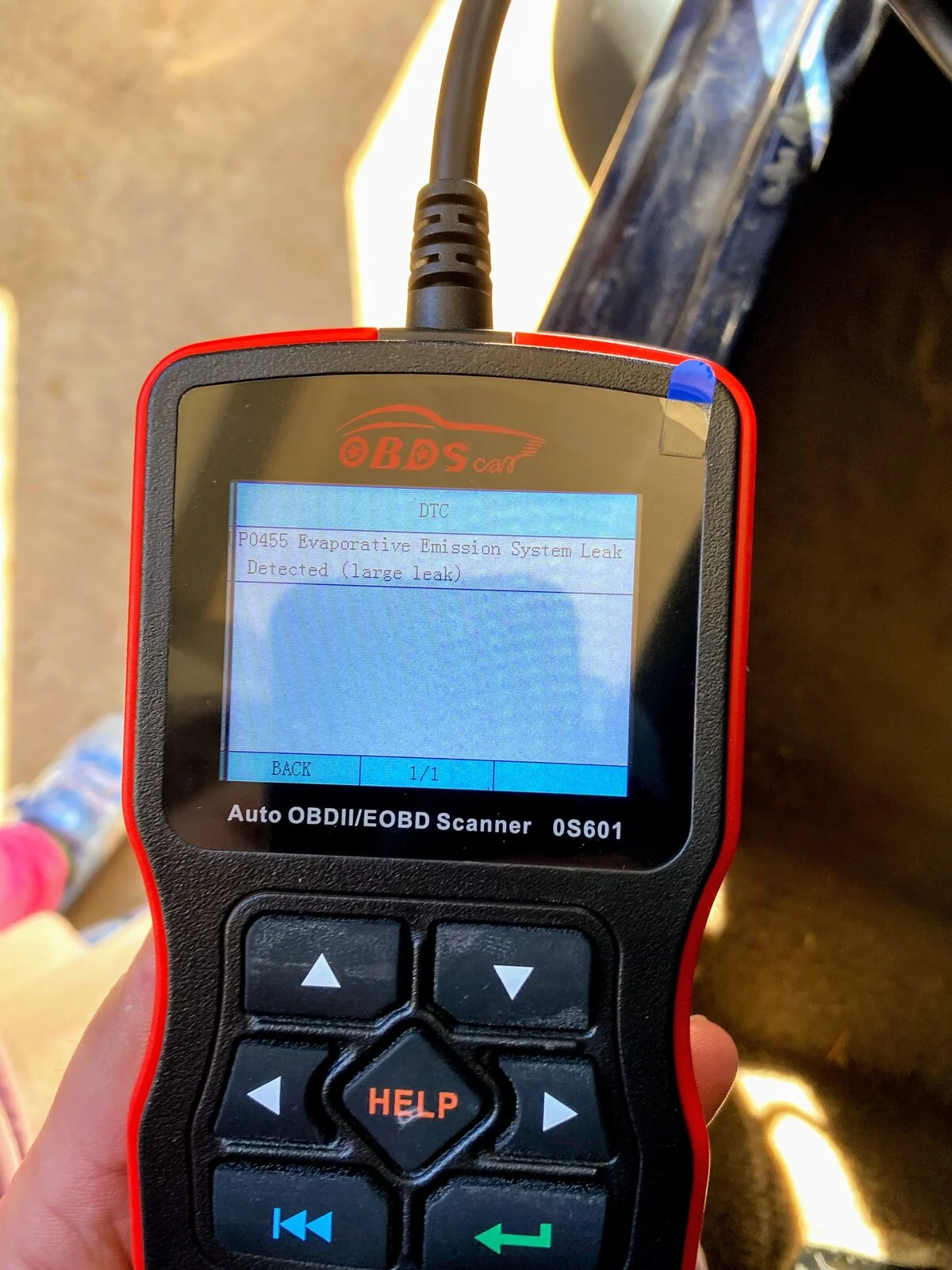
When we bolted it all back together the damn thing started right up on the first try and has been running well ever since. Except I've had a persistent CEL. I pulled the code and it's the P0455 large evap leak.

I went over all the vac hoses, replaced a couple that were cracked. There was a broken wire going to the EVAP canister that I figured must be it, but fixed that and no change. I replaced the fuel cap (which was some aftermarket garbage) with a new MOPAR one and it didn't fix it.

I'm assuming at this point I need to smoke test it, and that generally requires a visit to the shop, right? I need it to pass inspection in the next 6 weeks, otherwise I'd just leave it (like I've left it the past year!).

Appreciate any suggestions.
IMG_6355.webp
 
Yep, I'd say if you really want to find your culprit you're going to want to perform a smoke test. That's a lot better than guessing.
 
Carb cleaner maybe? Before a smoke test. Used it to find a small evap leak in my Audi. It def worked. It did help that i knew the general area where the leak was coming from
 
Carb cleaner maybe? Before a smoke test. Used it to find a small evap leak in my Audi. It def worked. It did help that i knew the general area where the leak was coming from

Do I basically just spray it on different hoses in the evap system and see if there's a change in engine speed?
 
Yes. If the engine Revs up then you found the leak. You do have to be careful since it’s flammable. I used the thin straw it comes with to spray more of a specific area.

From what I’ve read also, you can use spray a bottle of water on a cold engine and it should produce the same effects. This really didn’t work for me whenI tried it.
 
Yes. If the engine Revs up then you found the leak. You do have to be careful since it’s flammable. I used the thin straw it comes with to spray more of a specific area.

From what I’ve read also, you can use spray a bottle of water on a cold engine and it should produce the same effects. This really didn’t work for me whenI tried it.

Thanks - I have some carb cleaner, I'll give this a try (carefully). Otherwise - to the shop it is, from what I can tell it doesn't seem like it's feasible to borrow / rent a smoke machine.
 
Please don't confuse a "Large EVAP" leak with a vacuum leak.

The evap system collects fuel vapors from the gas tank and stores them in a charcoal cannister. Then the purge valve cycles open to allow the fuel vapors into the intake to be burned.

The first check to do would be to visually inspect all evap lines from the gas tank to the charcoal cannister and up to the purge valve.

Second would be to do a smoke test. A large evap leak should show up pretty readily with a smoke test.
 
  • Like
Reactions: Jamesval035
Please don't confuse a "Large EVAP" leak with a vacuum leak.

The evap system collects fuel vapors from the gas tank and stores them in a charcoal cannister. Then the purge valve cycles open to allow the fuel vapors into the intake to be burned.

The first check to do would be to visually inspect all evap lines from the gas tank to the charcoal cannister and up to the purge valve.

Second would be to do a smoke test. A large evap leak should show up pretty readily with a smoke test.

Yes - great point thanks for clarifying. But wouldn't carb cleaner test still work? My understanding is that the fuel vapors are being pulled back into the combustion chamber via vacuum, so it would pull in the carb cleaner the same way. No?
 
Please don't confuse a "Large EVAP" leak with a vacuum leak.

The evap system collects fuel vapors from the gas tank and stores them in a charcoal cannister. Then the purge valve cycles open to allow the fuel vapors into the intake to be burned.

The first check to do would be to visually inspect all evap lines from the gas tank to the charcoal cannister and up to the purge valve.

Second would be to do a smoke test. A large evap leak should show up pretty readily with a smoke test.

Yup, my mistake for confusing the two.
 
Double then triple check the lines near the charcoal box and the few that attach to the manifold. The elbows especially start to decay. Ended up replacing every line on it before the issue went away.

Also, you need to disconnect the battery to clear the code, unless your reader does that, the system will retest between 3/4 and 1/4 tank.
 
Double then triple check the lines near the charcoal box and the few that attach to the manifold. The elbows especially start to decay. Ended up replacing every line on it before the issue went away.

Also, you need to disconnect the battery to clear the code, unless your reader does that, the system will retest between 3/4 and 1/4 tank.
Double then triple check the lines near the charcoal box and the few that attach to the manifold. The elbows especially start to decay. Ended up replacing every line on it before the issue went away.

Also, you need to disconnect the battery to clear the code, unless your reader does that, the system will retest between 3/4 and 1/4 tank.

Sounds good - honestly, I'll probably just replace all those lines before I pay to have it smoke tested (especially since I can just do that in the driveway). Are they pretty standard lines to get an auto parts store?
 
As Alex stated....the Evap System Test is only performed when the gas tank is somewhere between 3/4 to 1/4 full and only on cold starts.

So it could take a couple of days for the PCM to rerun the test. If you don't get any new codes after a couple of days, check your readiness monitors to see if the Evap system shows "Ready". Then you know the test was run successfully.
 
  • Like
Reactions: Alex01
Sounds good - honestly, I'll probably just replace all those lines before I pay to have it smoke tested (especially since I can just do that in the driveway). Are they pretty standard lines to get an auto parts store?
Yes. Just take the lines to the store and find some with matching inner diameters.
 
Do I basically just spray it on different hoses in the evap system and see if there's a change in engine speed?
You have an evap leak, not a vacuum leak. spraying carb cleaner/brake clean or anything else isn't going to help.

You need to seal the evap system and perform a smoke test.

Unless you have a expensive scanner and a J-41313 emissions tester, you are going to need to visit a local shop or dealer ship.

P0455 is a large leak , if you are not finding anything disconnected and your gas cap is intact..... Then I would be looking at purge solenoid.

You stated that you had a broken wire, did it possibly ground out and blow the fuse.

Check fuse #11 in the underhood fuse box and see if its blown.
 
Last edited: