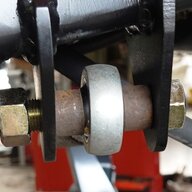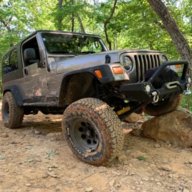
Is this bolt supposed to look like this?

Man o man ... Even if you have to drive the bolt back through there and lock it in place with vise grips to get home , do it .

We may have to fine you for running an unsafe rig...new rules.... Chris has a JK to pay for.

Wait... @Chris bought a JK? He can't run this forum anymore then.
 
  • Like
Reactions: jjvw
Here are two pics showing the hole on the right begin used. Is that the hole I should be using?
Anyone with more insight onto the two hole mystery please chime in.

On some lift kits, instead of an adjustable track bar they drill a second hole (the one on the right). With your adjustable track bar, you're using the right, or OEM hole.
 
On some lift kits, instead of an adjustable track bar they drill a second hole (the one on the right). With your adjustable track bar, you're using the right, or OEM hole.
Now that's confusing...I'm guessing you're saying "With your adjustable track bar, you're using the correct, or OEM hole"...?
 
@mrblaine explained to me that the hole closest to the passenger side, i.e. on the LEFT in the picture, is the factory hole and the one on the right was drilled to deal with a previous lift and move the factory track bar inboard.

The interesting thing is the factory hole (on the left) is larger then the one that was drilled (on the right).

1564492140921.webp
 
Goes to show that the size of the hole isn't as important as you'd think. It's all about the torque on the bolt/nut.
Within reason, it is not important at all. The bolt just has to be strong enough to clamp the two sides of the mount to the end of the bolt sleeve and stop it from moving.
 
  • Like
Reactions: mgroeger
Once you get the axle side track bar bolted up and torqued to correct spec (55 lbs), make sure you have someone turn the steering wheel back and forth between 10-2 (like a clock) and observe for any movement from both sides of the track bar. There should be absolutely no movement or you will have more death wobble eventually. If it moves at all you need a new track bar.

I find it interesting that the JKS track bar has a ball joint on one end which would seem a weak link in terms of it wearing out. Then again maybe I'm over thinking that.
 
Two things ruin a bolted slip critical connection. Under torque and over torque. Under doesn't develop enough stretch in the bolt to stabilize the connection, over stretches the bolt past the elastic limit into plastic deformation and it doesn't have any elastic ability left to stretch and develop enough clamping force to stabilize the connection.

The fact that bolts can/do stretch is a definite factor. Sometimes a Grade 8 will outlast a Grade 14. The Grade 8 will stretch and conform better than a Grade 14.
Good post mrblaine . . .
 
Now that's confusing...I'm guessing you're saying "With your adjustable track bar, you're using the correct, or OEM hole"...?

Yes. For example, on Zone lifts using the OEM track bar, you drill a second hole. This moves the track bar to center the axle. If you use an adjustable track bar, you use the original hole.