Questions about bump stop and suspension setup

Currie bumps divide the extension between the top and bottom.

Your spring math says the rear is at 6" of lift. That is a lot. Are you sure?

Measured from ride height, what will the up and down travels be with these shocks?
If you could head back thru the thread, most of this was figured out. From what I found, when I usually drive I remove my back seat and sometimes the spare tire. Unloaded the springs barely compressed so I was at 14 or so inches. Spring is 15.25" when its removed. When I have the jeep loaded for my average day the spring sets at roughly 12.5 to 13". In the end with my bilstein shocks, a 5" bump will be needed to keep my shocks happy. Still thought this was an unusually high number but I'm learning so what seems normal for everyone here is odd for me. 5" for an average 4" lift is odd. Lol.

 
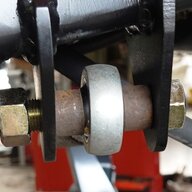
Seems like a likely stress point to have it ripped off or sheared off. Lots of leverage there.
Yes, there is a lot of leverage. But, the movement at the end of the extended upper should be fairly minimal since the shock will stop the axle's upward movement before the bump stop gets ripped out of the upper mount. I don't run them that way, but that doesn't change how much movement the end will have stopping the axle.
 
If you could head back thru the thread, most of this was figured out. From what I found, when I usually drive I remove my back seat and sometimes the spare tire. Unloaded the springs barely compressed so I was at 14 or so inches. Spring is 15.25" when its removed. When I have the jeep loaded for my average day the spring sets at roughly 12.5 to 13". In the end with my bilstein shocks, a 5" bump will be needed to keep my shocks happy. Still thought this was an unusually high number but I'm learning so what seems normal for everyone here is odd for me. 5" for an average 4" lift is odd. Lol.

One should endeavor to drive it in the manner for which the shocks work best or make the shocks work best for the manner in which is it driven the vast majority of the time.

The worst scenario is the one you created. Set it up to work nicely and then change it to ride like crap most of the time. When someone brings me a rig to set up, I tell them to pick a scenario and I will build to it. If you want to daily drive an empty rig, don't bring it back when it bottoms out and ride like crap getting to the trail because you loaded it down with a 1000 lbs of crap and it's dragging ass everywhere.
 
One should endeavor to drive it in the manner for which the shocks work best or make the shocks work best for the manner in which is it driven the vast majority of the time.

The worst scenario is the one you created. Set it up to work nicely and then change it to ride like crap most of the time. When someone brings me a rig to set up, I tell them to pick a scenario and I will build to it. If you want to daily drive an empty rig, don't bring it back when it bottoms out and ride like crap getting to the trail because you loaded it down with a 1000 lbs of crap and it's dragging ass everywhere.
Lol, I admire your honesty.

This is a true statement but my vehicles are very diverse. The jeep doesnt ride like crap with any situation I've placed it in thus far. My issue is simply figuring out that I cant have max travel out of off the shelf shocks because no one makes a shock that will compress to 13.5" and extend to 25". So I need to pick what places me closest to the middle when out on an average day. When I'm empty its usually because I'm driving to base and know that I'll be loading it up later on. When I'm loaded down it's usually simple gear or people. The tj really limits you to picking what you want behind the drivers seat. Your favorite tools or your favorite child. Hahaha. I'm also in limbo with trying to figure out what the spring rates are. The currie lift I believe being dual rated springs is lighter than the ones I have on now from teraflex. My kit is old from 2005 so I dont have much info on the rates. Alls I do know is that the system was installed with just 2.5" bump extensions in the rear and the included shocks were torn to shreds from them being bottomed out.

It's a learning curve for me as I mentioned prior, I come from road cars and so I understand suspension but on a much smaller scale.
 
I don't do numbers. I have no idea what bumpstop extensions measure or how long a shock is generally. But, I do know that when I jack the axle up all the way to the bump stops, I add or remove enough to stop the axle so the shocks don't bottom out. Do that with some propery and it will all get better.

Hey, can you please help me on that:

Should I add bump stops having the shocks 100% compressed? Or should I leave a small amount of travel for safety that they do not fully compress?
 
Hey, can you please help me on that:

Should I add bump stops having the shocks 100% compressed? Or should I leave a small amount of travel for safety that they do not fully compress?
Make the shocks your hard limit. Extend the bumps to match so that the jounces can do their job of slowing the travel.
 
Make the shocks your hard limit. Extend the bumps to match so that the jounces can do their job of slowing the travel.
So the jounces should slow the travel so it is going to stop a little before the shocks are 100% compressed. (i.e. 1/4" before) Right?
 
So the jounces should slow the travel so it is going to stop a little before the shocks are 100% compressed. (i.e. 1/4" before) Right?
Almost. 100% compressed means 100% compressed. Make the shocks the limit to travel.
 
Almost. 100% compressed means 100% compressed. Make the shocks the limit to travel.

So there is no problem with the shocks 100% compressed?

The problem is applying pressure on them while they are 100% compressed?
 
So there is no problem with the shocks 100% compressed?

The problem is applying pressure on them while they are 100% compressed?
It's a slow speed event.
 
  • Like
Reactions: TJim