Re-gear vibe eliminated

It would be nice to bend the Dana engineer’s ears on this.
Well here is something we can all generally understand... The more out of balance something he is the quicker it's going to show... In other words it's going to surface at lesser RPM.

In reality my drive shaft had to have a significant amount of weight added to it.. and it wouldn't start until about 67 which for some reason with my tires and gears is a really good cruising speed on my vehicle on the interstate

So one thing that stands out is a shaft that is significantly out of balance will somehow self-correct up till it gets to turning so many RPMs

At the same time I'm going to contradict myself and say this-mine had problems below 67 and I just didn't know it until I fix the problem above 67... In other words it was vibrating or buzzing some there too but it just didn't stand out in a lifted Jeep with beadlock wheels... Or another way of saying it is I didn't realize it was doing that until it was gone.

All that aside... The reason the 550 RPM Theory doesn't hold water is this... Things change as forces change... And once that shaft gets to Turning so fast... The imbalance could also cause the double cardan to do things that it just normally wouldn't do... Let's say it's got a little bit of play in it and it typically self-corrects ... But the unbalanced shaft could greatly exaggerate that at speed rather than let it correct itself

... One other thing... If you don't have problems with your u joints or double cardan... Keep running an unbalanced chef and you're probably going to.

Vibes damage things .
 
While I agree the 550 RPM seems way to low to properly balance a shaft that typically sees RPMs above 3,000 the other half of my brain tells me that if it is PERFECTLY balanced at any speed it should be balanced at all speeds.
 
  • Like
Reactions: Fouledplugs
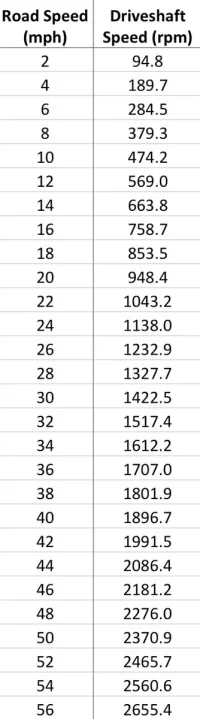
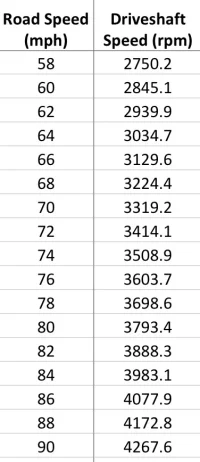
101.5”/12 = 8.458’

5280’/8.458’ = 624.26 rotations/mile

need to know your gears to figure out driveshaft revolutions

4.56 from his profile.
7B2945D5-6089-4A01-9706-BB39A0DA82DC.webp 348CF823-AA6C-4898-BE41-190A9AD1FEA1.webp
 
  • Like
Reactions: Apparition
There is a MUCH simpler way to find out the driveshaft RPMs at any given speed. What RPM would you be doing in your 1:1 gear at that speed?

For automatic drivers, what speed is your engine doing in 3rd gear with the torque converter locked? That is exactly your driveshaft RPM at that speed.

For manual owners it's either your 4th gear (5 speed) or your 5th gear (6 speed)
 
There is a MUCH simpler way to find out the driveshaft RPMs at any given speed. What RPM would you be doing in your 1:1 gear at that speed?

For automatic drivers, what speed is your engine doing in 3rd gear with the torque converter locked? That is exactly your driveshaft RPM at that speed.

For manual owners it's either your 4th gear (5 speed) or your 5th gear (6 speed)
That was pretty simple math especially if you assume 60mph as the speed. A mile/minute equates to rpm fairly well.
 
While I agree the 550 RPM seems way to low to properly balance a shaft that typically sees RPMs above 3,000 the other half of my brain tells me that if it is PERFECTLY balanced at any speed it should be balanced at all speeds.
Except for the fact that a shaft can be pretty out of balance and not even reveal itself until 67 or so... ...

So that tells you that it would give you a good reading up to 55 or 60...

Either it's perfectly balanced or it isn't.... the speed it has to be turned is irrelevant... If it's not perfectly balanced the more out of balance it is the lower speed is going to show up.

They are trying to say if it doesn't fire break at 550 that's going to cover most situations... But not necessarily true , especially with a double carbon unit. Our current experience proves this.

All the speed tells you is how bad the shaft is out of balance or what deficiency the double cardan has or a combination of both.
 
Except for the fact that a shaft can be pretty out of balance and not even reveal itself until 67 or so... ...

So that tells you that it would give you a good reading up to 55 or 60...

Either it's perfectly balanced or it isn't.... the speed it has to be turned is irrelevant... If it's not perfectly balanced the more out of balance it is the lower speed is going to show up.

They are trying to say if it doesn't fire break at 550 that's going to cover most situations... But not necessarily true , especially with a double carbon unit. Our current experience proves this.

All the speed tells you is how bad the shaft is out of balance or what deficiency the double cardan has or a combination of both.
I’m not disagreeing with the other opinion here, just relating what the driveshaft guy told me.
How about another balance scenario in the mix, do you think it’s possible to have a driveshaft balanced at say, 3,500 RPM but vibrate at a much lower RPM? Basically is it possible to have a situation opposite of yours?
 
I’m not disagreeing with the other opinion here, just relating what the driveshaft guy told me.
How about another balance scenario in the mix, do you think it’s possible to have a driveshaft balanced at say, 3,500 RPM but vibrate at a much lower RPM? Basically is it possible to have a situation opposite of yours?
I think a double cardan could sort of Center itself at speed if it's not finding an out of balance shaft... And although I'm not sure the answer to your good question.... What does confuse me is how they know which end to balance or could have been more or less out at either end and so forth.
 
I’m not disagreeing with the other opinion here, just relating what the driveshaft guy told me.
How about another balance scenario in the mix, do you think it’s possible to have a driveshaft balanced at say, 3,500 RPM but vibrate at a much lower RPM? Basically is it possible to have a situation opposite of yours?
It could be that the out of balance is good enough at lower speeds and considered negligible but at some point harmonics may exacerbate the problem.
 
Here's a twist, how come I get a harmonic starting at 50 mph, then at 60 mph it goes away, then comes back stronger at 63mph?
 
Something cancels it out in that range?

That is my thought process at this juncture. The hard top is like a tuning fork. I'm convinced. I wouldn't hear 80% of what I'm hearing with the added noise of a soft top, or no top. If I can't feel it in the seat, ignorance is bliss!
 
We talked about this resonance frequency theory in previous threads, and there is something to it. Simply changing the thickness of the t-case skid made a change. Here is where I'm at to date. 3" SL. 1" MML, 0.5" BL. Barnes 1/4" skid that raises the belly 1" from factory. So, the drive shafts considers this a 4" lift based on angles, until I put the 1" MML in. Now, it considers it a 3" lift. I lowered the t-case skid 5/16" with washers. No change, I re-adjusted the rear pinion angle (as lowering the skid changes things) to where the pinion is 0.5* lower than the DS. No change. Keeping in mind that before I changed the pinion angle after the washer lowering, the pinion angle was 1.5* higher than the DS. I've played this game several times, ranging from 3* higher to 5* lower, in increments, so I'm stumped.
 
There is a lot of talk and advice about aligning driveshafts vs pinions but Ive never seen mention of the axle pinion generally being offset to one side or the other vs the transfer case. Would there be any magic in making the horizontal and vertical angles match?
 
I’ve always had varying degrees of harshness in my drivetrain since lifting. I’ve tried a lot of adjusting, new shafts and a SYE but I’ve never completely eliminated the harshness. I felt the MML made it a little worse due to the increased difference in the angle of the transfer case and the front driveshaft.
I tried pulling the axles so that the pinions are as close as possible to being in line with the transfer case but the control arms didn’t like it and it really didn’t help with my harshness.
I have a three speed auto, 4.11, and 35’s. The harshness that manifests at 65+ makes me reluctant to go with lower or gears or smaller tires. In my case it may have to due with a high mile transfer case or my rebuilt engine. Has anyone noticed any difference after rebuilding the transfer case?
 
I had new vibes after my regear as well. At the time of the regear, I had no vibes, a MML, and a short (about 5/8)" t case drop.

Then afterward, I had vibes starting around 60. Added t-case drop to about 1.25" and got it tolerable but still there. Decided it was finally time for an SYE, and I took the shotgun approach with a JB super short.

While I had the transfer case and front driveshaft out I found the centering ball was loose. So I replaced it, as well as all three u joints.

I just put my new Tom Wood rear shaft in last night and will have my first test drive later today. I may have dumped $1200+ into an SYE because of a $70 centering ball, but if the vibes are gone, I don't even care.
Did this fix your problem?
 
Did this fix your problem?

at the time, yes. Note that what I had was definitely more of a typical driveline vibration, constant in intensity rather than the pulsing in and out that some solve with hubs.
 
Did this fix your problem?
Go through the forum, this topic had extensive discussion over time in different threads, make a list of possible things and start going through it ONE AT A TIME.
For the most part it is a dice rolling game, anyone guess or a solution may or may not be yours.