
Drilling isn't difficult with a regular drill. Just disconnect the swaybar and trackbar, jack up the vehicle by the rear diff, jack stands under the frame, and let the rear drop. You'll have plenty of room to work.

You are using an out of date browser. It may not display this or other websites correctly.
You should upgrade or use an alternative browser.
You should upgrade or use an alternative browser.

Tips for installing rear track bar relocation bracket?
- Thread starter jazngab
- Start date
FJQue
TJ Enthusiast
That's all good info, ty very much!I've done it three ways.
1. On a 2 post lift, during a lift install, with all the control arm bolts loose and sway bar disconnected. The axle drooped far enough to get the fuel tank out of the way and I don't even remember it being a struggle.
2. With the axle out of the Jeep during an axle swap. This was obviously the easiest.
3. On jackstands but otherwise much like scenario 1, though I think the sway bar was still connected. In this case the holes were there because I was just changing from a straight Teraflex bracket to an angled JKS bracket but I still had to get the drill in there because the holes weren't lining up quite perfectly and the top one had to be hogged out a little bit.
I've always had to use a ratchet strap to get the bar lined up with the bracket. And it needs to be a real one with some balls. I broke the last cheap flimsy one I tried to use to do it.
I suggest a ratcheting click type torque wrench when you torque the bar down, if you have stock style rubber bushings that have to be torqued at ride height. Access sucks and the range of motion you'll get with a beam type wrench will have you cussing when you have to pull the socket off and rotate it 90 degrees on the wrench between every turn on the bolt.
If you have a non-adjustable rear track bar and an existing bracket to accommodate the stock bar, is there any advantage to going with an adjustable? The bushings of mine look bad and was curious what the best was to proceed is.
Only advantage of an adjustable is you can center the rear axle at a number of different lift heights.If you have a non-adjustable rear track bar and an existing bracket to accommodate the stock bar, is there any advantage to going with an adjustable? The bushings of mine look bad and was curious what the best was to proceed is.
Got it. I’ll check to be sure my axle is centered. I assume this is left/right centering (if you were facing the car)Only advantage of an adjustable is you can center the rear axle at a number of different lift heights.
Yes, left/right centering. Find a common place of measurement from each side (I use the frame).Got it. I’ll check to be sure my axle is centered. I assume this is left/right centering (if you were facing the car)
Edit: I have a stock rear TB w good bushings if you need one.

Another advantage, or at least as perceived by me, is that a good adjustable rear track bar usually has some sort of flex joint at one end. The non-adjustable track bar that I took off of mine had split polyurethane bushings that didn't flex for crap and made me worry about overstressing my track bar bracket. I didn't necessarily rush to go replace it, but eventually I bought one to keep for the next time I was going to have it disconnected so I could do the whole two birds/one stone thing.
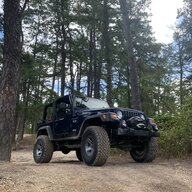
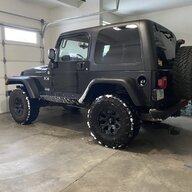
I'm in the process of gathering parts for a tummy tuck - waiting on JB SS SYE kit before I get adjustable track bar and relocation bracket. Will I need to get spacers too?If you don’t rotate your pinion and use the OME bracket you’ll need to use bump stop spacers somewhat larger than the standard 20 mm spacers OME sells. Otherwise the bracket will hit the tub. If you use the angled JKS bracket with a rotated pinion you’ll need to use even larger spacers because the bracket sticks up higher. I am using 1.5 inch spacers but I think it really needs to be 2 inches.

They wouldn’t hurt to have on hand and it’s likely you will need them. However you won’t fully know until you get everything where you want it, pull the springs, and cycle the axle.I'm in the process of gathering parts for a tummy tuck - waiting on JB SS SYE kit before I get adjustable track bar and relocation bracket. Will I need to get spacers too?
 . Thanks.
How about different length bump stops?They wouldn’t hurt to have on hand and it’s likely you will need them. However you won’t fully know until you get everything where you want it, pull the springs, and cycle the axle.
Fabrice509TJ
New Member
Hello, hope everyone is well. I'm new to the jeep Family. My question is do I need to add a trackbar relocation bracket for my TJ?
I have 33" tires, 2 inch coil springs, and shocks, 2-6 inch sway bar link.
Thank you!
I have 33" tires, 2 inch coil springs, and shocks, 2-6 inch sway bar link.
Thank you!
CreepinDeth
TJ Addict
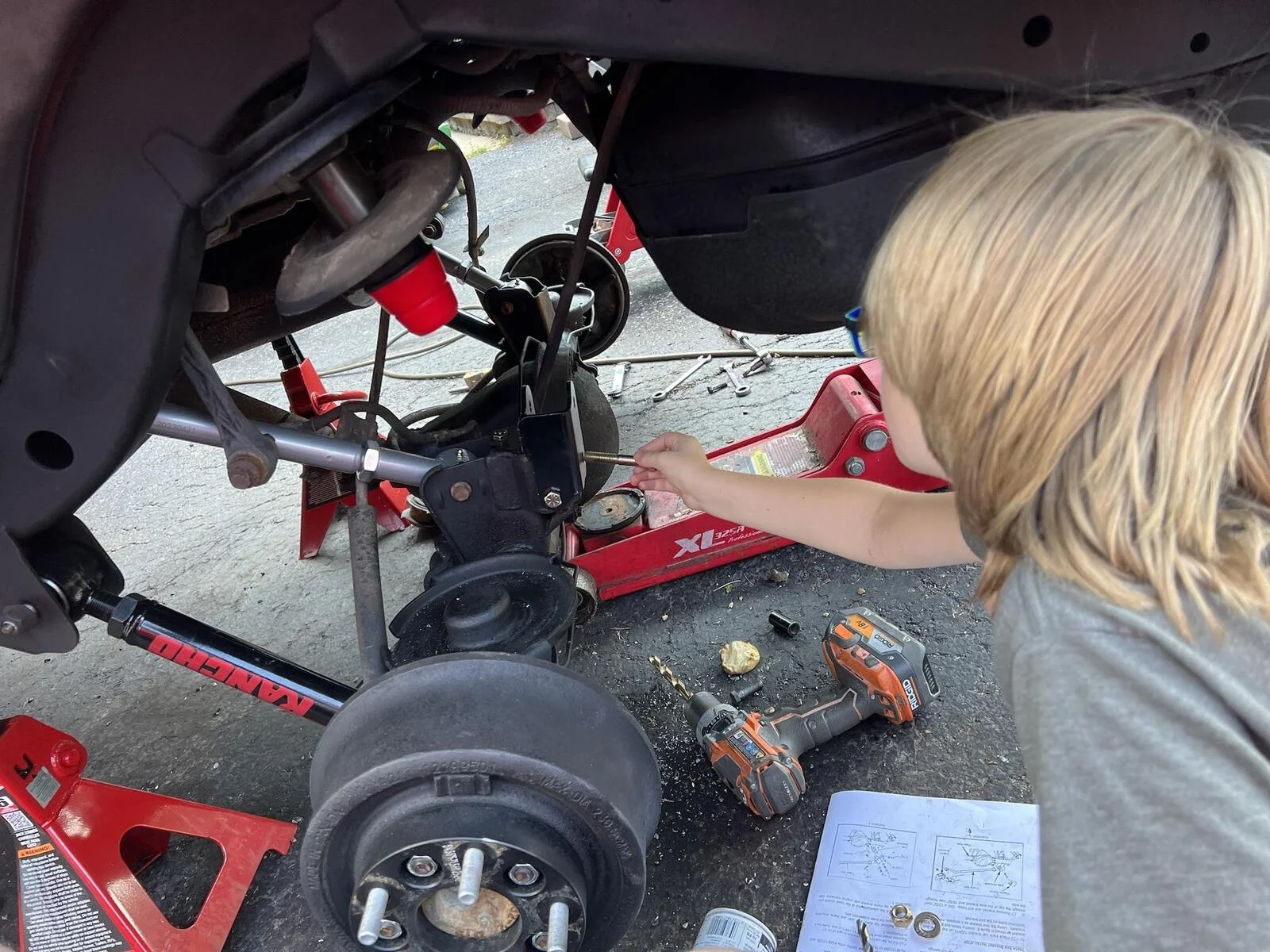
My 2.5” Rancho lift was designed by a team
It came with a trackbar relocation bracket
I installed it
Use the right drill bits, its not hard
I had my axle hangin, springs out, etc
Plenty of room for the drill pictured
Body was held up by two 6ton jack stands
Axle was held up by two 2 ton jack stands (or jack)
You make your own clearances with the stands & jack
Iirc I removed the axle stands and let it droop completely
Lil man was helpin with reassembly
I should have done it when the lower and upper arms were completely off but I didnt realize it til I already began reassembly , but it worked out
It came with a trackbar relocation bracket
I installed it
Use the right drill bits, its not hard
I had my axle hangin, springs out, etc
Plenty of room for the drill pictured
Body was held up by two 6ton jack stands
Axle was held up by two 2 ton jack stands (or jack)
You make your own clearances with the stands & jack
Iirc I removed the axle stands and let it droop completely
Lil man was helpin with reassembly
I should have done it when the lower and upper arms were completely off but I didnt realize it til I already began reassembly , but it worked out
Last edited:
Fabrice509TJ
New Member
My 2.5” Rancho lift was designed by a team
It came with a trackbar relocation bracket
I installed it
Use the right drill bits, its not hard
I had my axle completely detached, springs out, etc
Ah ok, I should probably install it then if it's recommended. To be on the safe side. Thank you!
Fabrice509TJ
New Member

Check to see if your rear axle is centered before using a relo bracket.without reinforcement they can rip the stock bracket off the axle. Lazy approach is to see if your tires stick out of the flares equally. More indepth would be to measure from the outside of the frame to the backing plates on the axleThank you so much!! That's exactly the details I needed.
CreepinDeth
TJ Addict
FWIW , its worth pushing the old track bar bushings out with a 12 or 20 ton press and a 1 1/8” socket. New bushings are only $23. Im a firm believer in doing it all right the 1st time
https://www.amazon.com/gp/aw/d/B003AVSF62?tag=wranglerorg-20
https://www.amazon.com/gp/aw/d/B003AVSF62?tag=wranglerorg-20
Last edited:
Similar threads
- Replies
- 2
- Views
- 640
- Replies
- 2
- Views
- 2,359

- Replies
- 1
- Views
- 783


- Replies
- 11
- Views
- 660


- Replies
- 1
- Views
- 1,033

