Selling roughly 3 million acres of public land to be required by updated budget bill

BlackJeep23

Member
Original poster
Supporting Member
Joined
Jul 3, 2019
Messages
64
Location
Utah
From Outdoor Magazine by Owen Clark
https://www.outsideonline.com/outdo...d-impact-millions-of-acres-in-western-states/

There’s a New Plan to Sell Off Public Lands. It Would Impact Millions of Acres in Western States.
On Tuesday, the U.S. Senate added a mandate to the budget bill to sell enormous swaths of public land managed by the Forest Service and Bureau of Land Management.

The latest stipulation would require the U.S. Forest Service and Bureau of Land Management (BLM) to sell off roughly 3 million acres by 2030.

On Tuesday, June 10, this plan was added to the draft legislation of President Donald Trump’s tax and spending megabill by the Energy and Natural Resources Committee in the U.S. Senate.

This sprawling piece of legislation, called “One Big, Beautiful Bill Act,” passed the House of Representatives in early June, and is currently under debate in the Senate.

Sources told The New York Times that two Republican lawmakers—Mike Lee of Utah and Steve Daines of Montana—worked closely to decide on the plan.

Previous plans to sell off public lands have been met with public outcry. An earlier version of the Big, Beautiful Bill Act included a smaller selloff proposal, suggesting the liquidation of nearly 500,000 acres of public land in Nevada and Utah.

This provision was axed before the bill passed the House of Representatives, after backlash from the House’s Public Lands Caucus, a bipartisan group led by New Mexico Democrat Gabe Vasquez and Montana Republican and former interior secretary Ryan Zinke. Zinke called the measure his “San Juan Hill.” He has previously told Outside: “The idea that you’re going to sell public land to get out of debt is folly.”

This latest—and substantially larger—land sale proposal was announced by Lee, who is the chairman of the Senate Energy and Natural Resources Committee. Specifically, the reconciliation bill’s language dictates that “not less than 0.50 percent and not more than 0.75 percent” of all BLM land be sold to the private sector, as determined by the Secretary of the Interior. Identical language and percentages dictate the sale of National Forest land as determined by the Secretary of Agriculture.
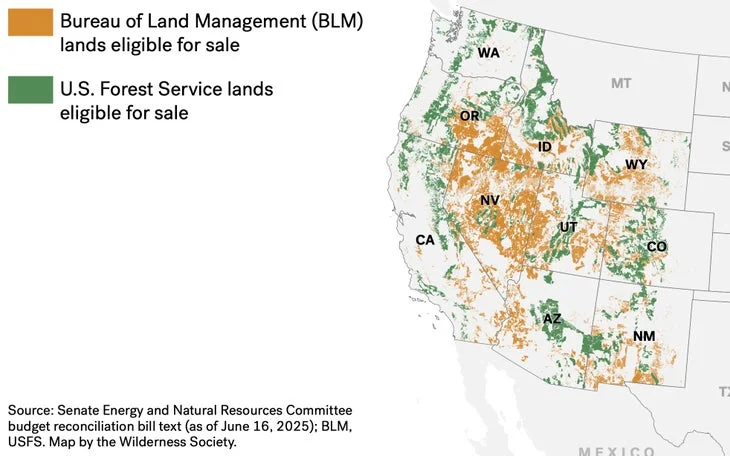
PublicLands1.webp
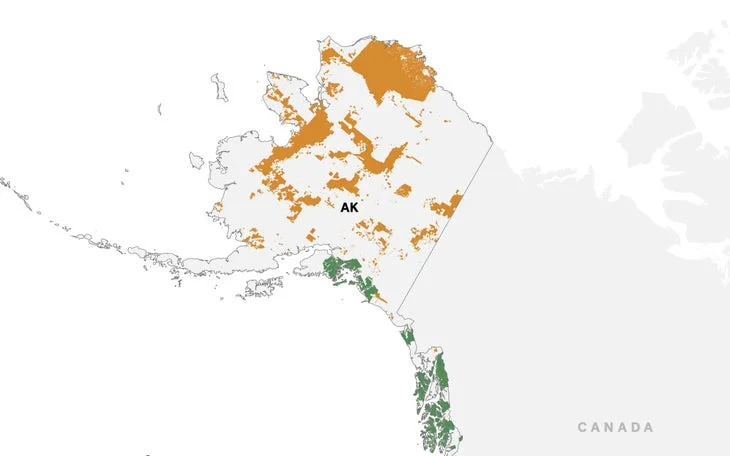
Using data provided to the U.S. Senate, the nonprofit Wilderness Society produced these maps showing public lands that are eligible for sale (Photo: The Wilderness Society )
PublicLands2.webp

The BLM manages 245 million total acres, and the the Forest Service manages 193 million acres. Under the plan’s rules, up to 3.29 million acres of public lands would be placed on the auctioning block.

Lawmakers have said the sale of public lands would raise funds for the federal government and clear land for housing development. The plan would put public lands in 11 states: Alaska, Arizona, California, Colorado, Idaho, Nevada, New Mexico, Oregon, Utah, Washington, and Wyoming.

Zinke’s state, Montana, is the only Western state excluded from this updated proposal.

The reconciliation text states that national parks, national monuments, and designated wilderness areas would be exempt from auction, and land near existing population centers would be prioritized. The bill also mandates that any public land sales must occur solely for “for the development of housing or to address associated community needs,” but it leaves the definition of these “associated community needs” up to the Secretaries concerned.

“Senate Republicans have finally said the quiet part out loud,” said New Mexico Senator Martin Heinrich, the ranking Democrat on the Energy and Natural Resources Committee. “They want to put millions of acres of our public lands up in a fire sale, destroy the investments that have created thousands of manufacturing and clean energy jobs – including in their home states, and obliterate programs that lower energy costs for everyday Americans.”

The plan received immediate criticism from nonprofit groups and organizations that work in conservation and outdoor recreation.

“What some may see as a barren lot on a map on a Senator’s desk may actually be where a community hikes after work, rides their ATV, or teaches their kids how to hunt turkey or ride a bike,” reads a statement from Outdoor Recreation Roundtable, a lobbying group for the outdoor recreation industry. “And once these treasured places are sold to private industry, they are gone forever, and in the case of this proposal, can be used for any purpose after ten years.”

David Willms, associate vice president for public lands at the National Wildlife Federation, called the plan “orders of magnitude worse than what the House proposed last month.”

“Mandating the fire sale of up to two-and-a-half million acres of public land violates more than a century of land stewardship, threatens wildlife and clean water, runs directly against widespread public opinion, and will not begin to solve either the budget crisis or the affordable housing crisis,” he said.
 
I haven't read enough about this yet to decide what to believe. And all I've read up to this point is what Patty Murray is saying and I only trust 10% of what she says. And I question the Democrats who are crying foul about this sale when at the same time these are the people who are trying to close these areas off to motorized recreation. Not sure where to find accurate information and real data about this. I've seen land sales here in WA that benefited everyone in the long run once it was explained as to why.
 
And I question the Democrats who are crying foul about this sale when at the same time these are the people who are trying to close these areas off to motorized recreation.
I see a consistent message there, preservation. Can you say you have never seen the results of a knucklehead ripping up the public lands? That is why they get taken away.

Money is an issue also, the USDA (forest service is part of USDA) isn't staffed or funded enough to manage all that land. They do provide grants for communities to maintain the land, but that has become a more difficult process.

I know nothing about BLM process or funding.

I would like to see those maps overlaid with population centers that need that land for development.

Then the same maps overlaid with available natural resources.

I suspect the latter is move of a motivation than housing development.
How will this affect ranchers who will no longer have access to previously federally owned property that is now privately owned by megabeef or the thistle preservation society?
 
I see a consistent message there, preservation. Can you say you have never seen the results of a knucklehead ripping up the public lands? That is why they get taken away.

Unfortunately I've seen it too many times & have been involved with restoration and building bridges over sensitive areas too.

Money is an issue also, the USDA (forest service is part of USDA) isn't staffed or funded enough to manage all that land. They do provide grants for communities to maintain the land, but that has become a more difficult process.

I'd like to see some DOGE action in the USFS

I know nothing about BLM process or funding.

I don't either

I would like to see those maps overlaid with population centers that need that land for development.

Then the same maps overlaid with available natural resources.

I suspect the latter is move of a motivation than housing development.
How will this affect ranchers who will no longer have access to previously federally owned property that is now privately owned by megabeef or the thistle preservation society?

I would really like to see more of this with both sides interpretation as to what is being done plus the land managers all in one room. I've been to some of the USFS meetings about things like this and it was enlightening to see other sides of the issue.
 
  • Like
Reactions: Weasellee
Elections have consequences.

That doesn't help in the current situation... And I worry when we have an anti-motorized recreation majority too. I don't want to see our public lands sold off since then we'll just end up like back east... But I also don't want to see our public lands closed off to us like what was happening around Moab.
And has been happening here in the PNW for 20+ years.
 
  • Like
Reactions: bbaldwin237
Same here in Arizona. We lost a LOT of miles of existing roads and trails over the last 10 or so years.

From the internet:

One source from 2020 mentioned that over 10,000 miles of roads were facing closure around Arizona.
 
"Federal lands" are being gamed by the Western States. Idaho, for example gets more money to "maintain" their federal lands than they get in taxes. (at least that was true when I lived there).

Where were the people when the government spent us into oblivion? The left somehow believe that the debt isn't an issue. Most on the left just get money in the mailbox so I get that.

If we're going to pay off the debt without raising taxes to 75%, which would collapse the country, they have to monetize US assets. For instance 6.6% of the US has at least 1M in total net worth. 5.8% have between 1 and 2 M in net worth. So... most of the millionaires are between 1 and 2 million in net worth. We are running $1.5 T to $2T in deficit spending each year. Add to that the $1T in interest on the debt. Each trillion is 1 million million. The roughly 19 million people having between 1 and 2 million could all be "taxed" to zero and it would satisfy roughly 63.33% of that 3 Trillion.

Federal land sales is a great way to avoid the inevitable. Our gold reserves are on the Treasury's books at $4.50 or so an OZ. Pegging those to today's value would be a massive help as well. Some are looking to leverage gold to $6K an OZ and make an even bigger dent in the debt.

There's a choice coming... resolve the debt or collapse the entire worlds economy. It's not a matter of if, but when if we keep living in the fantasy world of "just tax the rich". Anyone with a calculator and an understanding of what we call wealth would know that you can't tax or even confiscate your way out of it.

We're each (those who actually pay taxes) roughly 800K in debt TODAY... we will be roughly $2K a month more in debt as interest builds on the debt. We cannot tax our way out of this... we have to liquidate the assets and land is one of the biggest ones we have.
 
Last edited:
"Federal lands" are being gamed by the Western States. Idaho, for example gets more money to "maintain" their federal lands than they get in taxes.

Where were the people when the government spent us into oblivion. The left somehow believe that the debt isn't an issue. Most on the left just get money in the mailbox so I get that.

If we're going to pay off the debt without raising taxes to 75% they have to monetize US assets. Federal land sales is a great way to do that. Our gold reserves are on the Treasury's books at $4.50 or so an OZ. Pegging those to today's value would be a massive help as well.

There's a choice coming... resolve the debt or collapse the entire worlds economy. It's not a matter of if, but when if we keep living in the fantasy world of "just tax the rich". Anyone with a calculator and an understanding of what we call wealth would know that you can't tax or even confiscate your way out of it.

We're each (those who actually pay taxes) roughly 800K in debt TODAY... we will be roughly $2K a month more in debt as interest builds on the debt. We cannot tax our way out of this... we have to liquidate the assets and land is one of the biggest ones we have.

I don't want to agree with you.... And I remember when Regan was in office we were working towards a balanced budget or at least that is what was being sold to us..... And I get that WARS cost but I think we need to figure out a way to offset some of that..

And I'm not educated enough to weigh in with anything worth a tinkle damn.
 
I don't want to agree with you.... And I remember when Regan was in office we were working towards a balanced budget or at least that is what was being sold to us..... And I get that WARS cost but I think we need to figure out a way to offset some of that..

And I'm not educated enough to weigh in with anything worth a tinkle damn.

I don't want to agree with me either.... a Trillion is one million million. Our debt is roughly 38 T and it's being financed at roughly 3.1%. The debt is government bonds and we've had such low rates that the aggregate rate is roughly 3.1%. We're not paying it off so the bonds that were issued 10 years ago have to be replaced with new 10 year or longer bonds. Today the rates are around 5%... so not only are we not paying the debt off we're going to be financing it at 40% higher rates.

We have land and resources on that land. At some point you have to pay the debt.
 
  • Face Palm
Reactions: Weasellee
I've been watching this...

Mandatory sales of BLM and Forest Land. From the sale, 5% to state, 5% to backlog maintenance on federal lands, rest goes to the general fund of the US treasury to balance the budget gap. Lets sell all our assets to help pay for our budget deficit. All in the name of affordable housing🖕

https://www.energy.senate.gov/services/files/F45D5D1E-65F5-4631-8C8F-E8C67E0DBCBD

What's sad/scary is that if we did this and paid down the deficit would it really HELP? If we all of a sudden didn't have a deficit how long before we've dug ourselves back into a position where we have a deficit?
 
  • Like
Reactions: lBasket
What's sad/scary is that if we did this and paid down the deficit would it really HELP? If we all of a sudden didn't have a deficit how long before we've dug ourselves back into a position where we have a deficit?

I don't foresee the congressional tards paying anything down.
 

BlueRibbon’s Stance On Senator Mike Lee’s Public Land Proposal

2beb1d35-9c02-ca97-2857-9d0148b4f352.jpg
Senator Mike Lee has introduced a bill requiring the Bureau of Land Management and U.S. Forest Service to identify and sell between 0.5% to 0.75% (estimated 2 - 3 million) acres of federal land over the next five years. The intent is to make more land available for housing — a pressing issue in many rural Western communities.
Many of our members have asked where BlueRibbon Coalition stands. Our answer is grounded in the same principle that guides all our advocacy: defending public access to public land.

We have consistently opposed large-scale policies that convert public land into exclusive-use zones with no meaningful protections for recreation access — whether through private conservation leases, sweeping monument designations, speculative financial instruments, or rushed energy developments. In every case, our position has been based on one question: Does this protect or restrict recreation access? There is a risk that requiring the mass disposal of ~2 million acres of public lands could affect lands with recreation value and restrict recreation access.

We have also consistently supported small-scale land transfers, exchanges, sales, and disposals that convert lands with little — if any — recreation value to other uses. The Lee proposal is modeled after a law introduced and passed by Democratic lawmakers called the Southern Nevada Public Land Management Act (SNPLMA), which made 2.3% of the 3 million acres managed by the Southern Nevada District Office of the Bureau of Land Management available to sell specifically for housing. We have monitored the land sales proposed through this act, and they have been overwhelmingly uncontroversial and have not resulted in impacts to recreation access.

Because the risk to recreation access is high with this proposal, we’ve been analyzing the language in this bill and speaking with our members, officials in rural western communities where housing is a top priority, and policy experts. Other organizations have used this time to push a misleading narrative. Many of the maps and articles being shared about this proposal fail to recognize the protections written into this bill that would prevent the vast majority of lands with recreation value from being considered. The proposal excludes all federal land with a designation (like national parks, national monuments, national recreation areas, wilderness, etc.). It excludes lands with valid existing rights which will protect grazing leases and mining claims. It requires prioritizing lands next to already developed areas or orphaned parcels. The consultation requirements and right of first refusal for local governments is a strong guardrail that is often left out of other mass disposal policies. Most importantly to BRC and its members, the proposal excludes lands with an existing right-of-way, which protects many of our backcountry roads and trails. It is also clear that if this proposal becomes law, the policy will move forward with extensive public input, and the maps of what land is actually available for sale will be determined through a public process.

This proposal clearly defines recreation protections to safeguard access more than any other mass disposal policy we have seen. Yet, we are committed to protecting every inch of valuable recreation access to our public lands. Many have expressed concerns that the scope of the proposal is too large, the timeline for disposal is too rushed, the hard acreage requirement for sale is too rigid, and it isn’t clear which lands will ultimately be affected until the agencies identify which lands are available to sell. We are communicating these concerns to Senator Lee’s office, and we have let them know that these concerns must be addressed for BRC to support this proposal.

We are sensitive to the concerns of our members and supporters who are trying to raise families and build businesses in small western towns where housing availability is limited and community growth and development is severely curtailed by restrictive land policies. These are the same communities that provide basic and essential services to the millions of Americans who venture into our public lands. While it is not part of BRC’s core mission to develop and promote community development programs, our recreation experiences on public lands benefit from having strong communities located in the midst of our vast swaths of public lands.

We’ve been vigilantly watching this proposal since it was introduced, and will continue to do so, along with all proposals that will impact access to the public lands we all love and enjoy.

We worked closely with UPLA to do our due diligence on this proposal, and they have shared additional information that we encourage you to review if you want to learn more.


https://mailchi.mp/blueribboncoalition.org/weekly-newsletter-issue-10229175?e=7cc79dd8a3
 
  • Love
Reactions: Weasellee

BlueRibbon’s Stance On Senator Mike Lee’s Public Land Proposal

View attachment 624840
Senator Mike Lee has introduced a bill requiring the Bureau of Land Management and U.S. Forest Service to identify and sell between 0.5% to 0.75% (estimated 2 - 3 million) acres of federal land over the next five years. The intent is to make more land available for housing — a pressing issue in many rural Western communities.
Many of our members have asked where BlueRibbon Coalition stands. Our answer is grounded in the same principle that guides all our advocacy: defending public access to public land.

We have consistently opposed large-scale policies that convert public land into exclusive-use zones with no meaningful protections for recreation access — whether through private conservation leases, sweeping monument designations, speculative financial instruments, or rushed energy developments. In every case, our position has been based on one question: Does this protect or restrict recreation access? There is a risk that requiring the mass disposal of ~2 million acres of public lands could affect lands with recreation value and restrict recreation access.

We have also consistently supported small-scale land transfers, exchanges, sales, and disposals that convert lands with little — if any — recreation value to other uses. The Lee proposal is modeled after a law introduced and passed by Democratic lawmakers called the Southern Nevada Public Land Management Act (SNPLMA), which made 2.3% of the 3 million acres managed by the Southern Nevada District Office of the Bureau of Land Management available to sell specifically for housing. We have monitored the land sales proposed through this act, and they have been overwhelmingly uncontroversial and have not resulted in impacts to recreation access.

Because the risk to recreation access is high with this proposal, we’ve been analyzing the language in this bill and speaking with our members, officials in rural western communities where housing is a top priority, and policy experts. Other organizations have used this time to push a misleading narrative. Many of the maps and articles being shared about this proposal fail to recognize the protections written into this bill that would prevent the vast majority of lands with recreation value from being considered. The proposal excludes all federal land with a designation (like national parks, national monuments, national recreation areas, wilderness, etc.). It excludes lands with valid existing rights which will protect grazing leases and mining claims. It requires prioritizing lands next to already developed areas or orphaned parcels. The consultation requirements and right of first refusal for local governments is a strong guardrail that is often left out of other mass disposal policies. Most importantly to BRC and its members, the proposal excludes lands with an existing right-of-way, which protects many of our backcountry roads and trails. It is also clear that if this proposal becomes law, the policy will move forward with extensive public input, and the maps of what land is actually available for sale will be determined through a public process.

This proposal clearly defines recreation protections to safeguard access more than any other mass disposal policy we have seen. Yet, we are committed to protecting every inch of valuable recreation access to our public lands. Many have expressed concerns that the scope of the proposal is too large, the timeline for disposal is too rushed, the hard acreage requirement for sale is too rigid, and it isn’t clear which lands will ultimately be affected until the agencies identify which lands are available to sell. We are communicating these concerns to Senator Lee’s office, and we have let them know that these concerns must be addressed for BRC to support this proposal.

We are sensitive to the concerns of our members and supporters who are trying to raise families and build businesses in small western towns where housing availability is limited and community growth and development is severely curtailed by restrictive land policies. These are the same communities that provide basic and essential services to the millions of Americans who venture into our public lands. While it is not part of BRC’s core mission to develop and promote community development programs, our recreation experiences on public lands benefit from having strong communities located in the midst of our vast swaths of public lands.

We’ve been vigilantly watching this proposal since it was introduced, and will continue to do so, along with all proposals that will impact access to the public lands we all love and enjoy.

We worked closely with UPLA to do our due diligence on this proposal, and they have shared additional information that we encourage you to review if you want to learn more.


https://mailchi.mp/blueribboncoalition.org/weekly-newsletter-issue-10229175?e=7cc79dd8a3

I was just gunna link this too.

https://utahpla.com/understanding-t...il&utm_term=0_b494e6363a-3bda47079a-372725905
 
We’ll, we can’t keep living like irresponsible people who spend more money than they have and then cry when they can’t have their new Denali because the debt is called in.

The government is #1 offender. How do you bring the spending down, pay off the debt, and avoid a global economic meltdown?
 
  • Like
Reactions: Tob

Here's the important part

Final Conclusion

If you’ve read this far, you should be able to see that although this is a relatively short bill, it involves complex issues. One of President Trump’s campaign pledges was to improve home affordability, including opening federal lands, and Senator Lee has promulgated this Amendment as one way to deliver on this pledge.

After review, I believe the Amendment is crafted well enough to provide safeguards for OHV recreation and should not have any serious impacts on OHV or other forms of recreation, but that is just my opinion, and it will largely depend on our efforts to stay on top of NEPA actions as lands are nominated.

UPLA will make formal recommendations to make the bill better, but UPLA will not be taking a position on whether it is good or bad. In coming to your decision, I ask that you carefully consider the sources and veracity of information you use, not the frequency you see memes on social media. Whether you support or oppose this bill is less of an OHV decision, I believe it is more personal about your belief in the intent of the bill and your confidence that it will be well executed.

Thank you for your continued support. I would love to hear your opinions, please send me an email to [email protected]

Loren Campbell
President
Utah Public Lands Alliance
 
Here's the important part

Final Conclusion

If you’ve read this far, you should be able to see that although this is a relatively short bill, it involves complex issues. One of President Trump’s campaign pledges was to improve home affordability, including opening federal lands, and Senator Lee has promulgated this Amendment as one way to deliver on this pledge.

After review, I believe the Amendment is crafted well enough to provide safeguards for OHV recreation and should not have any serious impacts on OHV or other forms of recreation, but that is just my opinion, and it will largely depend on our efforts to stay on top of NEPA actions as lands are nominated.

UPLA will make formal recommendations to make the bill better, but UPLA will not be taking a position on whether it is good or bad. In coming to your decision, I ask that you carefully consider the sources and veracity of information you use, not the frequency you see memes on social media. Whether you support or oppose this bill is less of an OHV decision, I believe it is more personal about your belief in the intent of the bill and your confidence that it will be well executed.

Thank you for your continued support. I would love to hear your opinions, please send me an email to [email protected]

Loren Campbell
President
Utah Public Lands Alliance

Just a heads up, the BlueRibbon Coalitions Executive Director is Benjamin Burr who served as Mike Lee's Director of Digital Media then as a "political consultant" before stepping into the Executive Director role for the BlueRibbon Coalition. This is the same Mike Lee behind this addition to the budget bill who has been fighting to sell public federal lands for at least the last 14 years.
 
Last edited: