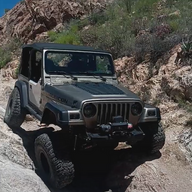
Novak Conversions Jeep Wrangler TJ radiator

Cold Air Intake FAQ

Thanks everyone for the advice above; this forum is great for gathering real world knowledge and information before making a modification commitment on our TJs.

From the discussions above I have come to a decision to implement a snorkel unit which will use the OEM air box and its filter. This will IMHO be the best path for me to hopefully solve my heat related issue (detailed below). I would use a top cap pre filter in combination with the OEM filter provided it meets the 315CFM performance.


My jeep;
2005 TJ, 4.0l, 6 speed manual tranny, Dana 35s, 3.11 gears, 265/75/R17 cooper At tires, 4” lift, heavy duty suspension and steering components

156K miles; runs perfect except as noted below.

My case is to minimize the extreme intake air temps I experience on daily work drives (34 mile each way, 4 lane) and trail rides (SE Alabama summer temps >95d with under the hood temps >165d). Gotta love those dual mini cats!

So my issue is that the Jeep just shuts off without any symptoms and no DTCs. Talk about a spincter tightening moment; 70MPH on a lifted Jeep in close highway traffic with no power brakes or steering!

In garage testing If I let it idle in the summer it starts a slight roughness (no misfires) followed shortly with cut off when under the hood temps > 160F. Again no DtCs.

have a Launchpro scanner to read / reset trouble codes; when the engine shuts off (I call it the “bonk”) there are no fault codes registered. This leads me to believe that it is an ESD from the PCM due to either an extreme CMP / CK timing error or multiple sensors going off the rails due to the extreme heat from the mini cats. When the PCM sends the ASD command I believe there isn’t enough time for it to record the event in the fault register as the entire DC power bus is removed.

I have replaced the ASD relay and confirmed its wiring harness. I have new OEM sensors installed and have confirmed all harnesses and grounds.

Mod done:

I have installed the heat kit on the fuel rail, injectors, and replaced the OEM intake manifold heat shield, thermal wrapped the fuel lines from the fuel rail all the way under the Jeep to near the txfr case. I have thermal wrapped using Volcano heat wrap the exhaust manifolds, mini cats, and cross over pipes to the lower cat flange.

I have wrapped the air box intake tube with thermal wrap (the IAT sensor is mounted on the air tube).

I installed dual air temperature sensors under the hood to measure real time temperatures of the air column near the mini cats and the rear engine compartment at the firewall.

As a test, a couple years back I cut away the PCM’ 5VDC source at the Cam Shaft sensor and replaced it with a precision in line 5VDC regulator (always hot) to eliminate the possibility of an intermittent 5V from the harness (shared with the speed sensor); bonks still happened.

Btw I have lots of thermal data log using thermal laser guns and static temp sensors if want to review it. All key under the hood temps before, during, after bonks for each thermal mods installed.

I solved the vapor lock problem, irratic EVAP dump, and rough idling issues associated with heat build up. Let me know if anyone wants to see my solutions.


Adding the snorkel mod is just another attempt to determine if the AIT is a major or a minor cause of the bonks; likely it might not have any affect on the issue but if I don’t try I’ll never know. If not affectation benefit I can always reverse the mod.

Any input to my snorkel mod would be helpful especially regarding filtration.


Thanks

A snorkel won't do anything to address whatever sensor problem your Jeep has.
 
A snorkel won't do anything to address whatever sensor problem your Jeep has.

It’s not a sensor issue (as in a bad or intermittent sensor) as the jeep runs perfectly 90% of the year. It’s only when operating in the peak summer temps that bonks occur. So it is a heat related response of 1 or more sensors either lying to the PCM and the PCM does not have a control output for the readings so it shuts the engine off.

My thinking is to provide a better environment for the AIT sensor (reports true ambient air temps and not under the hood temps to the PcM) and the engine with cooler denser air to operate on. The difference can be is 70F between ambient and under the hood temps in peak summer driving.

BTW can anyone point me to the PCM’s closed loop controls which explains how the sensor inputs are used to make real time adjustments to the timing and fuel mixture? I have the full service manual for the jeep but doesn’t include anything but basic information on open loop and closed loop controls. What I am looking for the the max reporting values used by the PCM’s closed loop matrix to derive its closed loop responses.

Also, if you believe I am on the wrong track to TS or correcting the heat bonk issue please provide some guidance or directions on what might be the real issues and their solutions.

Many thanks.
 
It’s not a sensor issue (as in a bad or intermittent sensor) as the jeep runs perfectly 90% of the year. It’s only when operating in the peak summer temps that bonks occur. So it is a heat related response of 1 or more sensors either lying to the PCM and the PCM does not have a control output for the readings so it shuts the engine off.

My thinking is to provide a better environment for the AIT sensor (reports true ambient air temps and not under the hood temps to the PcM) and the engine with cooler denser air to operate on. The difference can be is 70F between ambient and under the hood temps in peak summer driving.

BTW can anyone point me to the PCM’s closed loop controls which explains how the sensor inputs are used to make real time adjustments to the timing and fuel mixture? I have the full service manual for the jeep but doesn’t include anything but basic information on open loop and closed loop controls. What I am looking for the the max reporting values used by the PCM’s closed loop matrix to derive its closed loop responses.

Also, if you believe I am on the wrong track to TS or correcting the heat bonk issue please provide some guidance or directions on what might be the real issues and their solutions.

Many thanks.

A snorkel will do nothing to address whatever overheating problem your Jeep has.
 
  • Like
Reactions: Zorba
Thanks everyone for the advice above; this forum is great for gathering real world knowledge and information before making a modification commitment on our TJs.

From the discussions above I have come to a decision to implement a snorkel unit which will use the OEM air box and its filter. This will IMHO be the best path for me to hopefully solve my heat related issue (detailed below). I would use a top cap pre filter in combination with the OEM filter provided it meets the 315CFM performance.


My jeep;
2005 TJ, 4.0l, 6 speed manual tranny, Dana 35s, 3.11 gears, 265/75/R17 cooper At tires, 4” lift, heavy duty suspension and steering components

156K miles; runs perfect except as noted below.

My case is to minimize the extreme intake air temps I experience on daily work drives (34 mile each way, 4 lane) and trail rides (SE Alabama summer temps >95d with under the hood temps >165d). Gotta love those dual mini cats!

So my issue is that the Jeep just shuts off without any symptoms and no DTCs. Talk about a spincter tightening moment; 70MPH on a lifted Jeep in close highway traffic with no power brakes or steering!

In garage testing If I let it idle in the summer it starts a slight roughness (no misfires) followed shortly with cut off when under the hood temps > 160F. Again no DtCs.

have a Launchpro scanner to read / reset trouble codes; when the engine shuts off (I call it the “bonk”) there are no fault codes registered. This leads me to believe that it is an ESD from the PCM due to either an extreme CMP / CK timing error or multiple sensors going off the rails due to the extreme heat from the mini cats. When the PCM sends the ASD command I believe there isn’t enough time for it to record the event in the fault register as the entire DC power bus is removed.

I have replaced the ASD relay and confirmed its wiring harness. I have new OEM sensors installed and have confirmed all harnesses and grounds.

Mod done:

I have installed the heat kit on the fuel rail, injectors, and replaced the OEM intake manifold heat shield, thermal wrapped the fuel lines from the fuel rail all the way under the Jeep to near the txfr case. I have thermal wrapped using Volcano heat wrap the exhaust manifolds, mini cats, and cross over pipes to the lower cat flange.

I have wrapped the air box intake tube with thermal wrap (the IAT sensor is mounted on the air tube).

I installed dual air temperature sensors under the hood to measure real time temperatures of the air column near the mini cats and the rear engine compartment at the firewall.

As a test, a couple years back I cut away the PCM’ 5VDC source at the Cam Shaft sensor and replaced it with a precision in line 5VDC regulator (always hot) to eliminate the possibility of an intermittent 5V from the harness (shared with the speed sensor); bonks still happened.

Btw I have lots of thermal data log using thermal laser guns and static temp sensors if want to review it. All key under the hood temps before, during, after bonks for each thermal mods installed.

I solved the vapor lock problem, irratic EVAP dump, and rough idling issues associated with heat build up. Let me know if anyone wants to see my solutions.


Adding the snorkel mod is just another attempt to determine if the AIT is a major or a minor cause of the bonks; likely it might not have any affect on the issue but if I don’t try I’ll never know. If not affectation benefit I can always reverse the mod.

Any input to my snorkel mod would be helpful especially regarding filtration.


Thanks

I’d consider having Mark @Wranglerfix at least test your PCM. Maybe install one from him before summer and see what happens.
 
  • Like
Reactions: Wranglerfix
Novak Conversions Jeep Wrangler TJ radiator