


What is normal vacuum pressure?

DominicWilbrink

Member
Original poster
Joined
Feb 14, 2018
Messages
61
Location
Lansing, MI, USA
I have a 2001 Jeep Wrangler with a 4.0L. Does anyone know what normal Vacuum Pressure should be?

I am asking because I have a P0455 code (evap system gross leak) and I have ruled out the gas cap. My OBDii app can show me the Vacuum Pressure in real time but I have no idea what "normal" should be. Need a little help. The reading I am getting right now are -2.5 to -22.5 in/Hg while I am getting an active P0455 code.
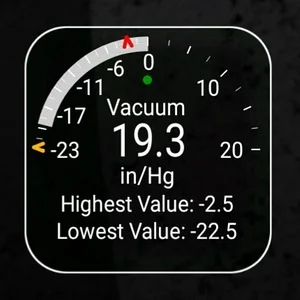
20180829_084445-S.webp
 
I have a 2001 Jeep Wrangler with a 4.0L. Does anyone know what normal Vacuum Pressure should be? First, it is only vacuum only. Inches of manifold vacuum varies in relation to throddle plate opening. At idle, the piston going down with the exhaust valve closed creates a suction and that is measured in inches of vacuum. That will be some of your highest readings, generally 15-19" . With the throttle plate wide open, it is easy for the motor to suck air, and you will have 0" of vacuum . When you are driving down the road, and giving it various amounts of gas, the vacuum reading will vary constantly with your throddle. So there isn't a certain number to be looking for. That is the basics of it.

I am asking because I have a P0455 code (evap system gross leak) and I have ruled out the gas cap. My OBDii app can show me the Vacuum Pressure in real time but I have no idea what "normal" should be. Need a little help. The reading I am getting right now are -2.5 to -22.5 in/Hg while I am getting an active P0455 code.

View attachment 53379
 
I found this info on www.xjtalk.com ; its for a 4.0L but I'm not sure that an XJ motor specs apply to a TJ... Any one know if these apply to a TJ:

Idle: 17~21
Deceleration: 25
Hard Acceleration: 3~5

My vacuum readings are currently close, but just a little under these specs.
 
According to the 2001 Wrangler FSM, 10" is normal at idle rpms.

VACUUM SUPPLY TEST
(1) Disconnect vacuum hose at speed control servo
and install a vacuum gauge into the disconnected
hose.
(2) Start engine and observe gauge at idle. Vacuum
gauge should read at least ten inches of mercury.
(3) If vacuum is less than ten inches of mercury,
determine source of leak. Check vacuum line to
engine for leaks. Also check actual engine intake
manifold vacuum. If manifold vacuum does not meet
this requirement, check for poor engine performance
and repair as necessary.
(4) If vacuum line to engine is not leaking, check
for leak at vacuum reservoir. To locate and gain
access to reservoir, refer to Vacuum Reservoir Removal/
Installation in this group. Disconnect vacuum line
at reservoir and connect a hand-operated vacuum
pump to reservoir fitting. Apply vacuum. Reservoir
vacuum should not bleed off. If vacuum is being lost,
replace reservoir.
(5) Verify operation of one-way check valve and
check it for leaks.
(a) Locate one-way check valve. The valve is
located in vacuum line between vacuum reservoir
and engine vacuum source. Disconnect vacuum
hoses (lines) at each end of valve.
(b) Connect a hand-operated vacuum pump to
reservoir end of check valve. Apply vacuum. Vacuum
should not bleed off. If vacuum is being lost,
replace one-way check valve.
(c) Connect a hand-operated vacuum pump to
vacuum source end of check valve. Apply vacuum.
Vacuum should flow through valve. If vacuum is
not flowing, replace one-way check valve. Seal the
fitting at opposite end of valve with a finger and
apply vacuum. If vacuum will not hold, diaphragm
within check valve has ruptured. Replace valve.
 
  • Like
Reactions: KCsTJ
According to the 2001 Wrangler FSM, 10" is normal at idle rpms.

VACUUM SUPPLY TEST
(1) Disconnect vacuum hose at speed control servo
and install a vacuum gauge into the disconnected
hose.
(2) Start engine and observe gauge at idle. Vacuum
gauge should read at least ten inches of mercury.
(3) If vacuum is less than ten inches of mercury,
determine source of leak. Check vacuum line to
engine for leaks. Also check actual engine intake
manifold vacuum. If manifold vacuum does not meet
this requirement, check for poor engine performance
and repair as necessary.
(4) If vacuum line to engine is not leaking, check
for leak at vacuum reservoir. To locate and gain
access to reservoir, refer to Vacuum Reservoir Removal/
Installation in this group. Disconnect vacuum line
at reservoir and connect a hand-operated vacuum
pump to reservoir fitting. Apply vacuum. Reservoir
vacuum should not bleed off. If vacuum is being lost,
replace reservoir.
(5) Verify operation of one-way check valve and
check it for leaks.
(a) Locate one-way check valve. The valve is
located in vacuum line between vacuum reservoir
and engine vacuum source. Disconnect vacuum
hoses (lines) at each end of valve.
(b) Connect a hand-operated vacuum pump to
reservoir end of check valve. Apply vacuum. Vacuum
should not bleed off. If vacuum is being lost,
replace one-way check valve.
(c) Connect a hand-operated vacuum pump to
vacuum source end of check valve. Apply vacuum.
Vacuum should flow through valve. If vacuum is
not flowing, replace one-way check valve. Seal the
fitting at opposite end of valve with a finger and
apply vacuum. If vacuum will not hold, diaphragm
within check valve has ruptured. Replace valve.

10" is considerably lower than my idle vacuum. It's almost like I have the opposite problem I thought I had (a leak). I'll watch the idle pressure a little closer in the next week.
 
It doesn't say 10" is the amount of vacuum that is required, it just says at least 10" is normal. More than that is ok/good.