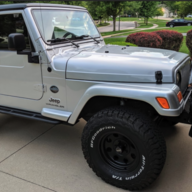
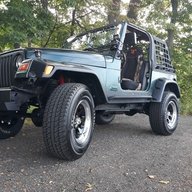
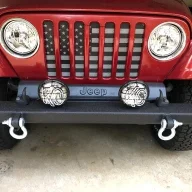
Grille inserts

You can't look at a fan the same way you look at a positive displacement pump. A fan can essentially cavitate or slip with the result of lessened flow. Impeding flow in front of a fan will reduce it's output. Whether or not that is enough to cause overheating is a different issue all together.

Block off the back of a box fan and see how much air it blows out the front. It's going to blow less than if it were unrestricted. Now put a AC filter element behind the fan, it will still flow but the restriction will cause it to move less air out the front. Now remove all restrictions and test again and you'll see optimum flow.

The air speed math only works if you force the same amount of CFM through the smaller opening.

The math was done considering a fan and not a positive displacement pump if that's what you are asking.
 
I've just had curtains cover the back of a fan and I can tell you first hand that they move less air when the intake is reduced. Air speed may increase some in the reduced intake but total volume of flow is less.
Curtains.
Dude, what?

I think post #46 suggests my opinion is the forces here are slightly more than something that curtains would have an effect on.
 
Last edited:
Too many parameters to have a real scientific discussion about this.
  • What type of grille inserts? I've see several different types with different aperture shape, size, and design.
  • Bumper changes redirecting airflow?
  • Lights or winches redirecting airflow?
  • Do any of the above cause the airflow to enter the aftermarket grille slots or holes at an angle that could cause different fluid dynamics, as opposed to if the air was able to come straight in (like stock)?
  • Are you in 120F heat in the desert or in 70F San Diego? Are you putting the engine under heavy load? Only in some rare cases do you ever need the full cooling system capacity. If you aren't at capacity, it really doesn't matter. The thermostat will open more often and take care of the problem.
  • What elevation are you at? Shouldn't matter since it is a pressurized system, at least this is my assumption. However, motors are able to make more power and heat at lower elevations and cooler temps.
  • Is your cooling system all stock and working as expected? Including, are your radiator fins clean or do they have a pound of mud and grass in them?
  • Is the math really the same with all of the different parameters, and if the Jeep is standing still vs. going 10 MPH, 30 MPH, 60 MPH etc.? I'd say not since at speed the air will be forced through in addition to being pulled through by the fan. BUT, usually overheating isn't a problem when you are moving...unless you have a big blockage of some sort. That shouldn't be the case here.
This is way too complicated without a real-word situation to test (Just like Blaine and the pulleys he was demonstrating in the one recent thread). Theoretical and real world are two different things. Being in science and/or computers my whole life, what happens on paper isn't necessary what happens in the real world. We are all humbled at some point along the way.

The box fan blockage examples are silly IMO, this is much different since the blockage is further away from the radiator and still allowing airflow to come around from different directions. This is not a complete "smother" type of blockage we are talking about here.

At the end of the day, are you overheating?
  • If no, then enjoy the inserts!
  • If yes, most of the time, it probably isn't the inserts...unless you have some weird combination of issues that you have created with your Jeep and you are in extreme temps.

My 0.02....discuss.
 
  • Like
Reactions: Oldguy
At the end of the day, are you overheating?
  • If no, then enjoy the inserts!
  • If yes, most of the time, it probably isn't the inserts...unless you have some weird combination of issues that you have created with your Jeep and you are in extreme temps.

My 0.02....discuss.

All I was getting at was that if you block some of the grill you are reducing some portion of the intake of the fan and likely reducing the output of said fan. It may or may not be enough to contribute to overheating (YMMV there are too many other variables in customized rigs). I just think it's silly to say that a fan will pull just as much air with a reduced inlet size as it would with a larger one. Anecdotal evidence points otherwise.
 
I just think it's silly to say that a fan will pull just as much air with a reduced inlet size as it would with a larger one. Anecdotal evidence points otherwise.

The math and evidence says that this is exactly what happens. That's kinda the whole point of this. The math agrees with the observation that reducing the size of the slots doesn't have any impact on the total airflow, just the load on the fan. Read this carefully, really, it's the whole thing in a nutshell.
 
Too many parameters to have a real scientific discussion about this.

Fine if you feel that way. You listed 8 points.
1. If you read the other thread I discussed exactly the reduction I calculated for
2-4. Anything in front of the grill has no effect on how much air can go through the slots if it is the width of the slot away which all the things you mention are
5. the temperature of the air doesn't matter, we are talking about flow
6. the density changes in air are way below the changes we are considering with the blockage
7. we ain't talking about a broke system
8. the fan is altering the pressure differential across the radiator, that's why the air moves. I think I assumed the Jeep was stopped or worse case scenario and it still resulted in an a tiny difference things get better as speed increases so I didn't worry about that

If you don't agree with anything it's no big deal, none of the above was some big scientific leap or guess. It's easy to throw a bunch of stuff out there and throw your hands up but you just have to take each one and look at it. Does this matter?

For example, if I change the ambient temp is it going to change the result? Well it changes the flow requirements so that matters so I guess I need to consider max flow. That's what I did, for basically everything you mentioned, more.
 
All I was getting at was that if you block some of the grill you are reducing some portion of the intake of the fan and likely reducing the output of said fan. It may or may not be enough to contribute to overheating (YMMV there are too many other variables in customized rigs). I just think it's silly to say that a fan will pull just as much air with a reduced inlet size as it would with a larger one. Anecdotal evidence points otherwise.

I understand, but this is the simple viewpoint without taking the time to think it through...it's not a knock on you, most of us started in the same place as well after the question was raised. There is so much more going on and other things to consider.

Fine if you feel that way. You listed 8 points.
1. If you read the other thread I discussed exactly the reduction I calculated for
2-4. Anything in front of the grill has no effect on how much air can go through the slots if it is the width of the slot away which all the things you mention are
5. the temperature of the air doesn't matter, we are talking about flow
6. the density changes in air are way below the changes we are considering with the blockage
7. we ain't talking about a broke system
8. the fan is altering the pressure differential across the radiator, that's why the air moves. I think I assumed the Jeep was stopped or worse case scenario and it still resulted in an a tiny difference things get better as speed increases so I didn't worry about that

If you don't agree with anything it's no big deal, none of the above was some big scientific leap or guess. It's easy to throw a bunch of stuff out there and throw your hands up but you just have to take each one and look at it. Does this matter?

For example, if I change the ambient temp is it going to change the result? Well it changes the flow requirements so that matters so I guess I need to consider max flow. That's what I did, for basically everything you mentioned, more.

Hey, I do agree with most of your reasoning and conclusion, and I respect them. You are making me think. Is that good enough? LOL. I did see your math and conclusions in the other thread. While I get what you are at, and can appreciate what it represents in theory, I don't tend to agree that we can boil all of this down to a simple HS physics problem. Honestly, I don't give a hoot about airflow if my Jeep never overheats. However, if my Jeep was overheating, and it was extremely hot outside, I would probably still remove the inserts as a "test" if I couldn't find anything else wrong. However, if was 70F and my Jeep was overheating, I would go with your theory every time...something else has to be wrong...it's common sense to me at that point. Can we agree to kind of agree? LOL.
 
However, if my Jeep was overheating, and it was extremely hot outside, I would probably still remove the inserts as a "test" if I couldn't find anything else wrong.

Me too.

I think anybody with any real life experience has had somebody tell them something was impossible, try it anyway and succeed.
 
  • Like
Reactions: mots
Grill.webp
 
  • Like
Reactions: Shamu and Oldguy