Eastwood frame paint

I've used quite a bit of the Eastwood stuff. Drill holes behind the skid plate to let it drain correctly. Give it a few days to dry, and tape all the holes. It should take 2-3 cans. Be sure to spray inside the crossmember above the gas tank. Water lays in there too.

I used 2-3 cans per side. I mistakenly used Fluid Film a couple of years later. Mistake IMO, because you can't recoat the Eastwood and have it stick once that greasy crap is inside the frame.
 
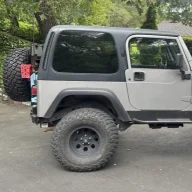
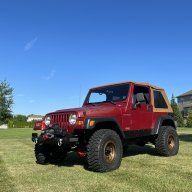
I've used quite a bit of the Eastwood stuff. PA winters. Enough said. The red TJ had a frame swap, and I used the internal frame coating. Get in there and wash it out well. Drill holes behind the skid plate to let it drain correctly. Give it a few days to dry, and tape all the holes. It should take 2-3 cans. Be sure to spray inside the crossmember above the gas tank. Water lays in there too.

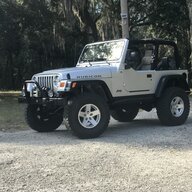
As others have said, prep is the key. I also use Fluid Film on my other vehicles. The LJ will never seen winter again. The red TJ might see some, but it's been frame swapped and coated internally. I had it sandblasted and then coated with 2K Eastwood chassis paint.

Thanks! And the crossmember above the gas tank is not something I've read yet. Thanks for that one too!
 
  • Like
Reactions: dan58
Question comes to mind. I am in California, so do I need to be as worried about getting into the frame rails? I can see the need to drill holes for drainage in case I do get deep in water. Not looking to shortcut, but seems like a lot of you guys know when it turns to winter by the snowy weather and not just a calendar like where I live.
 
Question comes to mind. I am in California, so do I need to be as worried about getting into the frame rails? I can see the need to drill holes for drainage in case I do get deep in water. Not looking to shortcut, but seems like a lot of you guys know when it turns to winter by the snowy weather and not just a calendar like where I live.

I would, and did. I don't live in a salty area, and my Jeep is just a toy, but when I got it I started doing a bunch of catch-up maintenance, which included a deep cleaning top and bottom. When I put the hose in the frame rails I blasted out at least a cup full of dirt/sand/mud from each corner. She had approximately 60K on it at the time and had mostly lived in garages, so that was most likely just road grime that had accumulated.
 
  • Like
Reactions: Korelick
You should also know that the "internal frame coating" is very runny and will find any and all leak points. It sticks to concrete very well, so tape off holes and put down something to catch it.
Naw, just do it on the grass...
810.webp


For the internal coating hose I like to let them hang and relax for a few days before using. I also like to tape the hose to something stiffer like a metal coat hanger when and where I can.
Hit the hose with a heat gun while holding it more or less straight. Once it cools, it will stay that way. I didn't do the coat hanger trick - maybe that would have been more better but I didn't seen to need to...
 
  • Like
Reactions: BlueC
Question comes to mind. I am in California, so do I need to be as worried about getting into the frame rails? I can see the need to drill holes for drainage in case I do get deep in water. Not looking to shortcut, but seems like a lot of you guys know when it turns to winter by the snowy weather and not just a calendar like where I live.

Drill the torque boxes too.

800.webp

801.webp

803.webp

804.webp


This help prevent:

809.webp


The usual bad engineering at Jeep. The wheel liner partially prevents crap from draining out, the added hole will help. The big hole next to it is mostly useless as it has a strengthening lip that prevents good drainage. I added the one in the front as well for similar reasons, water will pool there if the Jeep is nose down at all.

I only did 1/2" holes, a compromise to add some drainage but not compromise the strength of the torque boxes. I then sprayed a can of Eastwood into each side.

Its not a perfect solution, but beats a poke in the eye with a mascara brush at least.
 
I didn't do the coat hanger trick - maybe that would have been more better but I didn't seen to need to...

I like the coat hanger wire (if you have those hanging around) because it allowed me to hold the nozzle more or less center for a more even spray pattern where I could.
 
  • Like
Reactions: Korelick and Zorba
I would, and did. I don't live in a salty area, and my Jeep is just a toy, but when I got it I started doing a bunch of catch-up maintenance, which included a deep cleaning top and bottom. When I put the hose in the frame rails I blasted out at least a cup full of dirt/sand/mud from each corner. She had approximately 60K on it at the time and had mostly lived in garages, so that was most likely just road grime that had accumulated.

Sounds like we are in the same boat with mileage. I am also finding dirt in places you wonder how it got there on the interior. I good to clean her up to get her dirty again though.
 
  • Like
Reactions: BlueC
I like the coat hanger wire (if you have those hanging around) because it allowed me to hold the nozzle more or less center for a more even spray pattern where I could.

Yea, I used the "twist and flop" method with "2 or 3X overkill technique".
 
  • Haha
Reactions: BlueC
I have personal experience with Eastwood paint products, including some of their "rust" paints/coatings. Of the things I have used, I've always had good to great results. Probably a decade ago I used the rust encapslulator product and some "chassis black" on the rusty hitch receiver on my truck. It's starting to show some age and surface rust now, but for spray can products, I'm happy with it. I'd recommend Eastwood stuff.

yeah it’s good , I forgot to mention the wirlygig thing that spins inside the frame and gives 360 coverage is great too. I put a scope in to see and it worked very well.
 
I forgot to mention the wirlygig thing that spins inside the frame and gives 360 coverage is great too

Have they changed/improved the nozzle? They last time I sprayed it was simply a 4-hole nozzle at the end of the tube. Using a stiff wire and holding roughly center worked for me. I've also used the exhaust coating, and I used a sponge to keep that one centered as I pulled it through the tubes.

Exhaust tubing before
1785613620686.webp


After
1785613638217.webp


How I kept it centered.
1785613656419.webp


BTW, that exhaust coating actually keep the exhaust tubes about 10-15 degrees cooler at idle.
 
Didn't know this was a thing. Must research.

I used it 10+ years ago when I put on a new exhaust system. Since that car sits often, I wanted to protect the inside of the pipes, which is what killed the original pipes, corrosion from the inside-out. In hindsight I should just have had the tubes ceramic coated from the factory/seller since that was a $150 option. As for the Eastwood product, it seems to be a durable coating but it did require some time and effort. It does actually reflect some heat, as verified on an uncoated patch piece in my system.

https://www.eastwood.com/eastwood-high-temp-internal-exhaust-coating-with-24in-extension-nozzle.html

For reference, that exhaust system is a 2.5" dual exhaust (manifold-to-tips) with H-pipe on my New Yorker. I used 3-4 cans getting it coated.
 
  • Like
Reactions: chili_pepper
I want to look into your Waxoyl cavity wax, and the Spray Max alike.
I did Eastwood 2K paint on the outside of the frame.

I used KBS Cavity Coater inside the frame after adding a drain to the frame. We aren't a high rust area generally, but this seems like a decent solution for those who are.

After whatever other prep and paint is done.
 
Last edited:
  • Like
Reactions: dan58