

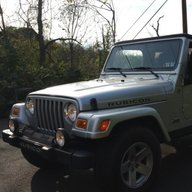
2004 LJ Death Wobble

Are you sure the slop isn't in the trackbar? You might feel it in the drag link when turning because the drag link and the trackbar react against one another.

Check not only the trackbar but also the welds for the mounts to the frame and axle. I've seen a couple posts where people have broken welds.

Check the steering box for excessive play as well. If the backlash setting is incorrect or the box is worn, there could be a lot of slop. Inspect the steering shafts while you're at it.

Play in the ball joints could also possibly lead to a clunk when turning the wheel.
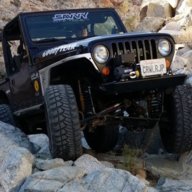
 
Are you sure the slop isn't in the trackbar? You might feel it in the drag link when turning because the drag link and the trackbar react against one another.

Check not only the trackbar but also the welds for the mounts to the frame and axle. I've seen a couple posts where people have broken welds.

Check the steering box for excessive play as well. If the backlash setting is incorrect or the box is worn, there could be a lot of slop. Inspect the steering shafts while you're at it.

Play in the ball joints could also possibly lead to a clunk when turning the wheel.
Good post , most bump activated death wobble is track bar related and you can tell zilch by shaking one by hand , it takes a dry test of the steering so the Jeeps weight is pushing against the bars movement ...and if it has any significant movement , it likely has a problem .

There are 2 ways to look at that ..1/8 of bushing compression is fine for example , because that is full time resistance.. but 1/8 of slop isn't. And at some point a failing bushing goes from providing resistance to being sloppy as it deteriorates.

Basically a track bar only needs controlled movement, anything beyond that and it can allow oscillation of the wheels.

As far as tires , the more aggressive they are , the greater the chances of issues . A tractor tire won't roll as smooth as a car tire . And a mud tire is pretty aggressive. They aren't evil, I have one TJ with them , and one with all terrains . There is no comparison on the road in drive quality , noise and vibes.
 
Are you sure the slop isn't in the trackbar? You might feel it in the drag link when turning because the drag link and the trackbar react against one another.

Check not only the trackbar but also the welds for the mounts to the frame and axle. I've seen a couple posts where people have broken welds.

Check the steering box for excessive play as well. If the backlash setting is incorrect or the box is worn, there could be a lot of slop. Inspect the steering shafts while you're at it.

Play in the ball joints could also possibly lead to a clunk when turning the wheel.


I checked the trackbar; both ends were tight. Trackbar mount on axle and frame appear good and free of cracks.

Aside from feel while driving / steering, what is a good protocol for checking steering box?

Ball joints only have about 4,000 miles; they were new with the ProRock Dana 44.
 
I checked the trackbar; both ends were tight. Trackbar mount on axle and frame appear good and free of cracks.

Aside from feel while driving / steering, what is a good protocol for checking steering box?

Ball joints only have about 4,000 miles; they were new with the ProRock Dana 44.
To perform an official check, you would follow the procedure in the factory service manual for measuring backlash in the gearbox. There is a procedure to correctly measure and adjust it.

More practically, you want to visually check that the backlash in the box isn't excessive. Have someone rock the wheel back and forth a small amount, just barely less than enough to wiggle the tires. If the steering wheel has a significant amount of travel before the pitman arm moves, the gearbox may have excessive backlash. Watch the steering shaft and see how much it turns before the pitman arm moves.

The backlash in the box is adjustable, but it has to be set correctly. If it is set too high, there will be a lot of play and steering will suffer. If backlash is too low, the internal gears will grind and chew themselves up over time. A small amount of backlash is normal and is required for the gears to turn, much like the backlash we so carefully measure when regearing ddifferentials.

The biggest driveability issue you would notice with a worn or incorrectly adjusted steering box is a dead spot in the steering. Imagine driving on the freeway. You adjust slightly left, and then slightly right. There will be a very small zone where you turn the wheel from left to right and nothing happens. If backlash is excessive, this dead spot will become more noticeable.

Excessive backlash typically has one of two causes. (1), the backlash is incorrectly set, or has been messed with. (2), the gearbox is simply worn from use or abuse.
 
  • Like
Reactions: AndyG
I checked the trackbar; both ends were tight. Trackbar mount on axle and frame appear good and free of cracks.

Aside from feel while driving / steering, what is a good protocol for checking steering box?

Ball joints only have about 4,000 miles; they were new with the ProRock Dana 44.
Did you check the track bar by turning the wheels alternate directions and watching for excessive movement such as degraded bushings... A track bar can feel absolutely fine by hand or with a pry bar but that doesn't come close to the amount of force it's under.

In other words you can't tell anything by hand... Also it isn't necessarily the ultimate amount of movement...but how fast does it occur. If either bushing has lost its density the track bar has lost it's ability to control the energy ... And if either bushing has lost half of its density that's the same as one losing all of its density.

Including the lower shock mount bushings , a TJ has 34 bushings underneath it, plus the body mount bushings . .

There is a lot going on with them.
 
  • Like
Reactions: Steel City 06
The first thing I will do with every TJ that I own is remove both the track bar bushings and install Moog K7252 bushings for a 3/4 ton Dodge and either sleeve the bushing or drilled amounts out to 14 mm.

I have that setup on my 2003 with 33 inch tires and it is fantastic.
 
Last edited:
My Jeep was as touchy to wheel/tire work as a race horse for the first 2 years. I was very frustrated. The 3rd time I visited the tire truing shop, the guy showed me that my wheels were not centering on the wheel. He loosened the lug nuts, then tightened them again, following a procedure for lug-centric wheels. Wow! A fix that was free. Since that day, I have had the wheels on and off many times with no trouble.
 
Last edited:
  • Like
Reactions: Steel City 06
My Jeep was as touch to wheel/tire work as a race horse for the first 2 years. I was very frustrated. The 3rd time I visited the tire truing shop, the guy showed me that my wheels were not centering on the wheel. He loosened the lug nuts, then tightened them again, following a procedure for lug-centric wheels. Wow! A fix that was free. Since that day, I have had the wheels on and off many times with no trouble.
Can you tell us that procedure so we know
 
Can you tell us that procedure so we know

Sorry, I was not at a place where I could have multiple windows open. Here is my thread:

https://wranglertjforum.com/threads/hub-centric-wheel-questions.26958/

Here is the procedure:

Here is how you should mount your aftermarket rims, after a rotation, new rims or tires, or a good ol cleaning

1. Jack car up and secure it with a jackstand (Safety First :) )
2. Loosen all lug nuts and either put on rim, rotate or whatever the hell you need to do.
3. Thread on all the lug nuts, but DO NOT tighten to where you can not move em.
4. Rotate the tire/rim until one of the 5 lugs is at the 12 o clock position.
5. Tighten lug nut with thumb and forefinger to the point that you can not do it anymore.
6. Rotate the tire clockwise, skipping one lug nut.
7. After skipping the one nut, put the 3rd nut in the 12 o clock position. Tighten this one the same as Step 5
8. Skip one more nut, and repeat Step 5. This last nut will be right next to the first one.
9. Let the truck down to where the tires barely touch the ground. Use a wrench and tighten all bolts with about 25% of your strength. Just enough to grab.
10. I then let the truck down all the way and torqued the bolts to 90.
11. Repeat all steps above for the rest of the truck and throw a couple of beers in there :)
 
  • Like
Reactions: AndyG
