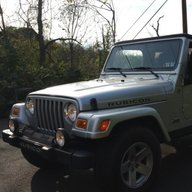
Aggressively Rough Idle / Driving

This is indeed a 4 banger, my apologies.

As for closed loop, while I am aware of how to achieve it, the issue is that I have to fight the Jeep at every stop sign/light to keep it from dying once braking starts. So when testing this stuff, I'm doing a drive around the block because that's the extent of what can be done, and will not reach closed loop in that manner of time.
 
It does look like you're in closed loop on Sensor 1, just not Sensor 2. Closed loop on Sensor 1 happens very fast, like maybe 30 seconds to a few minutes of idling depending on outdoor air temperature and if the car was already warm.

So it might report "closed loop fueling" but might say "not ready" on emissions for example.

What can happen if you have one injector spitting out more fuel than it should is that cylinder runs rich, and the sensor picks up the extra fuel in the exhaust. However, it doesn't know which cylinders have excess fuel, so it pulls fuel equally from all injectors. So three cylinders run lean while one runs very rich.

This also unfortunately tends to destroy the catalytic converter if it goes on too long. The cat gets way too much unburnt air and unburnt fuel and gets extremely hot.

In a six cylinder engine we have the advantage of having two banks, so we could narrow it to one set of three cylinders if we see one bank is way different on fuel trims and one is still fairly close to normal.


However give you report the issue starts after hitting the brakes, that does sound suspicious. If you're in a place where you can safely do it, you could try bypassing the booster and just plugging the vacuum line to see if the issue persists. Note you will have zero brake assist and you will have to stand on the brake pedal to stop. (In an emergency you could pull the parking brake as well.)

(Definitely don't do that test if you think you or anyone else would be at risk.)

 
Well I've already tested the running condition with brake booster detached and vac line plugged; there was no change.

I live in a quiet neighborhood, if the test is to have the vac line plugged from the brake booster and then see if the Jeep dies on slow down to a stop, I can definitely do that and report back tomorrow.
 
One thing that I have seen cause a similar intermittent issue is a failed catalytic converter. In that case, I had a large chunk of catalyst break free. When the engine was off, it would fall into a position that didn't really block the exhaust. But once I hit a certain RPM/engine load, it would flop up and plug the exhaust, meaning mad misfiring and terrible power until I shut the car off and restarted it.

If you haven't already, be sure to take a look at the catalyst to see if it's intact. A cheap borescope makes the process easier, but you can also just unbolt it and look right in at it
 
Well I've already tested the running condition with brake booster detached and vac line plugged; there was no change.

I live in a quiet neighborhood, if the test is to have the vac line plugged from the brake booster and then see if the Jeep dies on slow down to a stop, I can definitely do that and report back tomorrow.

Hmm... Sounds like that isn't the issue then. Or at least less likely.
 
It's a newer cat, but anything is possible! After all, this rebuild is from blowing a hole in piston #3 and basically forcing oil into the exhaust system for 10 miles until I made it home. That cat could be fried; I have a boroscope so I can take a look.
 
Yet another possibility to consider from my experience:

It can be possible for the manifolds to be perfectly seated while assembling, but then something during the drive cycle causes them to unseat. Super difficult to track down if it just reseats itself.

In my case I had a new aftermarket exhaust header. All worked perfectly except I would get terrible rev hang after running the engine hard. Like I would hit the clutch and it would hold 3k RPM, and eventually go down.

Turns out the intake header didn't have quite enough clearance from the exhaust header. The exhaust header would heat up under heavy load, expand, and touch the intake header. Then as it continued to expand it would push the intake header up and cause a vacuum leak where it mated to the head. But as soon as it cooled down a bit, the vacuum leak would go away. Drove me nuts until I figured out what it was. Ground some material off the intake header for some extra clearance and never had a problem since.

It is also possible that the forces from other parts of the exhaust system could do the same. A catalytic converter heats up and expands, and pushes one of the headers in a way that causes it to unseat. Or even just the acceleration/deceleration force could be enough to unseat a manifold if it isn't perfectly secured.
 
Hey, I appreciate all the insight and anecdotal stories from personal experience. I'll definitely give it a good go tomorrow and deep dive into all of the aforementioned potential issues and report back. Thank you guys!