Help me understand the battery wiring

Hackyman

TJ Enthusiast
Original poster
Joined
Mar 22, 2024
Messages
450
Location
Nevada
Im looking to replace the battery wiring. I see that the alternator is going directly to the fuse box, and that is crimped to a cable to the battery. There are two studs on the fusebox wiring, why is this?

Any reason this arrangement is preferable to a cable going straight from the alternator to the battery, and then a separate cable from battery to fuse box?

What is the consensus on the correct cable arrangement to replace? Will 90 degree cable ends make it to the fuse box stud, or are they typically too short? Is there any benefit beyond fewer crimps for the factory, to going directly to the fuse box from the alternator?

 
Is there any benefit beyond fewer crimps for the factory, to going directly to the fuse box from the alternator?
No difference other than cost of manufacturing. Fewer crimps equals less money to build. Saving a few pennies here and there results in millions of dollars across the fleet.
 
  • Like
Reactions: TJ Jim and Zorba
Has anyone been able to fit 90 degree battery ends onto the fuse box, without hacking the box completely apart?

What is the best way to terminate at the fuse box?
 
Just a note, there is a fusible link of 10 AWG in the factory setup going to the Alternator:

1784571825593.webp
 
  • Like
Reactions: Hackyman
Thanks Blaine,

Im far from an electrical expert, but is there any need to add a bussbar, as the two studs share a single buss bar already?

Is there any need to even connect to both of the studs?

My guess is the engineers who designed the PDC were thinking about the stability that two anchoring studs would give the battery cable, preventing it from rotating the ring terminal and loosening the nut that held it on. So they chose to design it with two studs instead of just one. It's probably not necessary to have a ring terminal with two holes as long as you tighten the nut, but using two single-hole 90 degree ring terminals with a bus bar with two holes placed over top to isolate any rotational movement of the ring terminals from the nuts would serve the same function.

https://www.amazon.com/Plating-Lithium-Battery-LiFePO4-Connector/dp/B0BBCGYVC4/?tag=wranglerorg-20
 
Last edited:
Thanks Blaine,

Im far from an electrical expert, but is there any need to add a bussbar, as the two studs share a single buss bar already?

Is there any need to even connect to both of the studs?
I don't have a PDC in front of me so I didn't recall if it already has a busbar. If it does, that's fine, if it doesn't, add one. I do recall that the early PDC doesn't have the dual hole terminal feeding the stud(s), or similar. I'll dig that up for clarity.
 
I don't have a PDC in front of me so I didn't recall if it already has a busbar. If it does, that's fine, if it doesn't, add one. I do recall that the early PDC doesn't have the dual hole terminal feeding the stud(s), or similar. I'll dig that up for clarity.

Ok that makes sense. I did see that the early models only had a single stud.

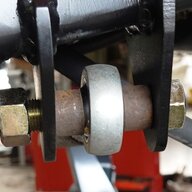
Here is the 2006 box, I will look for a 90 degree terminal.

20260710_180302.webp
 
  • Like
Reactions: GATORB8
I recently reworked all my cables using 2G wire with straight fittings and was able to put a 45-degree on them with a small amount of heat. It worked out great and didn’t need to butcher the fuse box or door to get it to close.

IMG_1065.webp
 
  • Like
Reactions: Hackyman
Unless you bought some bizarre lugs, no heat needed to bend pure copper.

You are correct but I still use light heat from a cigar torch. The lugs I’ve been using are a heavy duty deep barrel type and it seams around 2G plus sizes the heat helps..

IMG_2023.webp


IMG_1003.webp
 
  • Like
Reactions: GATORB8