Main ground connections

Not sure I follow the winch ground though since it is supposed to be hooked directly to the battery.
I did both - grounded the winch AND ran the wiring (both sides) to the battery. Gives a theoretical lower impedance ground, doesn't hurt anything, and was cheap.
 
So you basically solved a problem no one has, perfect.
I'm a lifelong electronics guy - theory is always in the back of my mind. Adding the ground connection cost about $5, so why not? Doing the math, at the admittedly rarely seen full load current of 450 amps, you'd get about .75 volt drop per leg, 1.5 volts total (#2 wire, 20 feet total loop assumed). The added ground path removes much of the negative side resistance, dropping the total loss to somewhere between .75 and a guesstimated 1 volt, most of it on the positive leg. In my world, that's not an insignificant improvement.

If everything is copacetic, the return wire carries very little current as its resistance is much higher (relatively) than a good chassis ground. BUT - a high current ground is a hard thing to make, it takes care to do so AND maintaining it in good order on a Jeep frame is problematic. "Vibration and corrosion". Thus the direct wire is far more reliable. So I have both.

In a real world situation, it probably doesn't make an iota of difference, but it makes me happy that I did the best job I knew how to - I worked with some high power electrical guys for many years, their thinking rubbed off on me!

 
I'm a lifelong electronics guy - theory is always in the back of my mind. Adding the ground connection cost about $5, so why not? Doing the math, at the admittedly rarely seen full load current of 450 amps, you'd get about .75 volt drop per leg, 1.5 volts total (#2 wire, 20 feet total loop assumed). The added ground path removes much of the negative side resistance, dropping the total loss to somewhere between .75 and a guesstimated 1 volt, most of it on the positive leg. In my world, that's not an insignificant improvement.

If everything is copacetic, the return wire carries very little current as its resistance is much higher (relatively) than a good chassis ground. BUT - a high current ground is a hard thing to make, it takes care to do so AND maintaining it in good order on a Jeep frame is problematic. "Vibration and corrosion". Thus the direct wire is far more reliable. So I have both.

In a real world situation, it probably doesn't make an iota of difference, but it makes me happy that I did the best job I knew how to - I worked with some high power electrical guys for many years, their thinking rubbed off on me!

Oh, well in that case, I'm a lifelong fastener pedantic. So, what you need to do is remove all your lug studs, replace them with longer versions. Then convert over to open ended lug nuts with flat outer faces. That way, you can torque them to spec in the rims and then use normal grade 8 hex nuts screwed down on top of those with red thread locking compound to double nut your lug nuts so your tires and rims don't fall off. I have no guarantee as to the efficacy since the incident rate of normal lug nuts done up properly failing but you never know since that likelihood isn't zero so there is a fucking chance it will make an iota of difference.
 
  • Haha
Reactions: MikeE024 and Zorba
Oh, well in that case, I'm a lifelong fastener pedantic. So, what you need to do is remove all your lug studs, replace them with longer versions. Then convert over to open ended lug nuts with flat outer faces. That way, you can torque them to spec in the rims and then use normal grade 8 hex nuts screwed down on top of those with red thread locking compound to double nut your lug nuts so your tires and rims don't fall off. I have no guarantee as to the efficacy since the incident rate of normal lug nuts done up properly failing but you never know since that likelihood isn't zero so there is a fucking chance it will make an iota of difference.
On second thought, why not simply weld the rims on? ;)
 
Ancient thread, I know. But if the title brings anyone here in a search, here is what I've found as the main grounding points on my 97 SE:
  • 1) Negative terminal to firewall between battery and engine (heavy gauge OEM wire).
  • 2) Negative terminal to engine block near dipstick base (second heavy gauge OEM wire).
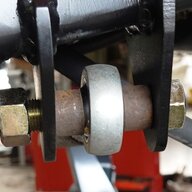
  • 3) Dipstick base to frame, just behind passenger shock tower (image here)
  • 4) Engine block to firewall (grounding strap off engine corner closest to driver).
  • 5) Same #3 firewall bolt to hood (another grounding strap).
 
Last edited:
My “big 7” kit has a battery to frame ground cable that is totally not analogous to anything in the original battery harness.

Sometimes, in the middle of the night, after three or four beers, I walk out to the Jeep, open the hood, and with a look of contempt on my face I point to that cable and say “you’re just bullshit aren’t you?!”

It never responds, but I would like to believe it has learned to do something important. You know, out of fear.

/s