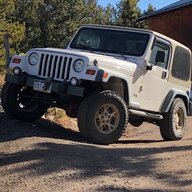
Novak Conversions Jeep Wrangler TJ engine mounts

My 1973 K10 Chevy Cheyenne

SFI definitely has big advantages over TBI, but neither work well if they're not tuned well. We tuned first on an engine dyno, then a chassis dyno (if available), and finally in the field, and the tuning went from coarser to finer in that process. Has your Sniper system been adequately tuned? As ColoJeep pointed out, there's probably room for improvement. However, TBI will never be as good as SFI, so switching to SFI, with both systems tuned properly, will be an improvement. Just don't expect to simply swap the Eddy system in and drive an improved vehicle. It will need to be tuned, and tuned well.
 
  • Love
Reactions: ColoJeep
Not direct injection. The Pro Flo is sequential fuel injection. Here's a primer on fuel injection systems, mainly in chronological order of usage on production vehicles:
  1. Throttle Body Injection - one or two injectors that inject fuel upstream of the individual runners, and the timing of the injections is not relative to intake valve opening - like a computer-controlled carb.
  2. Central Port Injection - GM used this weird system in the 90s. It had a single injector and then tubes with poppet valves to deliver the fuel just upstream of the intake valves. I've never even seen this system (only read about it), but it was a cool idea that predated multiple injectors. Cheap ECUs (PCMs in the TJ world) relegated this one to the dustbin.
  3. Multi-port Injection (MPI) - has one injector per cylinder, injecting just upstream of the intake valves. However, firing wasn't necessarily coordinated with valve opening. So, the first MPI systems were like having a computer-controlled carb for each cylinder.
  4. Bank-fire or Batch-fire Injection - a type of MPI system where injectors for multiple cylinders fire together, timed per revolution, but not with intake valve opening.
  5. Sequential Fuel Injection - the one that "stuck" in the production vehicle world (mostly, see #6 below). Each cylinder has an injector just upstream of the intake valve, and it's timed to the valve opening.
  6. Direct Injection - Mainly for emissions, this system is a special type of sequential fuel injection. It puts the injection point directly in the combustion chamber. Injectors must be much more durable since they experience the full pressure and heat of combustion. The fuel pressure is also much higher due to combustion pressures. The fuel pump has to pump fuel into the cylinder while combustion pressures are rising, and the fuel pressure has to be higher than the combustion pressure in order for fuel to flow out the injector.
The sweet spot, in my opinion, is number 5. I don't like DI because it really puts the injectors in a harsh environment, and requires a high pressure fuel delivery system. I'm not aware of any performance gains from DI. It's mainly an emissions advantage. I don't know what replacement DI parts cost, but I wouldn't want to find out. I'll stick to SFI on my vehicles...

So, there you have it. A brief history of fuel injection. I happened to start my automotive career with carbs and end just as DI was in development, so I got to experience many of those systems. Back in the late 90s, Orbital patented direct injection for two-stroke engines. Two-strokes are very dirty (emissions-wise) engines, and the EPA was really tightening up two-stroke emissions requirements. DI was seen as a way to get there, and many companies, Polaris included, bought rights to Orbital's patents.

In the snowmobile world, Ski-doo and Arctic Cat ended up going with DI. Polaris, on the other hand, developed their CleanFire engines, which are considered semi-direct-injection. They inject the fuel into the transfer port on the engine (two strokes don't use valves). I've been out of the snow machine world for about a decade, but as far as I know, Polaris is still using semi-direct-injection. They've somehow stayed ahead of the tightening EPA restrictions, which is a good thing, in my opinion. When I was there over twenty years ago, we all thought DI was our future. It wasn't! (not, yet, anyway)

Nice write up sab , I've had 1 , 2 , and 5 . I would pick #5 as my favorite as well. That being said , I didn't see much difference in performance between them .
For the most raw power , I would lean towards a well tuned carb . There are drivability issues , ( Most are directly related to the cat piss " gas " we are force to use to subsidize corn producers ) . On diesels My favorite is a P7100 Cummins , High pressure rail stuff is fun until it isn't . You can keep D.I. gas stuff , I wouldn't want it on a car I owned. The Arctic Cat F.I. was strong and reliable on the sleds I was around .
 
  • Like
Reactions: sab
SFI definitely has big advantages over TBI, but neither work well if they're not tuned well. We tuned first on an engine dyno, then a chassis dyno (if available), and finally in the field, and the tuning went from coarser to finer in that process. Has your Sniper system been adequately tuned? As ColoJeep pointed out, there's probably room for improvement. However, TBI will never be as good as SFI, so switching to SFI, with both systems tuned properly, will be an improvement. Just don't expect to simply swap the Eddy system in and drive an improved vehicle. It will need to be tuned, and tuned well.

I couldn't tell you if it's been properly tuned as I got it this way from the previous owner. However, once the Pro Flo 4 is installed I'm having it dyno tuned by a place in town that has experience with these things. I could have them do it with the Sniper, but the SFI has too many advantages over the TBI to ignore so there's no sense in it.

What I'd really like out of this setup is just for it to run a bit more smooth and consistent like an LS. The Sniper is worlds better than a carb, it starts every time and hasn't let me down once. However, it's a combination of the TBI setup and probably not being tuned perfectly.
 
  • Like
Reactions: sab and ColoJeep
When I looked up all my brake items, I just did the Rock Auto listing for the G30. There were a couple of brake options, I just went with the JB7 part # for the master. It's a big one with a two-piece body. The lower half is iron and the reservoir is aluminum.
Mine was for hyroboost, there's a different PN for vacuum booster.
I also made the whole system up myself, so the lines and fittings were whatever I wanted. You'll have to search around to make sure your stock current fitting sizes will match up with the ports on the master.
The brake hoses at the calipers might be the same for 1/2 tons, but it's been a while and I don't remember. I do have a folder with receipts, so the info is there.

https://www.rockauto.com/en/moreinfo.php?pk=13357737&cc=1047541&pt=1836&jsn=1057
 
Last edited:
As far as your hesitation, there should be a setting for what is equivalent to pump shot on a carb. I've tuned a couple of GM TBIs and when they're right they do fine.
Your new setup will be nice, and you can recoup some cost by selling the old. Either way, having a tuner take a look is a good idea. That's a deep DIY rabbit hole, and is quite time consuming to get it right when you haven't done it before.

For your cowl vent/recirc flap, is there a seal available for it? That's the route I'd go if you want to get the linkages connected right.
 
  • Love
Reactions: ColoJeep
Novak Conversions Jeep Wrangler TJ engine mounts