
I reversed my wife's trailer into our driveway recently and did use 4L to get it up a little ramp. As I was turning, I noticed how the transmission wound up, almost bringing the car to a stop. So, I changed to 2H and back to 4L for the remaining meter. Nothing broke fortunately. But now I'm wondering how you guys avoid this problem when you are rock-crawling? You are obviously in 4L but the rocky terrain doesn't allow much slip, does it? If I got it right, the Wrangler has a transfercase but not a centre-diff. Maybe it's a dumb question but how do you avoid transmission wind up?

You are using an out of date browser. It may not display this or other websites correctly.
You should upgrade or use an alternative browser.
You should upgrade or use an alternative browser.

Transmission wind-up
- Thread starter andyj
- Start date
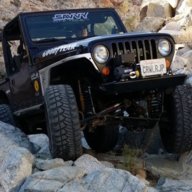
how do you avoid transmission wind up?
Not sure what you experienced, but my first thought is that you weren't completely in gear (4L) and it went to neutral.
Or you weren't use to how high the RPM can go in 4L reverse.
What you experienced is called driveline bind. There is no center differential, so the front and rear driveshafts can only spin at the exact same speed in 4WD.
When going in a straight line this is not an issue. But when turning, as you experienced, the front tires have to travel a longer distance than the rear. In 2WD, the front driveshaft is free to rotate at any speed, so this is a non-issue. On a low-traction surface in 4WD, this is also a non-issue, since the tires can slip. However, when in 4WD on a high-traction surface, this can cause bind, since the tires are trying to rotate at different speeds, but the transfer case won't let them.
In most 4WD cars, this bind can damage driveline components pretty fast. In jeeps, they're generally built to be more resilient, so it isn't necessarily going to break something right away, but it definitely incurs some risk. It also causes a lot of wear on the tires.
AWD cars and some clutch-based 4WD cars don't have this issue because they either have a center differential or a center clutch that allows the front and rear to spin at different speeds while still powering both axles. However, they typically don't have the same capability and durability of the simple 4x4 system.
As a general rule of thumb, 4WD should not be used on high traction surfaces except in a few very select cases. (These exceptions are generally limited to driving in a straight line or powering through a very difficult obstacle.)
If you want to be able to use low range without driveline bind on high traction surfaces, Teraflex makes a 2-Low kit that adds an additional shift point on the transfer case allowing low gearing while in 2WD only.
The rock crawlers avoid breaking things by increasing gearing and beefing things up. By adding locking differentials, they reduce the likelihood of grenading a differential by excessive torque. Lockers also help control wheel spin. (Wheel spin can quickly cause damage if one wheel suddenly gains traction.) They also install lower gear (higher numerically) ratios that reduce the force on the driveshafts and transfer case. They also choose driveshafts and u-joints that can take the abuse. They also upgrade the stock axle shafts to alloy to withstand more torque. Some also choose to install bigger transfer cases, or ones with much lower gearing.
The jeep is one of the few production vehicles that can survive powering through 4WD driveline bind on occasion. Doesn’t make it a good idea to do regularly, but it's probably not going to blow something up every time. That said, best to avoid binding it unnecessarily unless you're willing to take a risk or spend money to upgrade it.
When going in a straight line this is not an issue. But when turning, as you experienced, the front tires have to travel a longer distance than the rear. In 2WD, the front driveshaft is free to rotate at any speed, so this is a non-issue. On a low-traction surface in 4WD, this is also a non-issue, since the tires can slip. However, when in 4WD on a high-traction surface, this can cause bind, since the tires are trying to rotate at different speeds, but the transfer case won't let them.
In most 4WD cars, this bind can damage driveline components pretty fast. In jeeps, they're generally built to be more resilient, so it isn't necessarily going to break something right away, but it definitely incurs some risk. It also causes a lot of wear on the tires.
AWD cars and some clutch-based 4WD cars don't have this issue because they either have a center differential or a center clutch that allows the front and rear to spin at different speeds while still powering both axles. However, they typically don't have the same capability and durability of the simple 4x4 system.
As a general rule of thumb, 4WD should not be used on high traction surfaces except in a few very select cases. (These exceptions are generally limited to driving in a straight line or powering through a very difficult obstacle.)
If you want to be able to use low range without driveline bind on high traction surfaces, Teraflex makes a 2-Low kit that adds an additional shift point on the transfer case allowing low gearing while in 2WD only.
The rock crawlers avoid breaking things by increasing gearing and beefing things up. By adding locking differentials, they reduce the likelihood of grenading a differential by excessive torque. Lockers also help control wheel spin. (Wheel spin can quickly cause damage if one wheel suddenly gains traction.) They also install lower gear (higher numerically) ratios that reduce the force on the driveshafts and transfer case. They also choose driveshafts and u-joints that can take the abuse. They also upgrade the stock axle shafts to alloy to withstand more torque. Some also choose to install bigger transfer cases, or ones with much lower gearing.
The jeep is one of the few production vehicles that can survive powering through 4WD driveline bind on occasion. Doesn’t make it a good idea to do regularly, but it's probably not going to blow something up every time. That said, best to avoid binding it unnecessarily unless you're willing to take a risk or spend money to upgrade it.

I reversed my wife's trailer into our driveway recently and did use 4L to get it up a little ramp. As I was turning, I noticed how the transmission wound up, almost bringing the car to a stop. So, I changed to 2H and back to 4L for the remaining meter. Nothing broke fortunately. But now I'm wondering how you guys avoid this problem when you are rock-crawling? You are obviously in 4L but the rocky terrain doesn't allow much slip, does it? If I got it right, the Wrangler has a transfercase but not a centre-diff. Maybe it's a dumb question but how do you avoid transmission wind up?
The wrangler TJ has a center diff. You’re talking about Part-Time 4WD, which was on some Cherokee’s that just had a TCase. Driveline bind is what you were experiencing. Explained well in above post by @Steel City 06.
Are you sure?The wrangler TJ has a center diff.
The wrangler TJ has a center diff. You’re talking about Part-Time 4WD, which was on some Cherokee’s that just had a TCase. Driveline bind is what you were experiencing. Explained well in above post by @Steel City 06.
Ummmm….
The wrangler TJ has a center diff. You’re talking about Part-Time 4WD, which was on some Cherokee’s that just had a TCase. Driveline bind is what you were experiencing. Explained well in above post by @Steel City 06.
A center diff is what full time 4x4s and awd vehicles have.
TJs do not have a center diff.

I left mine in 4Hi once on a paved road. About 3 miles away, the T-case shifted itself into neutral.
The rock crawlers avoid breaking things by increasing gearing and beefing things up.
Wow, thanks for your brilliant explanation! Beefing things up sounds like some kind of brute force solution, so I wouldn't have thought of that. How would the lockers mitigate those effects?
About 3 miles away, the T-case shifted itself into neutral.
Maybe caused by the z-linkage and a bending car?
Wow, thanks for your brilliant explanation! Beefing things up sounds like some kind of brute force solution, so I wouldn't have thought of that. How would the lockers mitigate those effects?
Lockers basically prevent the differential from acting as a differential when the locker is engaged, and keep both the left and right axle shafts spinning the same speed, much like the transfer case locks the driveshafts together.
This tends to create more bind, but at the same time, massively increases overall traction, preventing excessive wheelspin that can cause significant damage.
Essentially with the transfer case in 4WD and both axles locked, all four tires must rotate at the same speed. Meaning if one wheel loses traction, it can spin no faster or slower than any other wheel. The only way to get appreciable wheelspin is to break all four tires free, which generally only occurs when one is hopelessly stuck.
The bind causes less damage than shock loads do. A typical cause of a shock load is by spinning a tire and letting it catch on something solid. All of the rotational inertia of the driveline is dumped through the entire system, creating very high instantaneous stress for a very short time. (Another example of a shock load would be dumping the clutch.)
So the idea is that even though lockers can make bind worse, they add control that helps to prevent very high shock loads.
In addition, a locked locker puts far less stress on its internal components when locked than it does unlocked. So it is less likely for the differential itself to fail when locked.
Lockers basically prevent the differential from acting as a differential when the locker is engaged, and keep both the left and right axle shafts spinning the same speed, much like the transfer case locks the driveshafts together.
This tends to create more bind, but at the same time, massively increases overall traction, preventing excessive wheelspin that can cause significant damage.
Essentially with the transfer case in 4WD and both axles locked, all four tires must rotate at the same speed. Meaning if one wheel loses traction, it can spin no faster or slower than any other wheel. The only way to get appreciable wheelspin is to break all four tires free, which generally only occurs when one is hopelessly stuck.
The bind causes less damage than shock loads do. A typical cause of a shock load is by spinning a tire and letting it catch on something solid. All of the rotational inertia of the driveline is dumped through the entire system, creating very high instantaneous stress for a very short time. (Another example of a shock load would be dumping the clutch.)
So the idea is that even though lockers can make bind worse, they add control that helps to prevent very high shock loads.
In addition, a locked locker puts far less stress on its internal components when locked than it does unlocked. So it is less likely for the differential itself to fail when locked.
A clarification is in order. While everything you stated is 100% accurate, lockers do have the ability to prevent or slow down shock loads from a single or diagonal spinning wheels, your point about them forcing all 4 tires to spin at the same rate has the potential to do something lots of folks overlook. It is not only possible, but fairly common on rock trails to get into situations where all the torque winds up being delivered to one corner and that's how we break stuff.
I've watched more than a few trying to get up an obstacle with rocks just right that drop a front tire over the top of a rock so it is on the down slope, other front is in the air, and then they pull the rear axle up on a diff hanger. That sends all the torque to the front tire with insane traction and that will break an axle faster than you can spit.

TDI Sahara
TJ Enthusiast
Since the transfer case rigidly couples the front and rear axles together with a chain there is no forgiveness for difference in axle speeds (when in 4wd). When you are turning on solid ground the steering tires are turning at a different rpm than the tires on the rear axle. It becomes hard to steer because the drivetrain is essentially binding at the transfer case. On slippery ground you might not notice because the tires can skid easily.
Similar threads

- Replies
- 14
- Views
- 2,012

- Replies
- 10
- Views
- 1,209

- Replies
- 3
- Views
- 725

- Replies
- 0
- Views
- 510

- Replies
- 5
- Views
- 1,851
