Ehh, I dont necessarily buy the too much flow thing... remember the pressure is provided by the water pump, what isnt "forced" is bypassed elsewhere in the cooling system or stalled at the pump imeller. I think this heater core was made in a "This Looks Like It Will Work" methodology. Good news is there is less heat in the heater box for summertime.
I was only musing on what could possibly have led them to hamstring its performance by letting a portion of the flow bypass the heat exchanger, but to be precise, not too much flow - too much pressure. The more you pinch off the flow (such as closing the thermostat and forcing all the flow through a few small tubes) the more pressure is produced.
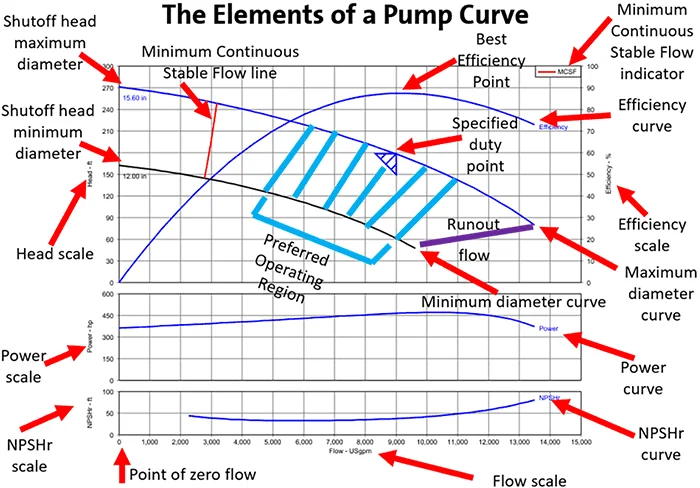
I don't have a pump curve for the 4.0 water pump so I don't know how high the pressure will go as the flow is choked down. I know worst case will be thermostat closed and high rpm (which moves the curve similarly to a change in impeller diameter demonstrated in the sample above), and I know aftermarket parts manufacturers are pathological in their relentless pursuits of cutting cost, including thinning materials, reducing labor time spent in processes and quality assurance, reducing labor cost by hiring less skilled workers, and all of those things will reduce the life of a pressure-containing part in a way that can be mitigated by reducing the pressure it's subjected to.
Occams razor points to it being intentional for me, because if one single person that knows how heat exchangers work saw that design, it never would have made it out the door. To assume it's just the result of some shooting from the hip requires the assumption that someone willing to put down the capital to open and maintain heat exchanger manufacturing equipment but not willing to hire someone that knows about heat transfer or fluid mechanics, which makes no business sense. In other words, it's easier to assume they knowingly made a cost-cutting choice than that not one single employee of a heat exchanger manufacturer understands the product they produce.
I would suspect that convection and the thermal mass of all the 200 degree water would be enough to keep the fins nice and hot, so more fins would help. I am not sure the design really requires ALL (as in 100%) the incoming hot water to flow through all the tubes, a slight circulation may be enough. Case and point, stop your jeeps engine and keep the heater and fan on high, it takes a while for that heat to cool down. I think the higher fin count may increase performance of this coil. Ultimately a cross flow core would be optimal, takes on either since but not sure that will package well in our heater box.
thermal mass has no effect on the steady state heat output, it acts only as a temporary buffer during transient operation. You could have a 100 pound heater core with 8 gallons of coolant in it and if the surface area, flow rates and material is the same, you'll get exactly the same steady state heat output, it'll just take forever to heat up and and cool down.