Cooling system cleanliness

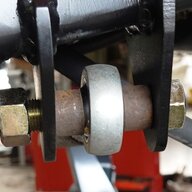
You could always cut the pipe off, remove the rest and do this with a longer, or added section of heater hose. I‘m thinking about it next time I have to change a pump.

View attachment 445386

It is easier if you just remember to turn the pipe just enough to point outwards and then snug it the rest of the way down after the pump is installed.
 
Well it appears I've wasted about 10 hours that could have been spent with my kids and $50 worth of thermocure only to end up right back where I started, if not even worse.

Repeated the process yesterday, In the following order, working as quickly as possible to reduce opportunity for rust formation.

1. Drain thermocure
2. Remove thermostat and water pump
3. Replace pump inlet tube
4. Flush and reverse flush heater core and radiator until it came out clear
5. Flush engine (in thermostat hole, out water pump hole) until it came out clear (clear stream, not caught in bucket)

At this point the inside of the engine was a nice clean shiny silver and I was feeling pretty good about it. Didn't think to take a photo cause I figured I'd have another opportunity at the end.

6. Reinstall water pump and thermostat housing, fan and shroud, etc.,
7. Fill with tap water, run 10 minutes, drain, 5x. Last bucket was clear enough. One of these times tried draining through lower rad hose to make it faster and soaked my hand in 160° water, went back to using the radiator draincock.
8. Fill with distilled water, run 10 minutes, drain, 3x.
9. While the third flush is still draining, remove thermostat housing to reinstall thermostat, inside looks like this.

PXL_20230803_030521432.webp


10. Say "F*** THIS", installed thermostat and filled it up with $25 worth of G05.

At this point I'm hypothesizing that the inside will rust if it's given any chance for the water to completely evaporate off, and I don't see a way to prevent that without adding some antifreeze to every flush cycle creating 15 gallons of toxic waste that has to be disposed of, or to let every flush cycle completely cool to slow down the evaporation rate which would take you two weeks to complete the process.

F*** this.

 
@freedom_in_4low sounds like you and I are going through similar things. I'm more or less given up on trying to get the cooling system completely clean. I also have to replace the radiator. I'll replace the rad, flush 1-2 times with distilled water, and then filling it with the proper radiator fluid mixture. I'm just done with this process.
 
Well it appears I've wasted about 10 hours...

It's only wasted if you don't put a value on learning. Frustration is often-times a by-product of the education process, at least for me. ;)


Here's my "working theory" on what you're experiencing. Your engine has established rust in it, not just surface rust, as evidenced by the scale in this photo:

1691075645313.webp


I suspect that what is happening is the Thermocure can't change that iron oxide or remove it. However, as we all know, Thermocure turns the water black. I think it initially leaves the surface black/grey, covering the red of the remaining scale. Then, you're washing that black/grey covering away, revealing the rust below it once again.

I don't know that it's worth worrying about. You've got it as clean as you're going to get it without a full engine rebuild with chemical wash.

Repeat after me:

"Serenity Now!"
 
Last edited:
  • Like
Reactions: JasterMereel42
It's only wasted if you don't put a value on learning. Frustration is often-times a by-product of the education process, at least for me. ;)


Here's my "working theory" on what you're experiencing. Your engine has established rust in it, not just surface rust, as evidenced by the scale in this photo:

View attachment 446730

I suspect that what is happening is the Thermocure can't change that iron oxide or remove it. However, as we all know, Thermocure turns the water black. I think it initially leaves the surface black/grey, covering the red of the remaining scale. Then, you're washing that black/grey covering away, revealing the rust below it once again.

I don't know that it's worth worrying about. You've got it as clean as you're going to get it without a full engine rebuild with chemical wash.

Repeat after me:

"Serenity Now!"

I can picture that...and I can't rule it out, but I'm not sure. After the thermocure, I sprayed it with enough pressure that it would have scoured it (at least at the entrance) far more effectively than just the normal flow from the water pump so I would think I would have seen the rust show up at that point.

It looked like this on February 5, 2021 before getting fresh G05. Note the deposits you point out in the photo were absent and though there is some thin rust that appeared as it dried (I didn't take a photo but I remember it being very clean while wet), you can definitely see iron underneath it.

IMG_20210205_220428.jpg


The only thing I can think of that would have been different is it was February in Colorado at 7,500' so it was cold and dry, and this time around its August in Oklahoma and 104°F and more humid outside.


@mrblaine have you seen anything like this before?
 
Assuming that what I circled is rust scale (and I think it is because it's red, not white like mineral scale), it didn't happen quickly. I'm theorizing that it was there before you started this process, and this process isn't capable of removing it. In the photo above, it wasn't there, so it appeared in the 2-1/2 years since. Hopefully Mr. Blaine has some input. He's seen more TJs than most people on the planet, I'd guess.
 
  • Like
Reactions: freedom_in_4low
Assuming that what I circled is rust scale (and I think it is because it's red, not white like mineral scale), it didn't happen quickly. I'm theorizing that it was there before you started this process, and this process isn't capable of removing it. In the photo above, it wasn't there, so it appeared in the 2-1/2 years since. Hopefully Mr. Blaine has some input. He's seen more TJs than most people on the planet, I'd guess.

I hope you don't take me as dismissing your input. You make valid points. Unfortunately that brings me back to the original question of the thread, of what is going on that's making the system rust like this? I would have expected this from a neglected vehicle that hadn't been maintained in years and years, not from one that was already relatively clean when it last got new high quality coolant.
 
I hope you don't take me as dismissing your input.

Don't worry - I don't. I feel your pain! I also see this as another opportunity to learn. I wish I had enough TJ, or even iron block engine, experience to help, but I just don't. Most of the engines I worked on, even 25 years ago, were state-of-the art and had aluminum blocks and heads.

Unfortunately that brings me back to the original question of the thread, of what is going on that's making the system rust like this? I would have expected this from a neglected vehicle that hadn't been maintained in years and years, not from one that was already relatively clean when it last got new high quality coolant.

I 100% agree with this concern. With proper anti-freeze and maintenance, I would expect that the corrision inhibitors wouldn't allow that kind of rust formation. Really curious to hear from the forum Wizard!
 
  • Like
Reactions: JasterMereel42
Water Soluble oil.

Put about half a cup in the radiator and you will not see anymore rust.

The water soluble oil gets in to the surface of the metal and coats it preventing rust and conducts the heat away for the block and in to the coolant.

I have been using it for decades and it works.
 
Assuming that what I circled is rust scale (and I think it is because it's red, not white like mineral scale), it didn't happen quickly. I'm theorizing that it was there before you started this process, and this process isn't capable of removing it. In the photo above, it wasn't there, so it appeared in the 2-1/2 years since. Hopefully Mr. Blaine has some input. He's seen more TJs than most people on the planet, I'd guess.

Here is what I know. We were working on one that wasn't maintained, it had all the common issues related to what we assume is poor thermal transfer between the cooling passage walls and the coolant. Gradual loss in efficiency, temps creeping up a few degrees over the years, etc. No outright failure, just not as good as it needs to be in our area.

Started with the Prestone drive around flush, that didn't get it all, did it again, still not all of it. Found Thermocure and tried in for 1 day and that got the rest of it but it took lots of flushing with tap water and the 3 flushes to get it clean which is what led us to start using both. On the problematic versions with no maintenance and the likely use of tap water with a high mineral content being used at some point, I can only guess the build up was higher than normal.

No ideas about any of the rest of it.
 
freedom_in_4low, were cooling system performance problems the reason you started this process, or was it just driven by preventative maintenance? If you didn't have problems, you likely won't once you button things up. As I said earlier, I don't know if you'll be able to remove the scale easily.

Just more thinking out loud - did you do the Prestone flush? I suppose it's possible that you the scale I'm guessing is rust is not rust, but red mineral deposits. Perhaps there's some iron in the mineral deposits that's turning them red? If so, maybe the Prestone flush would help... Again, some serious spitballing here.
 
freedom_in_4low, were cooling system performance problems the reason you started this process, or was it just driven by preventative maintenance? If you didn't have problems, you likely won't once you button things up. As I said earlier, I don't know if you'll be able to remove the scale easily.

I had a failed thermostat that was opening up in the 170s, and last summer I was getting into the 230s on the highway with the AC on, which didn't look bad on the gauge but was 20 degrees warmer than my 99 ran. I also found an aftermarket water pump while I was experimenting with fan clutches trying to find one that works and isn't annoyingly loud. My plan was to drain the coolant, change the pump and thermostat, and put the 2 year old coolant back in.

When I drained it, it looked much nastier than I expected, and looked rusty behind the thermostat, so I decided to do a thermocure.

Just more thinking out loud - did you do the Prestone flush? I suppose it's possible that you the scale I'm guessing is rust is not rust, but red mineral deposits. Perhaps there's some iron in the mineral deposits that's turning them red? If so, maybe the Prestone flush would help... Again, some serious spitballing here.

I told myself at the time that I could skip the prestone since it had only been 2 years and had not had any tap water. I could have been wrong. It's gonna have to wait though because I leave in one week for a wheeling trip in Colorado and still have other issues to address and don't have another day to spend on this.
 
  • Like
Reactions: JasterMereel42
I told myself at the time that I could skip the prestone since it had only been 2 years and had not had any tap water.

Well, running the Prestone flush seems about the only suggestion I have left.

... I leave in one week for a wheeling trip in Colorado and still have other issues to address and don't have another day to spend on this.

Well, heck - I'll be in Colorado for a long weekend the 11th-13th (the 10th and 14th are travel days). I'll be in the backcountry visiting a neighbor who spends most of the summer in the mountains to beat the heat down here. My LJ is not up to task, yet, so I'm planning to take the '01 Expedition I rebuilt last fall - not wheeling, though. The neighbor used to have a well-built CJ-6, but he's in his mid-80s and it got to be too much, so he sold it and now has an '08 2dr JK that's moderately-built. We'll likely do some light to moderate wheeling with him. He hangs out near 24/285 between Leadville and Salida, moving camp every few weeks to stay legal. He's in the Leadville area north of Camp Hale right now, so I'm guessing that's the general area we'll be in next week. If you're gonna be anywhere near there and want to shake hands, PM me for contact info!
 
When you take bare steel and subject it to acids or caustic solutions (your cleaning treatments) it will surface flash with rust very very quickly. You would need to immediately fill with coolant after the rinse to keep it clean looking. Also,i wouldn't run the motor with straight water if i could help it. The coolant helps lubricate the oump seals
 
When you take bare steel and subject it to acids or caustic solutions (your cleaning treatments) it will surface flash with rust very very quickly. You would need to immediately fill with coolant after the rinse to keep it clean looking. Also,i wouldn't run the motor with straight water if i could help it. The coolant helps lubricate the oump seals

Do you mean add antifreeze to the first fill with tap water after draining the thermocure?

The photo was taken while the final distilled flush was still draining, so there's nothing that could have done any more immediately, other than adding a corrosion preventative to each flush.
 
UGH!!!

The last day I worked on this was Sunday, and I strained my right trapezius which was spasming and compressing the ulnar/median/radian nerves on that side putting me in a steady state of mind numbing pain and unable to really use my arm. So rather than getting the water pump replaced and filling the system with coolant, I went to bed with it filled with distilled water and now it's got rust again, despite looking really clean when I previously removed the thermostat to flush out the thermocure.

View attachment 445154

So I've got another bottle of thermocure and I guess I'm starting again from scratch tomorrow, other than having the new water pump on it.

Looking back at this photo from before the second thermocure makes me wish I'd have just buttoned it up at that point and moved on, cause somehow it's worse now than it was. The only difference is that this one I opened up stone cold after sitting for days with distilled water, instead of opening it up still hot.
 
Do you mean add antifreeze to the first fill with tap water after draining the thermocure?

The photo was taken while the final distilled flush was still draining, so there's nothing that could have done any more immediately, other than adding a corrosion preventative to each flush.

Unless I'm reading you wrong step one was drain thermocure then flush then

". Fill with tap water, run 10 minutes, drain, 5x. Last bucket was clear enough. One of these times tried draining through lower rad hose to make it faster and soaked my hand in 160° water, went back to using the radiator draincock.
8. Fill with distilled water, run 10 minutes, drain, 3x."

So 10min x5 and 10 min x3. Plus whatever time steps 2- et cetera took?

When i have chemically removed rust from steel before it rusts within minutes. Especially if not neutralized and dried immediately.
 
It is a cast iron engine. It is going to have surface rust if you do not immediately fill it with anti-freeze after the flush. Do yourself a favor. Stop aiming for perfection (no surface rust after the engine is allowed to dry). The engine is as clean as it is going to get. Fill it with anti-freeze and enjoy driving the beast.
 
  • Like
Reactions: tworley and Rickyd
2000 TJ with 74,000 miles. It sat in a garage for 3 years with no maintenance during that time. I bought and brought it to my house.

One of the first things I did was replace the water pump. When I drained the coolant, it was nasty. Just looked like chocolate milk. I also had a lot dirt and rust in the radiator cap too. I do remember taking pics. The coolant is dirty, but the metal inside of the engine still looks pretty black and not rusty. So, engine block looks good and the radiator is aluminum so no rusting. I'm still amazed at how much rust still formed and was collected by the coolant.

IMG_3712.webp