I don't know if this could have posed an issue or not, the clutch hex bolts are 3/4" in length. The replacement socket cap screws that I had installed were 7/8" in length.


As long as they don't bottom out you are fine.I don't know if this could have posed an issue or not, the clutch hex bolts are 3/4" in length. The replacement socket cap screws that I had installed were 7/8" in length.
I I asked him a series of questions, one of which regarded the deformation of the pressure plate when I torqued the bolts down. He started off saying that it was impossible and I immediately countered with the fact that I witnessed it happen. According to him, they recommend turning the cover bolts a 1/2 turn at a time, not a few threads at a time as the FSM states.
When you are bolting on the pressure plate, you are compressing the springs and locking down the clutch plate. I think what you are describing is normal. Unless you can turn in all of the bolts at the same exact time it is going to compress those fingers per bolt you are tightening. So when you start your clutch cover bolts the plate is loose, but by the time it is cranked down the plate it tight. When you crank them down you are compressing the springs which are fingers.
How it works is your throwout bearing presses against those fingers and freeze up the clutch plate which lets the disk loose. Once the throwout bearing leaves the fingers the plate is tight again. The fingers are actually springs that pull and push the clutch cover surface against the clutch plate.
I hope that makes sense? So when you are tightening down the cover you are compressing those springs with the mounting bolts. That is why it looks like it deforms. The thing you have to worry about is when you are done all of those fingers must be even. If they are not then you have a problem.
Also make sure you clean all of the film off of the clutch cover surface. That could explain the irregular pattern on the plate honestly.
The first clutch that I put in DEFINITELY deformed as the bolts were torqued down. I dis an over exagerated star pattern with this new clutch, I didn't notice the same apparent deformation this time, so it might make the difference.I've seen the distortion around the edge when tightening the bolts down. Having never read how to do it or had anyone tell me how, I've always just turned opposite bolts in a few turns at a time to keep the cover moving towards the flywheel evenly due to seeing it flex. If I tightened it and the other bolts got loose, that would tell me the cover wasn't distorting but I've never found that to be the case but then again, I've only done a very low number, maybe 10-15 or so.

Move down here to Dallas, jeep boss, I'll help you work on your jeep.Just got the transmission back in. The rain beat me, probably ran down into the new clutch and flywheel as I was getting the bellhousing back in. For not being a state in the rust belt, rust forms in a matter of a couple of hours here. Might be time to move back to the southwest soon, so sick of this rain and darkness in the pnw. :/
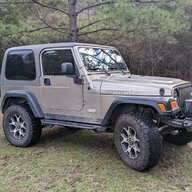
When this pissfest of rain gives way, I'm going to figure out how to remove the right front quarter panel and solder the wiring. It won't be fun, there doesn't seem to be any room to work with - but at least I wouldn't have to do it in a contortionist position working above my head, under the Jeep. I would very much like to publicly stone to death the engineer that implemented that wiring run right there, he / she / it has some negative karma coming their way.
You knew the wire harness was there. It isn't the engineers fault you screwed it up. Also why we lower the back of the motor down so we can actually see over the top of the trans and keep that harness out of harm's way. If you were intent on fixing it correctly, you should have done it while the trans was out because now it's going to be a real bitch to get up in there and do it right.
If you think about the harness for just a moment, you'll figure out there is just about no other place to run it easily and efficiently. If it went down the frame rail, it would have to cross over the exhaust twice and you'd be bitching that the exhaust melted it. If it came down the other side of the rig, they would have to do some pretty special gymnastics to keep it out of the driveshaft and shift lever on the autos and the t-case linkage on both. Where it runs is the best and most efficient location possible.
I don't have a shop, I work on the ground in the driveway under a tarp and I don't have a lift and if I did, I wouldn't use it. We lean the back of the motor down so we have access over the top of it to see the harness, tie it up out of the way, and access the bell housing top bolts with a long extension or extension string. You made your own life difficult, not the Jeep engineers.It wouldn't have killed them to put a $0.10 plenum studded zip tie instead of what they chose to do. I fought with that stupid wire harness the entire time, so I don't want to hear it. Not everyone has the luxury of a shop and a lift.
There was no where practical to tie up that O2 sensor harness on my Jeep. I would have had to have bent beyond what I would have been comfortable with to tie it along the main wiring bundle, and I wouldn't have had a safe way to cut the tie after the transmission was installed. My motor was titled all the way back each of the three times the transmission was reinstalled. I had the harness tucked at the rear of the block ahead of the bellhousing - it moved while I strong armed the assembly back into the motor and you couldn't see the wires stuck in there whatsoever with the naked eye.I don't have a shop, I work on the ground in the driveway under a tarp and I don't have a lift and if I did, I wouldn't use it. We lean the back of the motor down so we have access over the top of it to see the harness, tie it up out of the way, and access the bell housing top bolts with a long extension or extension string. You made your own life difficult, not the Jeep engineers.
I'm sorry for your trouble, it still isn't the engineers fault. FYI, I've done many trans jobs by myself under the rig on the ground and have never pinched the harness so I know it can be easily done with one person, but again, sorry for your troubles.There was no where practical to tie up that O2 sensor harness on my Jeep. I would have had to have bent beyond what I would have been comfortable with to tie it along the main wiring bundle, and I wouldn't have had a safe way to cut the tie after the transmission was installed. My motor was titled all the way back each of the three times the transmission was reinstalled. I had the harness tucked at the rear of the block ahead of the bellhousing - it moved while I strong armed the assembly back into the motor and you couldn't see the wires stuck in there whatsoever with the naked eye.
There was no "we" on this repair, this was a one man job in piss weather in the cold, dark and wet PNW. I don't need you or anyone else to tell me that the situation sucks or that I made a mistake, you're just being an asshole for saying so. I and everyone else that has had this issue stands by the point that the wiring run over that portion of the bellhousing is STUPID from a maintenance point of view, but Jeeps were never designed for maintenance beyond things like oil and spark plug changes. They should have ran the O2 wiring along the top of the motor just like the other three O2 sensors.
The wires are fixable, it's just more work that has to be done so meh.
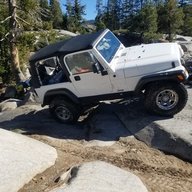
Yeah really, sheesh! I had feared the transmission was on its way out to lunch before doing the clutch job, but it turned out to be fine, near perfect even.Rejoice in your new found freedom!
Yeah really, sheesh! I had feared the transmission was on its way out to lunch before doing the clutch job, but it turned out to be fine, near perfect even.
I was planning on selling it after I did the clutch, but I took some time to clean up the area on the right side of the engine bay this afternoon and started realizing this little beast is pretty damned solid (and very clean) after the ~6 months of effort pit forth. There aren't any problems with it now whatsoever, just a bad taste in my mouth from the cascading shitstorm of issues that I have had to fix.
I'll have to figure out what I want to do, I need more hauling capacity, so that might be the deal breaker. Total coin toss at this point.