Beadlock wheels and grade 8 bolts

Mike_H

autos are better - WRWD508
Original poster
Supporting Member
Joined
Feb 28, 2017
Messages
12,942
Location
Grand Rapids, MI, United States
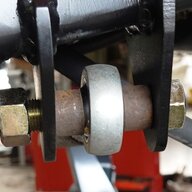
I recently picked up a set of walker Evans wheels. They came with old tires, so I’m changing them out. I’m going to replace the bolts, since they were not installed with anti-seize and they are pretty nasty. Thankfully all but one came out, but in my environment that isn’t always guaranteed, even with anti seize, unfortunately.

My question is this…would grade 5 bolts be strong enough for the application? 24 5/16” bolts is a lot of clamping force. My gut tells me that grade 5 is fine. Grade 5 are also MUCH easier to drill vs Grade 8 if that needs to happen. But the mfg spec’ed grade 8 and that is the “safe” bet.

Anyone care to comment here?
 
What torque spec are they calling for? Can the grade 5 bolts handle it? (Of course just apples to apples and not including the reduction for antisieze)
 
If you think it'll ever make love to a rock, grade 8. I probably wouldn't risk it either way, every MFG uses Grade 8 or better.

I have 2 sets of Walkers and I have de-headed more than one bolt on both.

LG
 
  • Like
Reactions: Mike_H
18-20, which is the spec for a grade 5, 5/16-18

Mike, I would think that the screws holding on a bead lock ring have a high tensile load component, and that competes with installation preload for available stress. That's why the torque spec is lower than max for Grade 8 screws. If you torqued to yield (max torque), you'd not leave much room for additional tensile loads in use. I have no idea what the in-use load is like, but keep in mind that the tensile forces that develop in the bolt as the tire flexes and tries to de-bead itself are probably localized to/concentrated on just a a few screws, not the total number of screws.

If you move down to Grade 5 screws, you'd be wise to calculate the difference between preload force and axial force to yield for the Grade 8 bolts, and then replicate that "head room" with the torque at which you install the Grade 5 screws. You'd also get a "seat of the pants" feel for whether or not that lower installation torque seems reasonable. I hope that makes sense. If not, give me a call - it's easier to explain verbally...
 
I recently picked up a set of walker Evans wheels. They came with old tires, so I’m changing them out. I’m going to replace the bolts, since they were not installed with anti-seize and they are pretty nasty. Thankfully all but one came out, but in my environment that isn’t always guaranteed, even with anti seize, unfortunately.

My question is this…would grade 5 bolts be strong enough for the application? 24 5/16” bolts is a lot of clamping force. My gut tells me that grade 5 is fine. Grade 5 are also MUCH easier to drill vs Grade 8 if that needs to happen. But the mfg spec’ed grade 8 and that is the “safe” bet.

Anyone care to comment here?

Nice! Great find,what size?
 
Nice! Great find,what size?

17 x 8.5

1773954735147.webp
 
Mike, I would think that the screws holding on a bead lock ring have a high tensile load component, and that competes with installation preload for available stress. That's why the torque spec is lower than max for Grade 8 screws. If you torqued to yield (max torque), you'd not leave much room for additional tensile loads in use. I have no idea what the in-use load is like, but keep in mind that the tensile forces that develop in the bolt as the tire flexes and tries to de-bead itself are probably localized to/concentrated on just a a few screws, not the total number of screws.

If you move down to Grade 5 screws, you'd be wise to calculate the difference between preload force and axial force to yield for the Grade 8 bolts, and then replicate that "head room" with the torque at which you install the Grade 5 screws. You'd also get a "seat of the pants" feel for whether or not that lower installation torque seems reasonable. I hope that makes sense. If not, give me a call - it's easier to explain verbally...

No, that makes perfect sense. I'd guess (since I'm lazy, and don't feel like looking up the equations) that 18-20 ft-lbs spec'd for the Grade 8s is less than 50% of Sy. That same value is probably 75-80 percent of Sy for a Grade 5.

Where I start to stumble with this if that is true, and the bolt isn't really torqued, what keeps it tight? The axial stress developed in the bolt when you torque them properly creates enough thread friction to prevent them from turning out. If you don't torque it...the bolt will loosen up. So, I understand leaving a little bit of "overhead" for extra axial load...but there isn't any other anti-loosening mechanism there and that seems worse...as a bolt loosens, its going to transfer the load to its neighbors and pretty soon they are either going to pop or loosen them selves.

Maybe I should go through the math...it would be interesting, if nothing else. Plus, it would make me look up how to do all that math again, LOL.
 
If you have never lived with bead locks, keeping them "torqued" is a life style typically, not a one and done. I assume that's partly due to the nature of torqueing less than the fastener is built for on top of rubber and partly due to how they get used.

LG
 
  • Like
Reactions: mrblaine
Where I start to stumble with this if that is true, and the bolt isn't really torqued, what keeps it tight? The axial stress developed in the bolt when you torque them properly creates enough thread friction to prevent them from turning out. If you don't torque it...the bolt will loosen up. So, I understand leaving a little bit of "overhead" for extra axial load...but there isn't any other anti-loosening mechanism there and that seems worse...as a bolt loosens, its going to transfer the load to its neighbors and pretty soon they are either going to pop or loosen them selves.
Oh, no - I wasn't suggesting they can be installed with zero torque. You're absolutely right that you have to have enough preload to keep it tight. When I said, "You'd also get a "seat of the pants" feel for whether or not that lower installation torque seems reasonable," what I meant was, if you do those calcs, and the result is that, in order to have the same available stress between yield and installed stress (to handle the loads in use), you can only install them to 4 ft-lb (just picking a low number), you'd know it wouldn't work because that's surely not enough to keep it from loosening.
 
  • Like
Reactions: Bud125 and Mike_H
Leave it to a bunch of engineers to overthink this shit. The standard torque value for gr.8 5/16-18 cap screws has always been 18ish ft lbs. with a K factor of .15 which indicates a lubricated condition. Anyone that doesn't run AS will eventually wish they had. Our number has always been 18-20 and will always be that being fully aware we are right at the limit with what that bolt can handle. Similar to above from Lanzg, I've had many sets of beadlocks over the years, Champion, OMF, KMC, et al, plus I've installed tires on many sets of Walker's wheels, a few sets of Methods, a few more sets of the same brands as mine, couple of sets of Trail Gear, and more Racelines than I can recall readily.

That info has held fairly steady across all of them with the only surprise being that sometimes the WE wheels spec out 24 which has scared me so I didn't do it. Same as the rest, 18ish. I express it as 18ish because we always use 220 inch lbs on a small torque wrench and 220 is easy to remember.

What I don't see mentioned is the absurdly high force the tire is exerting against the lock ring and bolts. There is a reason the wheel folks don't like the bro-dozer crowd to run their wheels with 80 psi 10 ply rated tires, the bolts can't take the forces. Bring the bolts up to a higher strength and then I suspect the aluminum won't take it even with the press in inserts like Raceline uses.
 
OK. Grade 8 it is. Lubricated liberally with anti-seize because 8 years from now, I do NOT want to be fighting broken grade 8 bolts.
 
Oh, no - I wasn't suggesting they can be installed with zero torque. You're absolutely right that you have to have enough preload to keep it tight. When I said, "You'd also get a "seat of the pants" feel for whether or not that lower installation torque seems reasonable," what I meant was, if you do those calcs, and the result is that, in order to have the same available stress between yield and installed stress (to handle the loads in use), you can only install them to 4 ft-lb (just picking a low number), you'd know it wouldn't work because that's surely not enough to keep it from loosening.

nor was I, but I was thinking that they wouldn't have the torque to develop enough "stretch"
 
  • Like
Reactions: sab
If you have never lived with bead locks, keeping them "torqued" is a life style typically, not a one and done. I assume that's partly due to the nature of torqueing less than the fastener is built for on top of rubber and partly due to how they get used.

LG

This will be new for me. I've been using adapters though and that is enough of a pain in the ass that I think the beadlocks will be OK...I don't think running around bolts that are accessible will be that big a deal...Pulling a tire off and checking torque on an adapter is a giant PITA
 
This will be new for me. I've been using adapters though and that is enough of a pain in the ass that I think the beadlocks will be OK...I don't think running around bolts that are accessible will be that big a deal...Pulling a tire off and checking torque on an adapter is a giant PITA

If you wheel them, get a dedicated 1/2 deep socket, you'll have to "Tap" the socket on alot to check them. I give them all a check before each trip.

LG
 
I found this chart at


because of smearing the hexes? I noticed they sit pretty proud.

10-4, not near as proud as some brands, but I find the completely recessed brands are even more work to get to once you smash aluminum into the hole with the ruined bolt head in it.
 
I found a chart at Fastenal. Thought it was pretty interesting. Gives you 4 different bolt strength specifications and 3 different K-values. Went looking because I got confused by something MrBlaine said about K-value of 0.15 being for a lubricated bolt, then I read something else about plated bolts also having a k-value of 0.15...so I wanted to make sure a plated bolt WITH lubrication would have the same K-value. According to Fastenal, it does.

https://www.fastenal.com/content/feds/pdf/Torque-Tension Chart for A307 Gr5 Gr8 Gr9.pdf
 
  • Like
Reactions: mrblaine
OK. Grade 8 it is. Lubricated liberally with anti-seize because 8 years from now, I do NOT want to be fighting broken grade 8 bolts.
Once upon a time we assisted the owner of winchline.com and helped him change tires on his Walker Evans wheels on the lakebed in JV. I whipped out the little impact and was removing the first bolt, it started bowing the ring up, went to the next, same thing, all but about 3 per wheel were the same. No A/S install, the "time-serts" were stuck to the bolts and the little shoulder was hitting the back side of the lock ring. So, 3 turns, next bolt, rinse and repeat endlessly until the ring was off complete with all the bolts and inserts sticking out of it. Giant pain in the ass. Fortunately, a pair of small vise-grips on the inserts got 99% of them off the bolts, 271 on the threaded hole in the wheel, A/S on the bolts and the only thing we lost was a lot of time fucking with them.
 
This will be new for me. I've been using adapters though and that is enough of a pain in the ass that I think the beadlocks will be OK...I don't think running around bolts that are accessible will be that big a deal...Pulling a tire off and checking torque on an adapter is a giant PITA
Until you are an experienced bead lock owner, I would encourage you to take the case of Phil Howell (editor of 4WD and Sport Utility back in the day) to heart and pay attention. He was swapping out his beadlock bolts with new ones. He failed to notice that the bolts were going all the way through the hole and bottoming out on the wheel behind the holes. After enough of that, the wheel said "fuck it" cracked, failed, and then blew the ring off with his arms in the way. It almost severed both between the wrist and elbow and it took him a very long time to regain any meaningful use out of them. If you don't know what you are doing, I'd strongly encourage you to deflate the tire anytime you dick with the bolts in a meaningful manner.