
You are using an out of date browser. It may not display this or other websites correctly.
You should upgrade or use an alternative browser.
You should upgrade or use an alternative browser.

Help with flashing CEL and slightly rough idle
- Thread starter rublicon
- Start date

Agreed, just throwing it in there.
Not purposely being disrespectful, AndyG, so don't take this the wrong way: I try not to "just throw things in there" when diagnosing problems, especially given the OP's post:
I have done the wrong thing by throwing parts at it to see what sticks and am currently at a loss and looking for direction on what to try next.
Even our beloved TJs have complicated engine control systems, so it pays to use an evidence-based approach. You are 100% correct that the vacuum elbows disintegrate and will cause rough running conditions, but I don't see that as solving a problem (running rich with new cats) that could be costly if not addressed.
Again, no offense meant - just explaining why I made my previous post reacting to yours.
Not purposely being disrespectful, AndyG, so don't take this the wrong way: I try not to "just throw things in there" when diagnosing problems, especially given the OP's post:
Even our beloved TJs have complicated engine control systems, so it pays to use an evidence-based approach. You are 100% correct that the vacuum elbows disintegrate and will cause rough running conditions, but I don't see that as solving a problem (running rich with new cats) that could be costly if not addressed.
Again, no offense meant - just explaining why I made my previous post reacting to yours.
Thanks for the suggestions on checking for vacuum leaks. We have inspected everything we could think of for vacuum leaks and also did a smoke test and could not find any leaks. Planning to work on it some more on Friday so I will take these suggestions and see what we find. The flashing CEL, when it does happen, is at low speed or idling, never when cruising, so I believe (or am hoping) that when there is a misfire and maybe rich fuel condition, it is a small percentage of time and hopefully not doing damage to cats. We shined light through the precats and they look to be in good shape currently.
My plan for Friday is to check fuel trims to see if that points us anywhere, remove and inspect CPS, and I would like to check the flywheel bolts. Maybe that is dumb and not something I should waste time on. Speaking of that though, is there an inspection cover on the NSG370 that is easy to remove to check flywheel bolts?
I'll also check the sensors that SAB mentioned. For fuel pressure regulator, do I have a separate one on my 05 or is it just in the pump assembly? My fuel rail has a little silver top hat looking thing and no test port. When we checked fuel pressure, I think we adapted something to connect to the soft line that goes into the fuel rail.
You also list ECT sensor, if that was bad, wouldn't I see some change on the temp gauge? It is always right in the middle (205 I think?).
Not purposely being disrespectful, AndyG, so don't take this the wrong way: I try not to "just throw things in there" when diagnosing problems, especially given the OP's post:
Even our beloved TJs have complicated engine control systems, so it pays to use an evidence-based approach. You are 100% correct that the vacuum elbows disintegrate and will cause rough running conditions, but I don't see that as solving a problem (running rich with new cats) that could be costly if not addressed.
Again, no offense meant - just explaining why I made my previous post reacting to yours.
No worries and you are correct - I do way too much skimming as I’m driving and a lot of times when I’m trying to be helpful, I’m being over general or off base..
Not sure the 4.0L has the option, but I've used scanner live data cylinder misfire counts to identify which cylinder is misfiring on other vehicles when it's not doing it enough to throw a code.
Identifying if it's a specific cylinder or bank misfiring may help you eliminate causes that would impact multiple cylinders.
Identifying if it's a specific cylinder or bank misfiring may help you eliminate causes that would impact multiple cylinders.

Regulator is in the tank.Thanks for the suggestions on checking for vacuum leaks. We have inspected everything we could think of for vacuum leaks and also did a smoke test and could not find any leaks. Planning to work on it some more on Friday so I will take these suggestions and see what we find. The flashing CEL, when it does happen, is at low speed or idling, never when cruising, so I believe (or am hoping) that when there is a misfire and maybe rich fuel condition, it is a small percentage of time and hopefully not doing damage to cats. We shined light through the precats and they look to be in good shape currently.
My plan for Friday is to check fuel trims to see if that points us anywhere, remove and inspect CPS, and I would like to check the flywheel bolts. Maybe that is dumb and not something I should waste time on. Speaking of that though, is there an inspection cover on the NSG370 that is easy to remove to check flywheel bolts?
I'll also check the sensors that SAB mentioned. For fuel pressure regulator, do I have a separate one on my 05 or is it just in the pump assembly? My fuel rail has a little silver top hat looking thing and no test port. When we checked fuel pressure, I think we adapted something to connect to the soft line that goes into the fuel rail.
You also list ECT sensor, if that was bad, wouldn't I see some change on the temp gauge? It is always right in the middle (205 I think?).
The hat is a damper for the injectors pulsing the fuel rail.
The temp sensor feeds the PCM which runs the gauge. You can read the actual undamped value on a scanner.
Check the MAP sensor reading with a scanner. Turn the ign to on, the MAP will read the atmospheric pressure. With a smartphone, use an app to read the "station pressure", compare, it should be very close. Don't use the weather pressure, which is corrected to sea level. Every time you start the Jeep or go WOT, the PCM reads the MAP sensor to set the baseline altitude.
My MAP sensor was reading incorrectly and causing a lean condition at low elevations (300 ft) in GA. Jeep ran better when in the E. TN mtns.
You can use the fuel trims to see if your richness issue is only occurring only under certain conditions. The main axes in the pulse width table are throttle position (engine load) and rpm, so think in those terms (what is my throttle position, and what speed is the engine at) when you are seeing or not seeing fuel trims get pinned at a negative value (removing fuel because it's rich). More fuel is introduced under both high load and high speed, so if you're only seeing a rich condition (negative trims) at low loads (light throttle) and low speeds, you stand a much better chance at avoiding a cat failure prematurely....The flashing CEL, when it does happen, is at low speed or idling, never when cruising, so I believe (or am hoping) that when there is a misfire and maybe rich fuel condition, it is a small percentage of time and hopefully not doing damage to cats.
My plan for Friday is to check fuel trims to see if that points us anywhere...
There is no inspection port. Look at the pictures in Post #390 of my build thread, especially the second-to-last one. However, if by "flywheel bolts," you mean the screws that hold the flywheel to the crank, you won't be able to see those until you remove the clutch pressure plate assembly and the friction plate because they both cover the flywheel mounting screws. If you wanted to take a peak inside the bell housing on the transmission side of the clutch, you could remove the clutch slave cylinder and look in that hole (visible in the pics I linked in my build thread.) Also, when you remove the crank sensor to inspect for rust on the sensor targets, you might be able to spin the crank and see if there's visible axial runout on the flywheel, which could be attributed to loose screws (or a bent flywheel.)Speaking of that though, is there an inspection cover on the NSG370 that is easy to remove to check flywheel bolts?
My friend reminded me that I have left a couple of possible variables out of this post but they are things that I think should be unrelated. I am running a Banks cold air intake, a Banks Monster cat back exhaust, and a Banks header. Also a 62mm Edge Trail Jammer throttle body. I am not using the piggy back ECU portion of the Trail Jammer. All of those things were installed and the Jeep running fine before this issue came up (for like a year). We're gonna look at fuel trims, map sensor, CPS contacts tomorrow and will report back.
The knocking is the 6 spd just being the 6 spd. They will knock slightly if left in N idling, when it starts missing, it's like a box of rocks. It goes away when you push the clutch because everything inside stops turning.
The throttle position sensor (TPS) is on the throttle body, and it's on the list of possible causes I posted. There are two tests you can do to rule out the TPS when you're looking at live data on your scanner tomorrow:My friend reminded me that I have left a couple of possible variables out of this post but they are things that I think should be unrelated. I am running a Banks cold air intake, a Banks Monster cat back exhaust, and a Banks header. Also a 62mm Edge Trail Jammer throttle body. I am not using the piggy back ECU portion of the Trail Jammer. All of those things were installed and the Jeep running fine before this issue came up (for like a year). We're gonna look at fuel trims, map sensor, CPS contacts tomorrow and will report back.

verified the front cats are in good condition (Jeep has 160k miles, and someone replaced the front cats with MagnaFlow before I bought it at 130k miles), gutted the factory rear cat (which did not show light in about 50% of the holes when checked with a flashlight).
The rear cat doesn't have any 02 sensors at least on my 06.
I recently found out I had been using an illegal cat (California BS) when trying to smog my Jeep, so I had to change it, and I'm glad I did because my Jeep runs a whole lot better.
My jeep was driving just fine before. I didn't notice any signs of performance loss. It was louder though. When I removed the cat everything inside was still intact
The rear cat doesn't have any 02 sensors at least on my 06.
I recently found out I had been using an illegal cat (California BS) when trying to smog my Jeep, so I had to change it, and I'm glad I did because my Jeep runs a whole lot better.
My jeep was driving just fine before. I didn't notice any signs of performance loss. It was louder though. When I removed the cat everything inside was still intact
Correct, the rear cat is not monitored so doesn't matter as long as it is not clogged which it most definitely is not. My front cats were replaced with MagnaFlow Federal cats prior to me purchasing it 3+ years ago (from out of state and specifically a non CARB state). It has since passed emissions in Colorado (CARB state) twice with those Federal (non CARB) cats so I believe most of the inspection places are only looking to see that everything "looks" factory.
As far as the state of my front cats, I have inspected them from both sides and they look good and no signs of clogs so I do not believe they are causing any of my misfire issues.
The throttle position sensor (TPS) is on the throttle body, and it's on the list of possible causes I posted. There are two tests you can do to rule out the TPS when you're looking at live data on your scanner tomorrow:
View attachment 682004
Thanks for this. Assuming it passes this test without the engine running but I am able to reproduce the flashing CEL later on, would you recommend performing the test again with the engine running while the CEL is flashing? Or maybe turn off the engine and run the test again?
I do not believe they are causing any of my misfire issues.
x2
Not sure the 4.0L has the option
My 97 has no PID for misfire count and both my Innova 5610 and Torque/Bluetooth dongle can't find it.
-Mac
I would expect the TPS to either be working or not, but intermittent problems are always possible. Looking at it with the engine off (key on, of course) and then when your CEL is flashing would rule out the intermittency.Assuming it passes this test without the engine running but I am able to reproduce the flashing CEL later on, would you recommend performing the test again with the engine running while the CEL is flashing? Or maybe turn off the engine and run the test again?
I don't believe the NGC PCM has a misfire counter, either. But I'm not 100% sure.My 97 has no PID for misfire count and both my Innova 5610 and Torque/Bluetooth dongle can't find it.
Last edited:
I would expect the TPS to either be working or not, but intermittent problems are always possible. Looking at it with the engine off (key on, of course) and then when your CEL is flashing would rule out the intermittency.
I don't believe the NGC PCM has a misfire counter, either. But I'm not 100% sure.
Went down a weird rabbit hole today. Tested TPS and looked at MAP sensor readings. I have me factory throttle body with all 3 factory sensors as well as an Edge Trail Jammer 62mm throttle body also with all 3 factory sensors. The 62mm is what has been installed for like a year. It's TPS voltage with engine off measured .77, not .92. We swapped to the other TPS sensor and it tested at .72 volts. Both sensors seem to work fine and register between approximately 15 and 80 percent when using the throttle. I have ordered a new Standard products TPS but have not installed it yet. I'm curious to test it and see what it's voltage reads.
We also tested the MAP by looking at pressure readings with engine off. My reading matched my buddies 2000 XJ so I think that sensor is fine. Since we had the factory throttle body with sensors that were all working when I pulled it off the Jeep, we decided to just swap throttle bodies/sensors and see if I continue to have the 0172/0175 and flashing cel. Planning to take a long drive tomorrow and we'll see how the Jeep does.
Funny thing from today, we found out that if you install an o ring with the TPS, it will make the TPS stick. It looked like there should maybe be an o ring but there wasn't one when we took the sensors off. We tried installing one and apparently it squished the sensor body just enough to make it stick on whatever highest reading it came to. We tested this with both of the factory sensors I had and without the o rings, they both seemed to work fine but with o rings, the reading would stick.
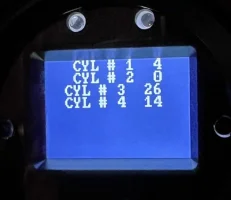
I don't believe the NGC PCM has a misfire counter, either. But I'm not 100% sure.
If I’m understanding correctly, I believe the NGC has a misfire counter since I can observe real-time misfires. My gauge only tracks cylinders 1-4 since the Neon SRT4 folks asked for this function.
Last edited:
When you're working through diagnostics, attention to detail is very important, especially if, because you don't know exactly how the logic in the PCM works, you have to follow the test procedures. Both TPSs are fine. Look back at the test procedure with more attention to detail:Edge Trail Jammer 62mm throttle body...TPS voltage with engine off measured .77, not .92. We swapped to the other TPS sensor and it tested at .72 volts. Both sensors seem to work fine and register between approximately 15 and 80 percent when using the throttle.
The first test is confirming that the TPS is set at a position that the PCM can adjust for the closed throttle position . The reason it's listed as a max value of 0.92V is so that the TPS doesn't run out of room on the top end. If it is higher than 0.92V at closed throttle, it may hit max voltage (5V, because that's the supplied sensor voltage) before the throttle plate is wide open. "In the olden days," the TPS had to be manually adjusted to a set value at closed throttle. The fuel injection engineers eventually realized that they could have the PCM learn the closed throttle position's voltage, eliminating the need to adjust the TPS position.
So, you passed Test 5 above with flying colors and with both throttle bodies. How about Test 6 above? Did the value change smoothly as you opened and closed the throttle position? If so, you've ruled out the TPS as a the cause of your problems (unless, as discussed earlier in this thread, it's an intermittent problem.)
If I’m understanding correctly, I believe the NGC has a misfire counter since I can observe real-time misfires. My gauge only tracks cylinders 1-4 since the Neon SRT4 folks asked for this function.
View attachment 682266
Interesting. I said I wasn't 100% sure because I couldn't check easily on my rig - the electrical system is all apart currently, so I couldn't power it up and check. My statement was based solely on scouring the Powertrain Diagnostic Procedures and Factory Service Manuals for any mention of it. Nothing was found.
Is your PCM the original, or is it a Wranglerfix PCM? If the latter, that could be because, as I understand it, Mark repurposes another Chrysler product's PCM for the TJ replacements. That feature may be a "leftover" from the other products' coding. Maybe? I don't know. I wish I could power mine up and see what the DRBIII shows...
Similar threads

- Replies
- 19
- Views
- 2,022
- Replies
- 9
- Views
- 2,136


- Replies
- 9
- Views
- 1,006
- Replies
- 29
- Views
- 10,063


- Replies
- 35
- Views
- 43,365

