4.0, 42RLE, NP241OR High Speed Vibrations After Re-Gear to 4.88 or Deeper

Would this test work?

Disconnect both driveshafts at the transfer case. Then put the transfer case in 4 wheel drive high. Then put it in drive and go through the gears until you hit highway speeds. I'm not sure how an automatic would work in this scenario or if it would even shift... In a manual, you could simply put it in 5th and rev up to 3,000 RPM. That would spin the both yokes on the transfer case at highway speeds while the Jeep is stationary. If the vibration is still there, then the transfer case is the problem. If it isn't, then the driveshaft must be the problem.
I don’t think that would show you anything because there isn’t a load on the transfer case in the form of a long, angled driveshaft with a double cardan joint on it.

The double cardan is going to transfer any play in the transfer case down through the driveline. I’m having trouble finding the words to explain this, but that output shaft has to be solid or else the double cardan is going to be flopping all over the place.
 
  • Like
Reactions: Chris
Would this test work?

Disconnect both driveshafts at the transfer case. Then put the transfer case in 4 wheel drive high. Then put it in drive and go through the gears until you hit highway speeds. I'm not sure how an automatic would work in this scenario or if it would even shift... In a manual, you could simply put it in 5th and rev up to 3,000 RPM. That would spin the both yokes on the transfer case at highway speeds while the Jeep is stationary. If the vibration is still there, then the transfer case is the problem. If it isn't, then the driveshaft must be the problem.

Then again, I feel like the weight of the driveshaft and the resistance of the tires must have some sort of effect on the transfer case.
No, since there is no output from the case. The yokes simply spinning would not provide enough mass to cause vibrations like they are experiencing.
 
  • Like
Reactions: Chris
Put the jeep on Jack stands so the tires are off the ground. In 2wd run it up to speed. Note is any vibes. Then, do the same in 4hi.
 
I don’t think that would show you anything because there isn’t a load on the transfer case in the form of a long, angled driveshaft with a double cardan joint on it.

The double cardan is going to transfer any play in the transfer case down through the driveline. I’m having trouble finding the words to explain this, but that output shaft has to be solid or else the double cardan is going to be flopping all over the place.
No, since there is no output from the case. The yokes simply spinning would not provide enough mass to cause vibrations like they are experiencing.

Yep, that was my worry. I didn't think there would be enough mass there to really do anything. I'm at a loss on what could be causing these vibrations. I'm currently trying to figure out why the front driveshaft is the problematic one. In my head, the rear driveshaft should cause much more trouble. My rear driveshaft is at a much steeper angle than my front one, but I've always had issues with the front, never the rear. The front one is longer, but I just can't wrap my head around how that would make it more prone to issues.
 
I have looked into this for the last year. I have had hour long conversations with Tom Wood reguarding this on my Lj and a few dozen other people. Two things come into play. A driveshaft is balanced the same at 1000 RPM as it is at 10,000 RPM. Look at a crankshaft for example a 10,000 HP top fuel car the crank is balanced at a low rpm even though it sees 9000 RPM. Balanced is balanced. Driveshafts have what they call critical speed which is the point the shaft will deflect and spin off center. To calculate this you need to know lenght, diaimater, and wall thickness of the tube. At a certain rpm it WILL spin off center. The front CV joint is good to be vibration free according to spicer up to about 5000 Rpm at a 13 degree total angle. Once you lift over three inches the angle is about 15 from what I remember. That drops the rpm to 2500-2800 or so where it may start to vibrate. The variable is in the tollarance stacking of the individual parts. Like the centering ball, u-joints,and the housing itself of the cv joint. Throw in the fact the joint is welded to the shaft and may be .001- .10 off centered (the reason it needs to be balanced) and you have one Jeep that is just fine and one that vibrates.
 
For those having these vibes, where is your front pinion angle at in relation to you front ds angle?
 
Once you lift over three inches the angle is about 15 from what I remember. That drops the rpm to 2500-2800 or so where it may start to vibrate.

Makes sense since that is a common lift size and the rpm's we are looking to get with a gear swap. What about a thicker walled shaft to reduce deflection??
 
Once you lift over three inches the angle is about 15 from what I remember. That drops the rpm to 2500-2800 or so where it may start to vibrate.

Makes sense since that is a common lift size and the rpm's we are looking to get with a gear swap. What about a thicker walled shaft to reduce deflection??

Balancing beads inside the tube like do with tires maybe?
 
Once you lift over three inches the angle is about 15 from what I remember. That drops the rpm to 2500-2800 or so where it may start to vibrate.

Makes sense since that is a common lift size and the rpm's we are looking to get with a gear swap. What about a thicker walled shaft to reduce deflection??


Won’t fit. But that is possibly the solution. Look at the clearance there is between the shaft and the trans pan at full compression on the drivers side and full droop on the passenger side. A larger shaft would hit the pan. I had a discussion with one guy that said an aluminum shaft with a carbonfiber wrap would probably be enough to stiffen the shaft to raise the defection rpm but the price was astronomical to build it to SEE if it helped.
 
Balancing beads inside the tube like do with tires maybe?
Not a crazy idea. Maybe filling the tube with dense foam?? The angle seems to be the issue. Mine spins faster than what you guys are and have no issues. But I am only at a touch under 3" in front and a touch over 2" in rear.
 
Looked at that also, i was told it would add to the weight and make it worse. GM used foam in some of the truck shafts for this reason and it absorbed the vibration. I couldn’t find anyone willing to try that.

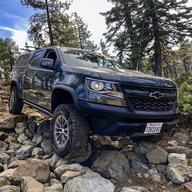
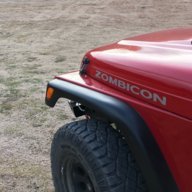
Wow, and I thought I just pulled that out of my ass :D I could see the long driveshafts in pick-ups being an issue. Just to clarify, you are vib free now that you performed the hub conversion?
 
  • Like
Reactions: jeepndogs
Yes, just drove it yesterday on a 300 mile round trip. Had the cruise set around 78 and just rolled along.
Nice. That damn conversion is not cheap. I need to invent a front driveshaft quick disconnect. :D

I wonder if the HP 30 would improve things. Not too difficult to source; direct swap; just need to re-gear to match the rear. Much cheaper than the hub conversion.
 
  • Like
Reactions: tomtaylz
Yes, just drove it yesterday on a 300 mile round trip. Had the cruise set around 78 and just rolled along.

Sounds like you've done your research though. When I regear if I run into this issue seems like the hub conversion is sort of the way to go.
 
Nice. That damn conversion is not cheap. I need to invent a front driveshaft quick disconnect. :D

I wonder if the HP 30 would improve things. Not too difficult to source; direct swap; just need to re-gear to match the rear. Much cheaper than the hub conversion.


It would have been if I knew it from the start and had the right gear set and differential for the HP. But since I had everything already the hub kit was the less costly way to go.
 
  • Like
Reactions: Rob5589
That kind of makes sense, I was going to say I never noticed this in my YJ, but the YJ is not solidly active it basically has a front drivline disco in the pass side axle. I wonder if I would have set that manually if it would have vibrated on the freeway.

Btw @Chris, I watched a video not too long ago that showed a kit that uses a Ranger kit to put locking hubs in front, but it was about 1100 bucks if I remember right.
 
That kind of makes sense, I was going to say I never noticed this in my YJ, but the YJ is not solidly active it basically has a front drivline disco in the pass side axle. I wonder if I would have set that manually if it would have vibrated on the freeway.

Btw @Chris, I watched a video not too long ago that showed a kit that uses a Ranger kit to put locking hubs in front, but it was about 1100 bucks if I remember right.

That’s cool! I think the bigger issue is that I would need new RCV axles if I got manual hubs, as I think the outer shaft needs to be longer.
 
  • Like
Reactions: ac_
I have looked into this for the last year. I have had hour long conversations with Tom Wood reguarding this on my Lj and a few dozen other people. Two things come into play. A driveshaft is balanced the same at 1000 RPM as it is at 10,000 RPM. Look at a crankshaft for example a 10,000 HP top fuel car the crank is balanced at a low rpm even though it sees 9000 RPM. Balanced is balanced. Driveshafts have what they call critical speed which is the point the shaft will deflect and spin off center. To calculate this you need to know lenght, diaimater, and wall thickness of the tube. At a certain rpm it WILL spin off center. The front CV joint is good to be vibration free according to spicer up to about 5000 Rpm at a 13 degree total angle. Once you lift over three inches the angle is about 15 from what I remember. That drops the rpm to 2500-2800 or so where it may start to vibrate. The variable is in the tollarance stacking of the individual parts. Like the centering ball, u-joints,and the housing itself of the cv joint. Throw in the fact the joint is welded to the shaft and may be .001- .10 off centered (the reason it needs to be balanced) and you have one Jeep that is just fine and one that vibrates.

@jeepndogs beat me to it with critical speed. I've been in the shadows, reading these and other threads. Everyone has mentioned driveshaft balance...no one has mentioned Driveshaft stiffness. My opinion is that the front driveshaft is exceeding critical speed and starting to deform (or whip). The longer the tube is, the earlier it will experience deformation...also smaller diameter and / or thinner wall stock. I wonder if Tom Woods or someone would make a custom DS with a larger diameter or heavier wall. This would change the response.

Someone should take some measurements of their set-up and plug them into this calculator...see what it spits out.

https://spicerparts.com/calculators/driveshaft-safe-operating-rpm-calculator
 
  • Like
Reactions: zebra12 and Chris
@jeepndogs beat me to it with critical speed. I've been in the shadows, reading these and other threads. Everyone has mentioned driveshaft balance...no one has mentioned Driveshaft stiffness. My opinion is that the front driveshaft is exceeding critical speed and starting to deform (or whip). The longer the tube is, the earlier it will experience deformation...also smaller diameter and / or thinner wall stock. I wonder if Tom Woods or someone would make a custom DS with a larger diameter or heavier wall. This would change the response.

Someone should take some measurements of their set-up and plug them into this calculator...see what it spits out.

https://spicerparts.com/calculators/driveshaft-safe-operating-rpm-calculator

From my Adams front driveshaft. Don't know what any of this means, just plugged in what the calculator wanted. I don't really understand how this calculator works without angles, but I'm going to assume it just bases everything off of deflection.

Screen Shot 2018-10-18 at 8.35.33 PM.webp
 
  • Like
Reactions: Chris