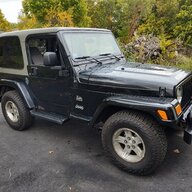
What did you do to your TJ today?

But since this is a what did you do to your TJ thread...I'll stay on topic...

This is basically a lounge thread in case it wasn't obvious.

Now do I pay a shop $1500 or do I buy a Vevor refrigerant recovery machine. I already have gauges, a tank, a scale...

I'd recover it and fix it yourself. The refrigerant badly leaked out of my truck's system after holding perfect vacuum and working well for about two days, so I don't have the burden you carry regarding recovery options. But, I'd still like to get a recovery machine in the future. I'll be replacing most of my AC system once my foot heals from this week's reconstruction surgery.

I've flushed my TJ's system, but I'm leaning towards paying to have that done since I'm not confident that the DIY way works as well. Any thoughts on that?
 
  • Like
Reactions: Kiwi TJ
Any thoughts on that?

Well I ordered a Vevor 3/4 HP refrigerant recovery machine. With a coupon and points from previous purchases it's $300. Then I ordered a Denso compressor, GHT receiver dryer and Four Seasons o-ring kit. I'm going to take a swing at it. I also need to hook back up my TJ AC. I've got all the parts. So we'll learn a little on the truck and then play with the Jeep.

We pull a lot of abandoned vehicles out of the woods. It'll be nice to recover all the refrigerant from them. I wonder if there's a place I can turn it in and make some money back.

There's plenty of off topic threads for folks. IMHO stay on topic.

-Mac
 
  • Like
Reactions: Kiwi TJ and Zorba
Well I ordered a Vevor 3/4 HP refrigerant recovery machine. With a coupon and points from previous purchases it's $300.

Thats about what I saw the 3/4hp version for.

Then I ordered a Denso compressor, GHT receiver dryer and Four Seasons o-ring kit. I'm going to take a swing at it. I also need to hook back up my TJ AC. I've got all the parts. So we'll learn a little on the truck and then play with the Jeep.

My main advice is to get the PAG oil dialed in for the entire system (I called Denso to get that info), and make sure to not install dry o-rings or o-rings that aren't quite the correct size. I used a combination of a Four-Seasons and GDP kit to dial in the TJ's new system about five years ago.

We pull a lot of abandoned vehicles out of the woods. It'll be nice to recover all the refrigerant from them. I wonder if there's a place I can turn it in and make some money back.

Maybe once the stuff gets more expensive....and you might want to keep it for yourself since it's already $18.00 for a 12oz can and will likely keep going up.

There's plenty of off topic threads for folks. IMHO stay on topic.

There's a lot of helpful and enjoyable side topics in this thread as well. If we're going to be critical about staying on topic, then you aren't allowed to plug your long YT videos that are mostly off topic from discussions at hand (and aren't time stamped to the info that might be relevent).

It's a balance of putting up with how each other operate in hopes to provide cumulative value. Sometimes we willingly turn a blind eye and other times it's gone too far.
 
Last edited:
If you look at the way the seat and rear fender are styled as one piece on the 'Glide and compare it to the VR 1000, you can tell the same person styled them. The VR 1000 took the concept a step further and wrapped the gas tank into the mix (the rider is multi-time GN dirt-track champ Chris Carr, and the young feller leaned over at the front is yours truly):
View attachment 703374

Willie G really liked horizontal lines, and he pointed out to me how the bottom of that tank-seat-tail formed a nice, horizontal line. Willie G would have done the same with the 'Glide, but at that time, they were two years into the AMF fiasco. I'm sure the AMF corporate attorneys put the kibosh on any talk of a fiberglass gas tank...

And since this thread is now thoroughly derailed, I apologize to all and thank you for letting me boast a bit. I've been blessed with a very fun career! :p

And to get the thread back on track, here's what I did to my TJ today:

🦗🦗🦗🦗 ⬅️those are supposedly crickets 😔

Very very cool, thank you for sharing! We have our share of Harley fans on this site as well, so I'm sure plenty of people enjoyed this!
 
Last edited:
And now back to our regularly scheduled program!

I put the Morryde tailgate reinforcement kit on this weekend. I still need to do the snubbers, but the pics are below. Please excuse my huge body lift, the Apex came with it and there are plans to swap it out for a 1" and add a 2" (ish) suspension lift). Not a bad kit to put on. I (per usual) had to use some heat to get some of the hinge bolts out but they came out easily enough with the blue wrench. The hinges pushed my tailgate far enough to the drivers side that I needed to remove a shim from the striker latch. As has also been discussed, you need to adjust the tailgate up over level so when you load it with the tire it comes back down. This seems obvious to me but i figured i'd mention it again.

I really like the kit. I like that I don't need a swing out bumper and I like the fact that it only adds something like 50 lbs to the back of the jeep.

Edited to add: I also did not use the offset brackets included with the kit. My wheel is on 15x10 rim and the tires are 33x12.5.x15. I forget what the backspacing is. Whatever it is, it's perfect. Without the offset brackets the wheel is sucked up close enough to the tailgate that i have no need to modify the oem carrier or fab a new one. Once I get the snubbers sorted out, I think this thing will be awesome.

Damn pricey, but I'm happy with it so far.

morryde1.webp

morryde2.webp
 
Last edited:
We pull a lot of abandoned vehicles out of the woods. It'll be nice to recover all the refrigerant from them. I wonder if there's a place I can turn it in and make some money back.
I'd caution against doing that. I have a friend back home who's the second-generation owner of a radiator and A/C repair shop. He's had to buy test equipment in order to determine whether or not the systems he works on are 100% the correct refrigerant. In the old days, when his old man ran the shop, everything was R12, and there were no issues.

However, my buddy had a situation where he evacuated a system into his recovery machine before starting repairs, but it wasn't R134a, as it was supposed to be. Someone, at some point, had charged it, at least partially, with R12 (or some other refrigerant - I don't recall if he knew what it was.) That was a costly assumption on his part. It contaminated his R134a supply in the machine, which cost him hundreds of dollars, but then he got a real surprise when he went to get rid of it. It was now hazardous waste, and it cost him four digits to dispose of it properly.

I have a Mastercool recovery machine for work on my personal vehicles. I've had friends ask me to pull down their systems for them, but I won't do it because I don't want to deal with contaminated refrigerant.

Edited to add: The cross-contamination is only getting worse. When he had a problem, there were only two refrigerants in use. Currently, there are three (although R12 is now very rare), and there's at least one other one coming...
 
Got around to removing the flat tow baseplate that my father-in-law put on it when he owned it. I knew it would be a slight PITA from researching how to install it. The nuts are inserted through holes in the frame with an attached metal rod that pops off when tightened. The plan was to remove bolts and use a magnet to get the nuts out of the frame.
FrontEnd.webp


Of course it wasn't that easy. Magnet was a no-go. A couple of nuts did not want to come off. You know...standard mess. After 3 hours, I finally got the nuts/bolts out with a Dremel since it was the only tool I had small enough to fit in the tights spots. Here's the aftermath of it all, including what's left of the Dremel cutting disk.

Parts.webp


And for @TheBoogieman....I rewarded myself with a tomato sandwich and some fresh raspberries - all from my wife's garden.

Food.webp
Food2.webp
 
Last edited:
Well, I've always seen them called "constant tension" clamps, but that's really irrelevant to why I made my comment. What I was responding to:


The way I read that exchange is that Mac was pointing out that when heat expands the O.D., the tension from the clamp stays constant. In other words, the "constant" part of Mac's statement meant constant over changes in diameter due to heat expansion - same tension as the diameter expands. That's entirely different than what I pointed out. Then, speeding_infraction responded, and then you responded that that was the only reason to have them. So, from my perspective, I saw a claim that had nothing to do with the constant pressure around the hose, and I added that.

I'm sorry if I offended you. It certainly wasn't my intent.

No offense taken, but there is still only ONE reason to use these clamps... and that reason is 'constant pressure'.
 
  • Like
Reactions: Kiwi TJ and sab
No offense taken, but there is still only ONE reason to use these clamps... and that reason is 'constant pressure'.

We'll have to agree to disagree on this one, Dan. I'll explain my position by examining the different types of hose clamps I've used on vehicles over the years. First, Oetiker clamps provide constant pressure, but there is no give to them, so they don't tolerate expansion due to heat (actually, it's contraction due to cooling, as leaks occur when the temperature cools and the tension is lost):
1786297552351.webp


Then there is this type of spring-loaded worm drive clamp, which provides thermal expansion protection, but doesn't provide constant pressure due to the worm drive assembly, similar to a normal worm drive clamp:
1786297456465.webp


And finally, the clamps originally discussed provide both tolerance for thermal expansion and constant pressure:
1786297780757.webp


So, at least in my mind, there are indeed two reasons to use that type of clamp: to get constant pressure around the perimeter of the hose and to allow for thermal expansion.
 
No offense taken, but there is still only ONE reason to use these clamps... and that reason is 'constant pressure'.

(First 17 seconds)

View: %5BURL%5D%5BURL%5D%5BURL%5D%5BURL%5Dhttps://www.youtube.com/watch?v=H9AnPuyLP8g[/URL][/URL][/URL][/URL]

I take this all to mean that a constant tension clamp provides uniform tension/pressure and is designed to contract with fatigued hose material (to a point) and expand/contract with a hose experiencing expansion/contraction (due to temperature fluctuations).
 
We'll have to agree to disagree on this one, Dan. I'll explain my position by examining the different types of hose clamps I've used on vehicles over the years. First, Oetiker clamps provide constant pressure, but there is no give to them, so they don't tolerate expansion due to heat (actually, it's contraction due to cooling, as leaks occur when the temperature cools and the tension is lost):
View attachment 703629

Then there is this type of spring-loaded worm drive clamp, which provides thermal expansion protection, but doesn't provide constant pressure due to the worm drive assembly, similar to a normal worm drive clamp:
View attachment 703628

And finally, the clamps originally discussed provide both tolerance for thermal expansion and constant pressure:
View attachment 703630

So, at least in my mind, there are indeed two reasons to use that type of clamp: to get constant pressure around the perimeter of the hose and to allow for thermal expansion.

(First 17 seconds)

View: %5BURL%5D%5BURL%5D%5BURL%5D%5BURL%5Dhttps://www.youtube.com/watch?v=H9AnPuyLP8g[/URL][/URL][/URL][/URL]

I take this all to mean that a constant tension clamp provides uniform tension/pressure and is designed to contract with fatigued hose material and expand/contract with a hose experiencing expansion/contraction (due to temperature fluctuations).


I may be wrong, but i feel like maybe Dan is saying the same thing you two are just in simpler terms, and by "constant pressure", he means that regardless of changing thermal conditions, a constant tension clamp is constantly providing adequate pressure due to its design.

I could be completely misinterpreting, however.
 
I guess some folks just want to argue. 🤷‍♂️

I’ll stick with my original statement… “constant pressure” is the ONLY reason to use this type of a clamp.
It’s not easier to use, not cheaper, not fancier on the eye, etc…
But it maintains the same clamping force regardless of engine temp, age of hose, etc.
 
So, at least in my mind, there are indeed two reasons to use that type of clamp: to get constant pressure around the perimeter of the hose and to allow for thermal expansion.

I'm with you about uniformity around the perimeter, but now I'm thinking a bit more about the pressure part of the conversation lol.

Doesn't a spring clamp match the force applied to it in order to achieve constant tension? I could use some help to better explain how a spring clamp can maintain tension on a hose that has contracted without it's pressure changing. It seems like its pressure would actually decrease to match the load on it that has decreased, and spring pressure would increase as the load/force increases from hose expansion.

In my head that's why it's called a constant tension clamp rather than a constant pressure clamp.

Edit 1: I can mess myself up even more by recalling that tension is known as pulling force. Should we be calling these constant resistance clamps?
Edit 2: Answer: No. I was thinking about it the wrong way. The spring band clamp is being actively pulled/stretched just like how a rubber band or fastener under elastic deformation tries to get get back to it's original shape, which creates the clamping force.

Sheesh, I think I'm done now. :sleep:
 
Last edited:
  • Like
Reactions: Kiwi TJ
I feel like the odd man out here as I toss every constant tension clamp i touch in the trash and replace all of them with T bolts if they’ll fit. Can take some trial and error to get the bolt in the correct orientation to clear everything and snugged up but I prefer them. This comes from working on heavy equipment and always having used them with good results. Nothing scientific, just field testing with good results. I will keep a constant tension clamp over a worm gear on smaller hoses. Depending on the style of worm gear clamp. The cheap worm gears damage most hoses. If I can’t fit in a T bolt clamp I almost always use one. I suppose the rubber flexes enough to make up for the expansion 🤷. Not something that ever crossed my mind.

IMG_5371.webp
 
I feel like the odd man out here as I toss every constant tension clamp i touch in the trash and replace all of them with T bolts if they’ll fit. Can take some trial and error to get the bolt in the correct orientation to clear everything and snugged up but I prefer them. This comes from working on heavy equipment and always having used them with good results. Nothing scientific, just field testing with good results. I will keep a constant tension clamp over a worm gear on smaller hoses. Depending on the style of worm gear clamp. The cheap worm gears damage most hoses. If I can’t fit in a T bolt clamp I almost always use one. I suppose the rubber flexes enough to make up for the expansion 🤷. Not something that ever crossed my mind.

View attachment 703636

I use them, as most do, for sealing charge pipe and intercooler fittings on boosted engines. Not sure how small they get down to, but I think price is a major factor for why folks don't run them as often.

We also have to verify they don't have leaks from contraction just like we have to do with hose clamps. That said, they are great clamps and must be somewhat forgiving when it comes to tightening...or we'd have leaks all over the place or we'd destroy our hoses from over tightening (either possible in my case). Constant tension clamps are more annoying to deal with when space is limited, but they seem to be superior for longevity.
 
Last edited:
I feel like the odd man out here as I toss every constant tension clamp i touch in the trash and replace all of them with T bolts if they’ll fit. Can take some trial and error to get the bolt in the correct orientation to clear everything and snugged up but I prefer them. This comes from working on heavy equipment and always having used them with good results. Nothing scientific, just field testing with good results. I will keep a constant tension clamp over a worm gear on smaller hoses. Depending on the style of worm gear clamp. The cheap worm gears damage most hoses. If I can’t fit in a T bolt clamp I almost always use one. I suppose the rubber flexes enough to make up for the expansion 🤷. Not something that ever crossed my mind.

View attachment 703636

I like the Tbolts also, but like you mine is from working on heavy equipment and class 8 trucks.

Tbolts are way better than the stupid shrink clamps they put on Turbo hoses now days.
 
  • Like
Reactions: Kiwi TJ