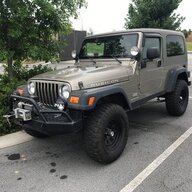
What did you do to your TJ today?

I guess some folks just want to argue. 🤷‍♂️
Well, from my viewpoint, we in this thread (not just you and I) were having a discussion, not an argument. I can tell that you were offended by our exchange after all, and. again, I apologize (despite MikeE024's objections.) :ROFLMAO: I honestly wasn't arguing. I'll buy you the beverage of your choice to make it up to you if we ever meet on the trail.

Sab seems like a guy who enjoys discussing engineering principles and how things work. I wouldn't put any more into it.
Bingo. I've spent 40 years solving technical problems, and glossing over things that seem obvious to others was a common mistake I made over those years. I've learned from those mistakes. I like to fundamentally understand how things work, and that requires frequent splitting of hairs. I participate here as a two-way street. Sometimes I'm gaining knowledge, and sometimes I'm sharing knowledge. In this case, I was simply pointing out that the clamps under discussion solve two problems that other clamps don't.

I may be wrong, but i feel like maybe Dan is saying the same thing you two are just in simpler terms...
Yes, that's obvious now. Dan clearly understands the dual benefits of these clamps. However, I'm not sure other members were connecting the dots, so I was trying to do that.

Doesn't a spring clamp match the force applied to it in order to achieve constant tension? I could use some help to better explain how a spring clamp can maintain tension on a hose that has contracted without it's pressure changing. It seems like its pressure would actually decrease to match the load on it that has decreased, and spring pressure would increase as the load/force increases from hose expansion.
Don't overthink it. You are correct, it doesn't actually maintain constant pressure with changes in diameter. It's a spring and has a spring rate (call it psi per inch of diameter change). However, it's a very low spring rate compared to a worm drive hose clamp. Also, it has a much larger working range of diameter changes (diameter changes once installed, not that it fits a wider range of diameters.)

A worm drive clamp quickly loses all pressure as the diameter drops - the clamp with actually slide out of position in extreme cases. Additionally, as the diameter increases, the worm drive's spring rate is very high (it's essentially a steel rubber band, after all), so in extreme cases, it can cut the hose as it expands instead of expanding with the hose like the constant tension clamp. While what we're calling constant tension clamps in this discussion don't truly apply constant pressure, they are much closer to constant than a worm drive hose clamp. That's all you can infer from the name.

As far as T-bolt clamps go, that's a discussion for another day. I think the only place we used them on Indy cars was the exhaust, but they are all over the heavy equipment used by the civil construction company I used to work for.
 
Well, from my viewpoint, we in this thread (not just you and I) were having a discussion, not an argument. I can tell that you were offended by our exchange after all, and. again, I apologize (despite MikeE024's objections.) :ROFLMAO: I honestly wasn't arguing. I'll buy you the beverage of your choice to make it up to you if we ever meet on the trail.


Bingo. I've spent 40 years solving technical problems, and glossing over things that seem obvious to others was a common mistake I made over those years. I've learned from those mistakes. I like to fundamentally understand how things work, and that requires frequent splitting of hairs. I participate here as a two-way street. Sometimes I'm gaining knowledge, and sometimes I'm sharing knowledge. In this case, I was simply pointing out that the clamps under discussion solve two problems that other clamps don't.


Yes, that's obvious now. Dan clearly understands the dual benefits of these clamps. However, I'm not sure other members were connecting the dots, so I was trying to do that.


Don't overthink it. You are correct, it doesn't actually maintain constant pressure with changes in diameter. It's a spring and has a spring rate (call it psi per inch of diameter change). However, it's a very low spring rate compared to a worm drive hose clamp. Also, it has a much larger working range of diameter changes (diameter changes once installed, not that it fits a wider range of diameters.)

A worm drive clamp quickly loses all pressure as the diameter drops - the clamp with actually slide out of position in extreme cases. Additionally, as the diameter increases, the worm drive's spring rate is very high (it's essentially a steel rubber band, after all), so in extreme cases, it can cut the hose as it expands instead of expanding with the hose like the constant tension clamp. While what we're calling constant tension clamps in this discussion don't truly apply constant pressure, they are much closer to constant than a worm drive hose clamp. That's all you can infer from the name.

As far as T-bolt clamps go, that's a discussion for another day. I think the only place we used them on Indy cars was the exhaust, but they are all over the heavy equipment used by the civil construction company I used to work for.

Damned engineers
 
I apologize (despite MikeE024's objections.) :ROFLMAO:

Lol I was playfully booing you for previously being so offensive :D

Don't overthink it. You are correct, it doesn't actually maintain constant pressure with changes in diameter. It's a spring and has a spring rate (call it psi per inch of diameter change). However, it's a very low spring rate compared to a worm drive hose clamp. Also, it has a much larger working range of diameter changes (diameter changes once installed, not that it fits a wider range of diameters.)

Thanks man, I realized I needed to consider more about how it worked and be better at using proper terms. I’d rather lay out my thought process than only show the conclusion. That’s how I got extra points in my 5th grade math college classes. 🥹
 
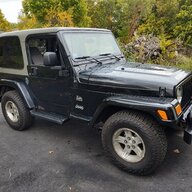
Picked up a 2004 TJ with 4.0L and 5-speed last weekend. About 165k miles.

Today: Air filter and spark plugs! Slowly but surely working my way through this thing and cleaning up from previous owners lol. Front-end steering geometry is next - has bump steer like crazy, and a 3.5" lift with no SYE (and all the vibrations and grinds to go with it), so tackling all that stuff in the coming weeks.

First one!.webp


Side-bonus: Put new bags and different shocks (struts?) on my Indian:

Indian.webp
 
Picked up a 2004 TJ with 4.0L and 5-speed last weekend. About 165k miles.

Today: Air filter and spark plugs! Slowly but surely working my way through this thing and cleaning up from previous owners lol. Front-end steering geometry is next - has bump steer like crazy, and a 3.5" lift with no SYE (and all the vibrations and grinds to go with it), so tackling all that stuff in the coming weeks.

View attachment 703647


Side-bonus: Put new bags and different shocks (struts?) on my Indian:

View attachment 703648

Without knowing anything else, make sure you don’t have a dropped pitman arm installed (I realize you’ll address that stuff soon).

Congrats on the rig and the bike :)
 
Without knowing anything else, make sure you don’t have a dropped pitman arm installed (I realize you’ll address that stuff soon).

Congrats on the rig and the bike :)

It does have a drop pitman arm! I was likely just going to take it off and put a stock one on, b/c the angles are WAY off on the front. Also going to replace the control arms b/c they're still the stock ones. Open to other suggestions!

Thank you!
 
OK, MoRryde tailage reinforcement kit is complete. Making and trimming snubber extensions was kind of a pain and a dirty job. I used an extra set of snubbers to make the spacers. I'm still not clear on how long the snubbers are supposed to be. I've probably got 1/2" between the wheel hub and the plate before I start snugging the lugs, maybe a little less....3/8". The lower one thats on the tub and not on the tailgate i left as a looser fit to the tire so it doesn't press against the tailgate much and try to open it. I *think* I am happy with the snubbers, but I may trim the lower ones a bit more later. I'm concerned that they will add unnecessary stress on the tailgate and break something, but with that 1/4" plate there, probably the only thing that would break would be the OEM caerrier, which I could live with.

The MoRryde kits comes with 4 spacers for the snubbers which I did not use for their intended purpose. The were the perfect height to move my 3rd brake light up to clear the 33" tire. After egging the holes in the factor brake light mount so I could move it away from the spare as much as possible, I bolted it on with these spacers. The 33 just clears this. I had to move the 3rd brake light wiring a bit to get it to reach nicely, but I didn't need to extend it. The only thing I needed to purchase was some bolts for the snubbers, as the ones that came in the kit were too long, and the originals were too short with the spacers and the 1/4" plate of the tailgate reinforcement. I had some longer bolts that worked with mounting the 3rd stoplight on the spacers.

All in all I dig it. I don't dig the $450 and change, but I like this so much better than a swing away tire carrier.

Pic:

Morryde_carrier_done.webp
 
Last edited:
In the last couple of weeks, I've bought a set of tires & wheels (5), drivers side mirror, Rancho shocks.
And finished the install of the Savvy skid plate and adjusted the exhaust hanger to get rid of the slight rub/vibration when taking off from a stop.
Wheels are U.S. Indy's, 5 slot, old school mags. Tires are Goodyear Wrangler Dura-tracs, 31-10.5/15's.
Next is the installation of the Savvy Aluminum control arms.
On the wish list is to replace the broken brand x radio with a stock one or a simple one from Crutchfield.
Speakers too.
Also there is a weld in cage kit that I'd like to get done while the weather is good.

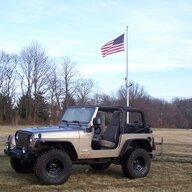
This is the White '03 TJ that I bought from my SIL after my BIL passed.
 
Last edited:
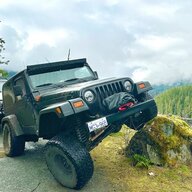
I feel like the odd man out here as I toss every constant tension clamp i touch in the trash and replace all of them with T bolts if they’ll fit. Can take some trial and error to get the bolt in the correct orientation to clear everything and snugged up but I prefer them. This comes from working on heavy equipment and always having used them with good results. Nothing scientific, just field testing with good results. I will keep a constant tension clamp over a worm gear on smaller hoses. Depending on the style of worm gear clamp. The cheap worm gears damage most hoses. If I can’t fit in a T bolt clamp I almost always use one. I suppose the rubber flexes enough to make up for the expansion 🤷. Not something that ever crossed my mind.
View attachment 703636

I love the clamp approach.

Just a thought, watch this one and/or replace soon:

IMG_5371.webp
 
  • Like
Reactions: Kiwi TJ
Sadly no pics but I replaced the fan clutch on my 2.5

Had an "incident" recently where I was lead rig driving up an increasingly overgrown logging road and somehow got an alder branch up into my engine bay. Miraculously this branch missed the serpentine belt but unbeknownst to me it wedged itself in my rad fan. I estimate i drove another 2km (2187.3 AR-15's laid end-to-end for you Americans;)) before my dash light alerted me to my situation...

I flushed/replaced my coolant when I got home and figured I was good but the old girl was running noticeably warmer than usual. Chocking it up to still having a few air bubbles in the system I drove it as-is. Just last week the idea popped into my head that maybe, just maaaybe my fan clutch was not healthy anymore. Jeep would come down to a nice temp at idle but got warmer when driving... Hmmmmm..

One fan clutch later we're back to perfect water temp and I feel like I can trust the old girl a little bit more again😅
 
I love the clamp approach.

Just a thought, watch this one and/or replace soon:
That’s just cause she lives next to the A/C line. She’s good for another 10 or so years. Got replaced 2 years ago with the heater core. If that goes again then it gets the heater core deleted. 😆
 
I would like to add to the hose clamp discussion. The worm drive clamps have been around for a while and the tension clamps from my experience, take that as you want :ROFLMAO: are newer. Now from what I learned the and have seen that most of the tension clamps came around the same time as plastic/composite material in our engine came. Worm drive clamps have to much force and can deform the plastic/composite material. So along came the tension clamp.
Any validity to that or am I talking out my backside?
 
Last edited: