My spacers came with red lock tite, so I’m assuming they recommend it. So, I used the loctite with them. If I have to apply a little heat to unlock it, then so be it.


I have run spacers multiple times over the years and have never used a thread locker. Nor have I ever had a spacer nut come loose, the same way I have never had a lug nut come loose.
Just some info, Permatex makes an Orange Threadlocker. Advertised as "the strength of Red Threadlocker with the removability of Blue Threadlocker."
I have some but haven't used it on anything yet nor have I ever used threadlocker on wheel studs.
Orange Threadlocker
View attachment 402660
Sounds cool but to be honest I'm a bit mystified how removability wouldn't be directly tied to strength. I'll have to read up on that.
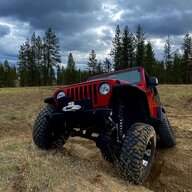
I thought the same thing until I lost a wheel. Now I use red locktite
I read through both of those installation procedures and I do not see where it says "NO LOCTITE".
 “I don’t know, I think beer would be better.”
That's definitely a unique perspective. I personally believe that properly torqued, they won't come loose (but should be checked at rotation time), and threadlock may have come along as a bandaid for common poor maintenance practice.
Buuuuut, my spidertrax spacers actually came with little tubes of the red stuff, and I used it without giving much thought to it. Not sure it's the same formulation as the permatex stuff because I can still break it loose with a 24" breaker bar.
So basically I agree with you in theory but I didn't practice what we're preaching.
 color?
That's because your junk is always up on jack stands. Wheels on, wheels off. Wheels on, wheels off. Sounds like Mr. Miagi
View attachment 402707
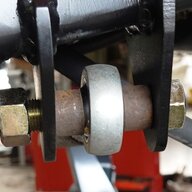
No, but I do use 271, 262, 272, or equivalent on the wheel spacer lug nuts. Typically, we are not using extra long wheel studs in our shorter spacers like the 1" versions that we commonly use. The lug nuts in those are pretty short and I'm not always impressed with the quality. I do it for the same reason that I use it on my dually front wheel spacers which is I'm taking half of the lug nuts out of the chance for a problem equation.Do you also use Loctite on your wheels?
How is it a unique perspective if the first two sites I looked up install instructions on do not mention loctite of any snow cone
Isn’t it more likely that this is a lawyer who suggested the company send out little packets of red stuff just in case someone was negligent and decided to blame the wheel spacer?
Yes, I have wheel spacers on a rig. No, one has never come loose. We also add anti seize between the spacer and the rotor mounting face so they don’t rust together. Never had a problem.
How is it a unique perspective if the first two sites I looked up install instructions on do not mention loctite of any snow cone
Isn’t it more likely that this is a lawyer who suggested the company send out little packets of red stuff just in case someone was negligent and decided to blame the wheel spacer?
Yes, I have wheel spacers on a rig. No, one has never come loose. We also add anti seize between the spacer and the rotor mounting face so they don’t rust together. Never had a problem.
I like to weld the spacers/wheel adapters in place

I lost a wheel without wheel spacers. I think it just means we didn’t get a lug nut torqued down. Human error. It means the same thing as far as spacers. There is no more proclivity for a spacer nut to come loose than a lug nut.
Depends on perspective and understanding. I don't use it on carrier bearing cap bolts, I do on the ring gear bolts. I don't use it on flywheel to crank bolts because those are place bolts. I will use it on torque converter to flex plates because I can see it came that way from the factory.
I don't use it on lug nuts that hold the wheel on, I do use it on spacer lug nuts. I use blue on drive shaft CV bolts, I don't use it on pinion cap u-bolts but I do on strap bolts at the pinion. I use red on caliper saddle to knuckle connections, I don't use it on caliper to guide pin bolts.
I use some sort of thread locker where a loose fastener has the potential to really make life difficult and in the case of lug nuts with spacers, I want to take 1/2 of the potential out of the equation.
You use lock tite on the spacers because they are not assessable to check them periodically unless you take the wheels off. That's why "I" use lock tite.
We have the wheels off once a month. Maybe that’s an important distinction.
What is the correct torque for lugnuts with Loctite? Or anti-seize? I've heard that Loctite recommends reducing applied torque by 20% from dry values, but I can't find that in their FAQ or anywhere official.
So should it be about 95 ft. lbs. * 0.8 = 76 ft lbs?





