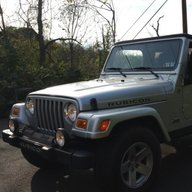
Death wobble, fully rebuilt front end

Sometimes even just unfortunate combinations of different components that are otherwise fine but have similar resonant and harmonic frequencies can be enough to allow death wobble or other significant NVH.

It’s possible the old wheels had inadequate stiffness when combined with the tires and would literally deflect during a death wobble event at nearly the same frequency as the resonant frequency of the steering system. Changing the wheels or even just altering the tire pressure might have been enough to change the resonant frequency.

I’d wager that the swap in wheels “cured” it simply due to a different tire pressure.

Shocks that control movement effectively will go a long way towards mitigating the occilations that result in death wobble.
 
Shocks that control movement effectively will go a long way towards mitigating death wobble.
In many cases, absolutely.

By changing the properties of the system damping in one mode of vibration, you’re changing the damped resonant frequency and also changing the frequencies that get most heavily absorbed in that mode of oscillation.

Same effect as adding a steering damper, which provides damping to a separate mode of oscillation. The steering damper tends to have a more dramatic effect, however, as it directly dampens one of the major modes of oscillation during death wobble, whereas shocks are modifying a secondary mode of oscillation.

Get enough modes of oscillation either adequately damped or far enough apart in natural frequencies (including higher order harmonics) and you will not have an issue with death wobble.

There are many modes of oscillation that can come into play, and not necessarily all of them will have an impact every time. Some major ones:
  • Oscillation of the steering geometry relative to the axle. This is the primary mode of vibration that creates the dramatic “death wobble” effect. But many other modes play in as well, and at least one has to line up to resonate with it.
  • Deflection of the trackbar and or steering joints - Commonly seen as parts wear out, they can develop slop.
  • Torsional deflection of the tires - super common, can’t be eliminated. However a change in tire pressure automatically changes the resonant frequency, as does changing to a different tire size or brand.
  • Vertical deflection of the tires - seen as “bouncing” when viewed from the outside. Not seen in every case, but it can happen. Dependent on tire pressure and multiple properties of the tire itself.
  • Tire-road interaction effects - This one is fairly difficult to understand for most, but the contact surface between the road and the tire is one of the most important modes of oscillation in a death wobble event. What happens is the contact patch isn’t constantly in the same location. Instead, it can shift around the profile of the tire both inboard and outboard and also forward and back, thereby rapidly oscillating the forces imparted back on the axle and steering hardware. The inboard-outboard oscillation is equivalent to constantly changing the scrub radius; likewise, the forward-backward oscillation is equivalent to constantly changing caster. Depending on the mode of oscillation of everything else, these modes can have constructive and destructive effects. Tire pressure and especially initial scrub radius can have a huge impact on this. Hence why changing wheel offset can worsen or cure death wobble.
  • Torsional deflection of the steering column, with the hands of the driver as a part of the system - The resistant force provided by the driver can be enough to create a natural frequency that aligns with the rest of the system. Hence why sometimes death gripping the wheel can stop it or make it worse, and in rare scenarios why letting go of the steering wheel can sometimes stop it. (Don’t attempt that last one.)
  • Deflection in the axle assembly or other “solid” parts - unclear how much of an effect this has, but it is almost certainly not zero.
  • Oscillation in the driveline assembly - rare as the driveline assembly tends to have a significantly higher natural frequency in 2WD than the steering oscillation, but can come into play when in 4WD vs 2WD.
  • Oscillation in the suspension - actually quite a number of different modes of vibration possible here. The two simplest and probably most important being the axle bouncing up and down and dancing left to right. Properties determined by vehicle mass, unsprung mass, spring rate, and damper (shock) properties.
  • Oscillation in the control arm assemblies - usually only comes into play with really worn control arm bushings. Most aftermarket bushings are stiff enough to push the natural frequency well above the frequency of concern, but it can become an issue with OEM bushings or very worn out aftermarket bushings.
  • Oscillation modes in the vehicle body itself - this one is hard to change, but extremely important. This is also why the whole cabin shakes violently. Changes in vehicle mass and rotational inertia and even simply how well objects inside are secured can all have an effect. This also occurs in all six degrees of freedom (roll, pitch, yaw, vertical, longitudinal, and transverse), although some (especially yaw) tend to be more important and pronounced than others.
In most, if not all cases, only a few of these modes need to line up to create a “death wobble”. Break enough modes apart to have different damped natural frequencies and/or have enough damping altogether, and the “problem” goes away.
 
I’d wager that the swap in wheels “cured” it simply due to a different tire pressure. The OP noted that 30 PSI was way worse than 22 PSI. I wouldn’t be surprised if the new wheels and tires are at a significantly different pressure, perhaps higher. I.e., if 30 PSI is unbearable, 38 PSI might randomly be perfectly fine.
In my case

Old wheels with old tires 26 psi , old wheels with new tires 26 psi, new wheels with new tires 26 psi

I'm on a 35” tire btw
 
  • Like
Reactions: Steel City 06
In my case

Old wheels with old tires 26 psi , old wheels with new tires 26 psi, new wheels with new tires 26 psi

I'm on a 35” tire btw

Wholly wasn't paying attention and thought your post about the cure was the OP's...

Definitely a lot of things can play into it. I do pay for the dynamic balance as well and recommend it.

I'm currently running Balance Masters balancers (which are simple Leblanc balancers) but they won't correct for out-of-plane imbalances. Same with the Centramatic balancers.
 
Not sure if this reply is timely, but I'd like to chime in here. 9* of caster is way too much. I have a '97 with 35s on a 2" lift on a Dana 30 high pinion axle. I adobted a death wabble when I changed my upper control arms. Didn't realize the caster changed that much when I changed the UCAs, but it did. Fix your caster to 6* or less (preferrably less) and your death wabble will go away, just like mine did. As others have noted, make sure your tie rod ends and ball joints are tight. In my experience the stock ball joints can't handle much offroading so I upgraded mine to Apex Chassis HD ball joints for $240 for four (apexchassis.com). They are the best I have tried, albeit many others may also be as good, but priced much higher. They have a lifetime warranty, too. I had my steering box rebuilt, too, and I don't recall any play in it, so maybe 1mm either side is okay, but if the old owner was running 37s he may have screwed it up and you may need to have it rebuilt. Don't ignore that, but fix the caster first and see what happens because that is definitely a key part of your problem.
 
  • Like
Reactions: Sensei