Emission grey zone?

Dillonx37

New Member
Original poster
Joined
Jul 2, 2020
Messages
11
Location
Upstate NY
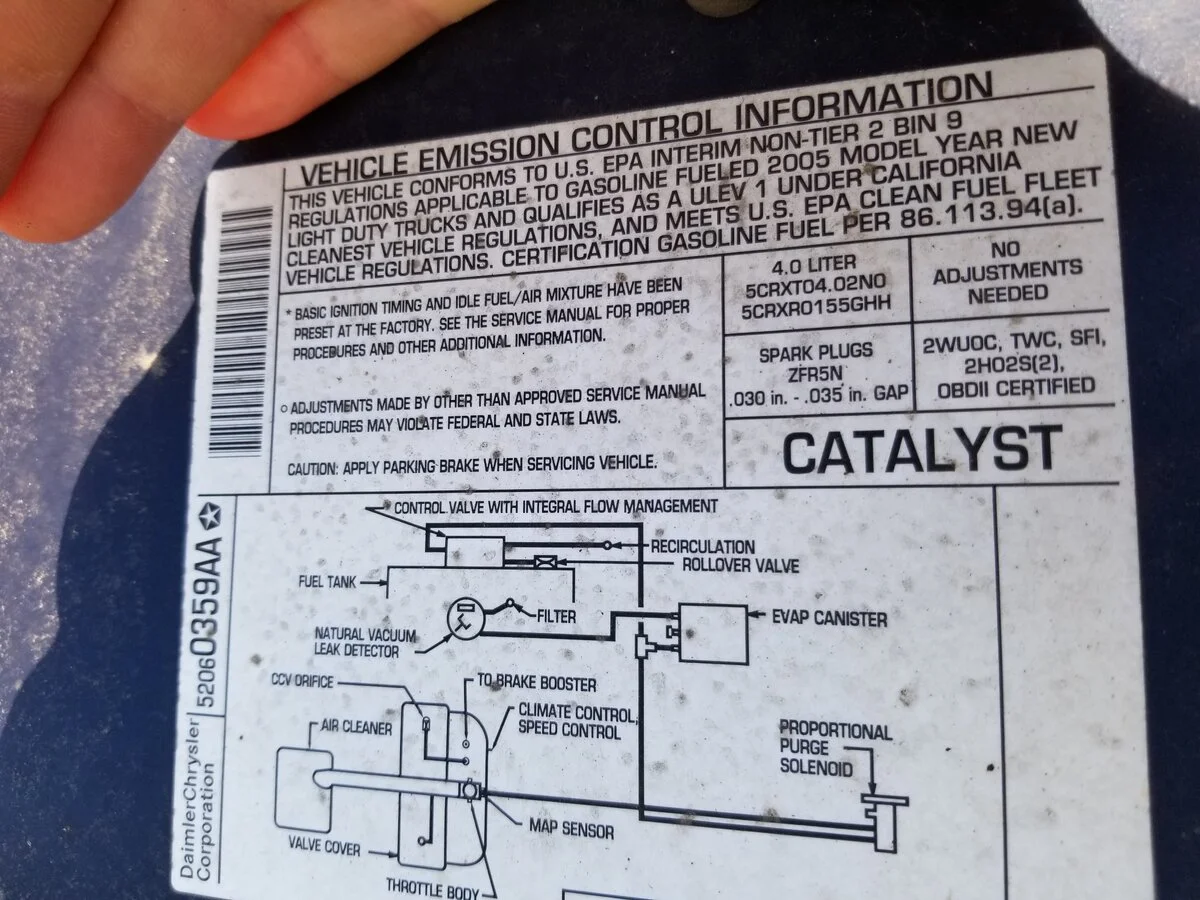
So I have started trying to change my oil pan+seal for my 05 4.0 LJ and typically you need to unbolt the twin cats by the manifold to get it out. I could not do this as I really dont have a proper work area to complete it myself so I am taking it someplace and I am worried with how rusty and corroded it is. So I am thinking of just buy a new system from the manifold back. However I do not know much about emissions. So as I did some research on the matter and because I live in NY with the call CARB rules I have found myself in a grey area with the year of my jeep. This link ( https://dieselnet.com/standards/us/ld_t2.php ) is the standard and the photo is of my jeeps emissions sticker. Now if I am reading it correctly because my vehicle is in Bin 9 it is no longer required to meet these regulations and I can switch over to a single (or no) upper cat instead of the OEM twin cat Y pipe. What do you guys think or if anyone knows more about this it will be greatly appreciated.

20200713_134548.webp
 
My last truck (1996) had the exhaust system rot off thanks to the profound use of salt here (I'm upstate NY too) and could only pass an inspection if I knew the guy doing it. They still as of last spring were 'sniff' testing and doing a visual inspection of all emissions. I actually had a broken lower wishbone they (state) were ok with, but the lack of any cats would be an instant fail. I would talk to several inspection shops and see what they say. Also if they conflict with the 'actual' laws they still have the right to fail you for a visual inspection reason.
 
If you remove the catalytic converters, you will get a CEL. Whether or not that would fail an inspection depends upon your state rules. Here in PA that would fail inspection in counties that require emissions inspections.

When my catalytic converters self-destructed, I went with the Magnaflow bolt in catalytic converters assembly. It was a perfect fit, legal, and causes no CEL.

They offer three versions. They have a federal emissions one, one for vehicles with California emissions vehicles outside of CA, and one for CA emissions vehicles in CA. Since my vehicle had CA emissions, I had to install the 2nd one.

A catalytic converter set for a vehicle with CA emissions is more efficient at converting pollutants to inert gases, but also costs more because it has a higher rare metal load. They flow just as well as the other type.

Vehicles with CA emissions in CA are held to a different standard, as the catalytic converters also have to be a very specific size. Other states, even those that have adopted CA emissions, do not require these, but require converters with the higher rare metal load.

If you were to install a non-CA emissions converter in a vehicle with CA emissions, a CEL will occur because the catalytic converters aren’t as efficient. Installing catalytic converters for CA emissions in a vehicle that doesn’t require it will cause no issues. The only difference would be less carbon monoxide and nitrogen oxides coming through the tailpipe.
 
I dont plan on deleting the main larger cat under the belly I just want to get rid of the 2 baby cats right by the manifold.
 
I dont plan on deleting the main larger cat under the belly I just want to get rid of the 2 baby cats right by the manifold.
Those two cats are the only ones that are monitored by the emissions system. There is an oxygen sensor before and after each one. The 3rd cat over the skid plate is not monitored.

If you gut or remove one or both precats, you will cause a CEL unless you wire up some sort of system to fool it. If you gut or remove the 3rd cat, you will not get any CEL, though you may fail a visual inspection.

Personally I run all 3 for both legal and ethical reasons, but it is pretty common for people to gut the 3rd cat, though any performance benefit is negligible at best unless the cat is plugged.