Another thing to consider, the engine can't move forward/backward much since it's also held in place back at the transmission. So the main forces are going to be up/down.



Which means what? You don't have a number but you agree with the other guy? Or you have a number and you don't want to share it?Wow.
I’m sure @toximus will be fine.Which means what? You don't have a number but you agree with the other guy? Or you have a number and you don't want to share it?
the other guy only posted anything out of genuine concern for the mans 15k worth of engine and the crazy power that beast is gonna lay down. if the advice is misguided, it was well intended and i back away.
Easy to test. Use a standard grade 8 9/16" bolt with normal washers that don't get close to the inside of the horseshoes. Go drive it as long as you like and it won't move.the other guy only posted anything out of genuine concern for the mans 15k worth of engine and the crazy power that beast is gonna lay down. if the advice is misguided, it was well intended and i back away.
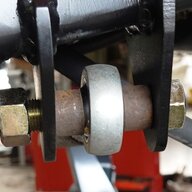
as for this washer in the horseshoe, i have a way to test it, my pig head has to see it to digest it.
it's (old Dana 30) sitting loose in the driveway.........nobody wants it so i'll grind the horseshoes off 1 of the brackets, torque in an MC joint and give it a few whacks with a hammer. the axle is loose the joint is squishy...all that aids the side of it not budging.Easy to test. Use a standard grade 8 9/16" bolt with normal washers that don't get close to the inside of the horseshoes. Go drive it as long as you like and it won't move.

It's really not impossible... Torque is simply the product of force and distance. Tox already posted that his engine will generate about 450 lb-ft of torque. The further away the mount is, the less force it will see from the engine.you ask for the impossible. there is no way to gauge what a stress fracture could have occurred from. be it an instant event or a long term leverage issue. but along a weld it's usually the temper that has made that line more brittle.
lets leave this at............1 might suggest not nukin that material when welding.
and the other question is also impossible to pinpoint without a complicated equation of mass and speed compounded by available torque and leverage.
All you really have to do is believe that the horseshoes are not locating the bolt. Once you believe that, then you can consider how much force the lower mount sees at freeway speed when a tire drops into a pothole.it's (old Dana 30) sitting loose in the driveway.........nobody wants it so i'll grind the horseshoes off 1 of the brackets, torque in an MC joint and give it a few whacks with a hammer. the axle is loose the joint is squishy...all that aids the side of it not budging.
surely i cannot generate what an impact at speed would, with a 2# hammer.
do you have a way of determining what forces that bracket (MM) is gonna be subjected to? is there a formula to follow, do we have enough info to use? or are we working against what we believe it should hold vs an unknown?
Is a flat belly possible with a 4.0, 241, 1.25” BL, and a homemade crossmember?
It would be easier than this Atlas. I will say, I don't think it's worth it and I wouldn't do it again...Is a flat belly possible with a 4.0, 241, 1.25” BL, and a homemade crossmember?
Where did you buy your 6061 from.It would be easier than this Atlas. I will say, I don't think it's worth it and I wouldn't do it again...
Where did you buy your 6061 from.
Did you end up going with 1/4”?Cheapest place I've found and I've always received exactly what I ordered: https://www.xometry.com/supplies/materials/aluminum-6061-t6
For very thin stuff like 0.032" I buy from McMaster-Carr.
Did you end up going with 1/4”?




