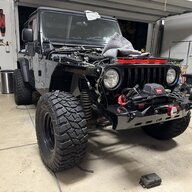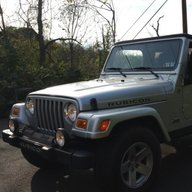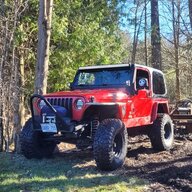
Keep it or let it go?

IMO, that doesn't look too bad. That would be on the "better" side of things as far as TJ's go in my area.

If you don't want to pour a bunch of money into it, I think your best bet would be some time with an angle grinder, needle gun and paint. Clean it up a bit, address the worst spots, and then go get it oil sprayed (inside frame rails too). I haven't used it yet, but I've heard good things about woolwax. It'll stop the rust from progressing any further and basically keep it where it's at.

My larger concern would be the body, as that's a lot tougher to fix rust on than the frame.

Or you could buy a clean one. I unfortunately don't have that luxury as my options are buy a clean one for a lotta coin, or deal with importing.
 
  • Like
Reactions: TheBoogieman
Thanks all! I should have prefaced with stating that I am not mechanically inclined and don't have the knowledge, tools, or gear to do this type of work. While I would enjoy the opportunity to have my mechanic brother help me get this Jeep back on the road, I have a demanding full time job and many other home projects going on.

At this point, with a heavy heart, I'm leaning towards selling it. Given I just put around $2k into it (full brakes, shocks, and 5 new tires), what do you all think would be a fair asking price? The new tires have < 50 miles on them.

One other important bit; the Jeep has ~140k miles on it. I don't know if that really matters, though, since the engine that everybody told me would last forever is kaput. 😢

Frank
 
Thanks all! I should have prefaced with stating that I am not mechanically inclined and don't have the knowledge, tools, or gear to do this type of work. While I would enjoy the opportunity to have my mechanic brother help me get this Jeep back on the road, I have a demanding full time job and many other home projects going on.

At this point, with a heavy heart, I'm leaning towards selling it. Given I just put around $2k into it (full brakes, shocks, and 5 new tires), what do you all think would be a fair asking price? The new tires have < 50 miles on them.

One other important bit; the Jeep has ~140k miles on it. I don't know if that really matters, though, since the engine that everybody told me would last forever is kaput. 😢

Frank

Damn, man. A non-runner is only gonna get you a couple grand.

If you were closer, I'd say bring it by and we'd see if it really is smoked.

If you aren't willing to do the $5k, I'd at least see if you can find a local shadetree guy on marketplace to drop you in a junkyard motor. Maybe you could get that done for a couple grand?
 
Non running rusted Jeep at most will get you $2k.

That being said I've seen plenty sold for $7 to $8k to unsuspecting buyers. Don't be that guy.

You'll get more parting it out.

Sell the PCM and complete wiring harness on eBay.

Interior. Top. Tub might not be rusted.

-Mac
 
  • Like
Reactions: NDSpeed
Thanks all! I should have prefaced with stating that I am not mechanically inclined and don't have the knowledge, tools, or gear to do this type of work. While I would enjoy the opportunity to have my mechanic brother help me get this Jeep back on the road, I have a demanding full time job and many other home projects going on.

At this point, with a heavy heart, I'm leaning towards selling it. Given I just put around $2k into it (full brakes, shocks, and 5 new tires), what do you all think would be a fair asking price? The new tires have < 50 miles on them.

One other important bit; the Jeep has ~140k miles on it. I don't know if that really matters, though, since the engine that everybody told me would last forever is kaput. 😢

Frank

$1000 and free shipping to Va? 🤔 Got any pics of the Jeep? What size are the new tires?
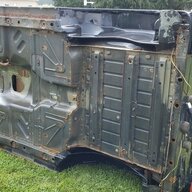
p.s. Since you don't actually know what's wrong with it, I'd list it for best offer and see what happens. That rust isn't an issue IMO. Any Jeep driven at OBX will look worse than that.
p.p.s. I bought a Jeep in Washington D.C. and didn't crawl underneath it to check things out (15 Jeeps ago). Got it home to find a redneck frame patch job with welds that looked like chewed bubble gum. The skid was welded to the frame too. Needless to say, I drove it for a few weeks and sold it for a $500 profit. I was honest with the buyer and he didn't care about the hillbilly frame repair. He said he was going to take it to the beach, then flip it for a profit. I sold it to him for $6500 and he sold it for $9000. I'm betting he wasn't honest like me. I just couldn't do that to anyone.
SAHARA JEEP4 (2017_11_20 00_38_12 UTC).webp
 
Last edited:
Local FB Marketplace gets way more viable action.

I'm in the mindest that OP saw value and trust in this form by joining it to ask for advice therefore, he'd prefer to "rehome" it to an enthusiast and possibly a WTJF member. He'll get action on Marketplace for sure, but much of that action is getting kicked in the nuts by broke-asses and shady flippers.
 
I'm in the mindest that OP saw value and trust in this form by joining it to ask for advice therefore, he'd prefer to "rehome" it to an enthusiast and possibly a WTJF member. He'll get action on Marketplace for sure, but much of that action is getting kicked in the nuts by broke-asses and shady flippers.

Plus it presupposes that he's on facesuck in the first place.
 
There is always a 3rd option versus selling or repairing it. OP could simply mothball it and push it to the back of the garage until he has the time or money to fix it the way he wants. (I'd only recommend this if OP has an emotional attachment to this particular car however.)

Plus, isn't it a jeep thing to have a clapped out YJ or TJ in the back of the garage that hasn't ran in 15 years, rusting away like the memories of your youth? Then when you finally fix it you realize you're too old, so you give it to your teenage kid instead, and they suddenly become the coolest kid on the block.
 
I went and had a chat with the mechanic this morning, in the hopes I can get closure on this situation. I'm going to have him take a look to be sure it's not just a sparkplug or coil or something repairable.

If the diagnosis is worse than something relatively simple, you might see an ad on this site.

Thanks again to all for the responses and feedback!
Frank
 
I went and had a chat with the mechanic this morning, in the hopes I can get closure on this situation. I'm going to have him take a look to be sure it's not just a sparkplug or coil or something repairable.

If the diagnosis is worse than something relatively simple, you might see an ad on this site.

Thanks again to all for the responses and feedback!
Frank

Perhaps also start a thread describing the symptoms. Especially include any codes that come up. There are a lot of unique problems to the 4.0 that a general mechanic might not be aware of.

One of the great things about this forum is that we see a lot of the same things over and over again, and some users are really adept to point out things to try, sometimes super simple things.

To me it sounds like your engine is in limp mode. Basically no power, and the governor is set to just over 2,000 RPM so it will cut out just above that.

Limp mode could be caused by any number of things, possibly simple or complex. E.g., a bad camshaft or crankshaft position sensor, a tiny wiring fault, a bad ECM, a spun camshaft synchronizer, a bad alternator, a clogged catalytic converter, a bad oxygen sensor, or any number of things, most of which are repairable.

Perhaps if we knew the error codes we could narrow down a few things.
 
To get the codes without a reader, put the key in the ignition. Cycle it off to run three times without starting it, leaving it in Run on the 3rd time. (OFF-RUN-OFF-RUN-OFF-RUN)

The error codes will flash across the odometer one by one, followed by “donE”

Post those here or in a new thread and we’ll give you some ideas to have the mechanic look at.
 
As for the engine itself, consider having the mechanic do a compression test and a leak-down test on each cylinder unless you find something obvious right away.

Both tests will give you good information and tell you different things, and will give you a good idea if there is a major issue in the block cylinders, pistons, or valvetrain assembly. It’ll also give you a good idea on the overall health of the engine block.

If you have an air compressor, this is probably something you could do yourself with a loaner tool kit from your local auto parts store.

As for the debris underneath, the mechanic will probably have to pull the oil pan to see what is going on. If it’s just a small amount of metal shavings, it’s probably nothing major to worry about. All engines leave behind a small amount of debris. But if there are actual chunks of connecting rod or something in the pan, then you’ll know that engine needs an overhaul.
 
A final consideration is to consider how much this car is worth to you. Sure you may be able to sell it for a given price, but that doesn’t necessarily mean that is the value to you. If you’re attached to it, the actual value could be a lot higher. Or if you despise it, its value to you could be a lot lower, maybe even negative.

The reason I bring this up is because you will get many different opinions on if it is worth rebuilding or not, often times dependent on the poster’s own biases. Some of us are very attached to our cars because it is our first and only jeep, or perhaps we’ve had it a very long time. Others might be on their 5th or 6th TJ and just burn one up and then part it out and buy another.

Nothing on the TJ is irreparable or irreplaceable. You can literally buy every single part used to assemble the TJ as a new aftermarket part, even the frame and the tub. (Granted, you’d probably spend $50-100k trying to fully Ship of Theseus a TJ with all new aftermarket parts.)

The point being, it’s all about what you are willing to spend and only you can make that decision for yourself.
 
I had no idea
To get the codes without a reader, put the key in the ignition. Cycle it off to run three times without starting it, leaving it in Run on the 3rd time. (OFF-RUN-OFF-RUN-OFF-RUN)

The error codes will flash across the odometer one by one, followed by “donE”

Post those here or in a new thread and we’ll give you some ideas to have the mechanic look at.

I had no idea you could do this! Very cool!!!!!

Here are my codes (P0303 P0121 P1494 P0456), along with AI suggested causes/explanations. Maybe I can get away with new sparkplugs and/or coil?


P0303 — Cylinder 3 Misfire Detected

What it means:
Cylinder #3 isn’t firing correctly.

Common causes:

  • Bad spark plug or coil (very common)
  • Fuel injector issue
  • Vacuum leak near that cylinder
  • Low compression (less common but more serious)
How urgent?
👉 Medium to high — if it’s actively misfiring, fix soon to avoid catalytic converter damage.


P0121 — Throttle Position Sensor (TPS) Range/Performance Problem

What it means:
The throttle position sensor is giving inconsistent or out-of-range readings.

Common causes:

  • Failing TPS
  • Dirty throttle body
  • Wiring/connectivity issue
Symptoms:

  • Rough idle
  • Hesitation or jerky acceleration
  • Weird shifting (in automatics)
How urgent?
👉 Medium — affects drivability, but not usually catastrophic immediately.


P1494 — Leak Detection Pump (LDP) Switch or Mechanical Fault

What it means:
Your EVAP system’s leak detection pump isn’t behaving correctly.

Common causes:

  • Faulty leak detection pump
  • Vacuum line issues
  • Electrical problem
How urgent?
👉 Low — emissions-related, won’t affect how it drives much.


P0456 — EVAP System Small Leak Detected

What it means:
There’s a small leak in your fuel vapor (EVAP) system.

Common causes:

  • Loose or bad gas cap (start here!)
  • Cracked vacuum lines
  • EVAP canister or hoses leaking
How urgent?
👉 Low — mostly emissions, not drivability.


What’s Likely Going On (Putting It Together)

You’ve got two separate issues:

1.​

  • P0303 (misfire)
  • P0121 (TPS issue)
👉 These could be related. A bad TPS can mess with fuel/air delivery and contribute to misfires.


2.​

  • P1494 + P0456 together
👉 Very common Jeep combo. Usually:

  • Bad gas cap or
  • Leak detection pump / hoses

Smart Order to Fix (saves money)

  1. Start cheap & easy:
    • Replace spark plug on cylinder 3
    • Swap coil with another cylinder (see if misfire moves)
    • Tighten or replace gas cap
  2. Then check:
    • Throttle body (clean it)
    • TPS (very common failure on older Jeeps)
  3. If EVAP codes remain:
    • Inspect vacuum lines
    • Consider leak detection pump

Quick Reality Check

If your Jeep:

  • Idles rough or shakes → focus on P0303 first
  • Drives fine but has a check engine light → EVAP stuff can wait

 
  • Like
Reactions: macleanflood
Imho the only one there of consequence is the 303 cylinder misfire.

I'd get a compression tester from harbor freight for $50 or order one from Amazon. Super easy to pull the spark plug. Pull the fuel pump relay. Screw in the hose from the compression tester by hand and crank the engine for 10 seconds. See what the gauge reads.

The IAC might be relevant. I had a mouse eat my air filter. I didn't realize it until after I drove on a dusty road...went to knock it out and discovered most of it converted into a mouse nest...the throttle body was filthy. So check your throttle body and eventually clean your IAC... there's a write up in resources.

That dirt probably didn't do good things to my cylinder walls or rings.

-Mac
 
  • Like
Reactions: Steel City 06
I would definitely focus on the Cylinder 3 misfire. That is almost certainly what is causing limp mode.

Essentially, the PCM monitors crankshaft speed throughout the rotational cycle to see if there are variations based on when each cylinder is supposed to fire. It counts events it thinks are misfires, and once it hits a certain threshold, it throws a code. If it hits a higher threshold, it goes into limp mode.

The primary reason it goes into limp mode is to protect the catalytic converters from damage. If you have fuel+air but no spark, the cylinder exhausts the unburnt mixture, which detonates as soon as it hits the catalytic converter, causing damage. The ECM has no way of knowing if the misfire is caused by a lack of fuel, a lack of air, a lack of spark, or a lack of compression, so it defaults to limp mode as a fail-safe.

A misfire can usually be broken down into four major causes: a lack of fuel, a lack of air, a lack of spark, or bad compression. Lack of air is fairly rare for just one cylinder and is usually a result of bad compression, so you can rule that out as an independent cause.

Then it’s just hunting down everything else. Fuel and spark can be tested by swapping the injector and the spark plug to different cylinders and seeing if the issue follows. For spark you’d also need to test the coils and/or distributor, and you’d want to check the spark plug wires if you have a distributor. Compression can be checked with a compression tester; a leakdown test will give more data and hopefully the two tests would narrow down or rule out any concerns there.