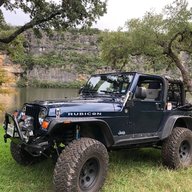
King Shock Pressures

PBTJ04

TJ Enthusiast
Original poster
Supporting Member
Joined
Jun 21, 2018
Messages
106
Location
San Antonio, Texas, USA
I have king shocks on my 04 with a 4" lift with 35's. They have 100lbs of nitrogen in them but my rear is bottoming out. I think my springs are weak but i think the shocks should have at least 170 lbs. Has anyone played around with pressures and found an ideal pressure?
 
If your springs are providing the ride height that you want, then they are not the problem.

Are your shocks valved for your Jeep? How much suspension up travel do you have? Are your bump stops extended correctly?
 
Shocks only have about 4" of travel and have adjustable valves and i have them set all the way on firm. when i bottom out the bump stops do not come in contact with the axle and they are extended out as far as they go. I also notice that the rear control arm is hitting the gas tank skid plate at the top, guessing it happens when i bottom out. I talked to King and at first they recommended 100lbs so that is where i had them set, now when i talk with them they say i can go as high at 200 but it is up to me on how i want the jeep to ride. The valves have 20 clicks of adjustment. I think my springs may just not be as firm as other springs of similar height.
 
Shocks only have about 4" of travel and have adjustable valves and i have them set all the way on firm. when i bottom out the bump stops do not come in contact with the axle and they are extended out as far as they go. I also notice that the rear control arm is hitting the gas tank skid plate at the top, guessing it happens when i bottom out. ...

First things first, your bump stops are not correctly extended for your setup. It also sounds like your suspension travels are much less than you think and the rear axle isn't positioned quite where it ought to be.

Post several pics of the rear.
 
Rear axel too far back? it appears to be centered on fender wells? I have a long arm lift and have had it aligned but i got a new drive shaft and have been playing around with the diff angle due to a vibration i cannot seem to get rid of either.
 
Let's focus on your bump stops and actual travels. This is not a spring issue.

Get out the tape measure and take some pictures.
 
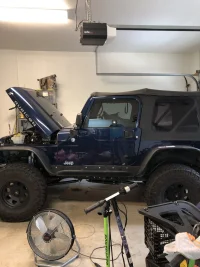
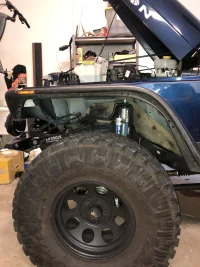
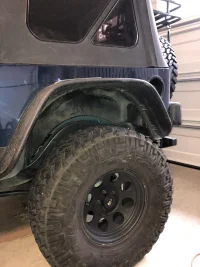
Here are some photos

23262B5D-C7EC-4ACF-926F-CE8FA4149ACB.webp


EC859F3F-241E-4CC4-ADD1-42987E8331E4.webp


4955F932-EA00-4687-A497-BB1831135053.webp
 
The rear has about 2.5" of lift. The shocks have 4" of up travel. The bump stops allow for 6" of up travel.

Without knowing more, your expensive shocks are acting as the bump stops. Eventually, this will either damage the shock or tear off a shock mount.

To fix the problem as shown in the pictures, you need more bump stop extension or shorter shocks or more realistically a combination of both.

It would be useful to know the extended length of the shock shaft. I suspect that they are too long for your setup.

It would also be very beneficial for you to fully cycle the suspension by removing the coils and soft jounce bumpers and move the axle around with a floor jack in order to confirm what your limit to up travel really is. Is it the shocks or is it something else?

Also post a pic of the rear driveshaft from the t case to the axle. It is odd to have a long arm with that low of a lift. How is the pinion set?
 
Last edited:
The rear has about 2.5" of lift. The shocks have 4" of up travel. The bump stops allow for 6" of up travel.

Without knowing more, your expensive shocks are acting as the bump stops. Eventually, this will either damage the shock or tear off a shock mount.

To fix the problem as shown in the pictures, you need more bump stop extension or shorter shocks or more realistically a combination of both.

It would be useful to know the extended length of the shock shaft. I suspect that they are too long for your setup.

It would also be very beneficial for you to fully cycle the suspension by removing the coils and soft jounce bumpers and move the axle around with a floor jack in order to confirm what your limit to up travel really is. Is it the shocks or is it something else?

Also post a pic of the rear driveshaft from the t case to the axle. It is odd to have a long arm with that low of a lift. How is the pinion set?
 
it is a 12 year old 4" teraflex long arm lift running 35's. Body lift, motor mount lift, belly skid spacers. Maybe overall the springs are sagging. They feel soft. ie reason for wanting to know shock pressures. The jeep sits level? The diff is in line with the CV coming off transfer.
 
Stock was 12" front, 8" rear.

What is your tire size?

Even if the springs are sagging from age or added weight, the bump stops are wrong for those shocks. Neither springs nor shock pressure will fix that.
 
The first post says 35" tires. That ought to have about 5" of total lift. 4" of spring and a small body lift is common.

I am still interested in what the rear driveshaft and pinion angle are doing.
 
What are the compressed and extended lengths of the shocks? How was their size determined?

Step one is to put the ride height where it needs to be with the appropriate springs. Also, adjust the pinion angle for the new ride height, as that will effect the position of the lower shock mounts.

Then the axle needs to be fully cycled through it's full movements in order to determine what the minimum and maximum measurements between shock mounts are. With the tires on and the springs/jounces removed, raise the axle to find the first point of interference and measure the space between shock mounts. Then, hang the axle with the springs loosely in place, measure between shock mounts again.

From there we can determine the appropriate shock length. The overall shock travel should be roughly split in half. I prefer to favor more up travel than down travel, if possible. Finally, the bump stops most likely need to be extended to protect the compressed shocks.

If the rear end is any indication of how things are set up, I would be looking at the front as well to see if everything is playing well together.

After all that setup, and only after, should you start messing with the shock valving.

 
If it helps, you can cycle the axle right now and find that first point of interference without addressing the ride height. This will tell what is hitting the gas tank and help you figure out what to do about that. All of these things relate to each other and play a role in determining the final set up.

35" tires aren't easy to make work, but cycling the axles will take most of the mystery away from what needs to be done to make everything work well together.