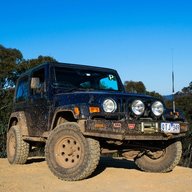
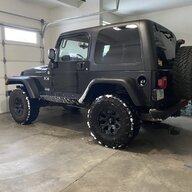
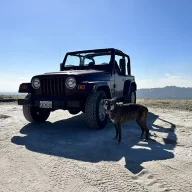
Long range fuel tank

When I first started building my Jeep, I added a tire carrier that held two 5 gallon cans and fantasies of running out of gas somewhere remote. It never happened unless I wanted it to be passing up a gas station. One of the best things I ever did to the Jeep was ditch that carrier.
 
I carry an additional 5 gallons only when Winter wheeling or camping. While I’ve never run out of gas on the trail there have been a few times which I ended up running the last stretch to a fuel station with the low fuel light on. It only ever happened during Winter runs where the trails can become unpredictable. The same trail could be a 6 hour day or 16 hour day. After cutting it close a few times I now carry extra fuel and pour it in the tank mid trail.
 
  • Like
Reactions: srimes
I believe there is much more utility in having fuel under the car than outside the car. Gas cans are a decent backup option, but they really don’t save time or effort over simply stopping for gas earlier. They may help you push farther into emptying the tank, since you at least won’t be stranded, but you would still have to pull over and turn off the vehicle to use them.

Where the long range and large (Genright) tanks come into play is running constantly without stopping. At 12 mpg, I would have to pull over every 150 miles or so to fill up the tank. With the Genright, I can make it about 220 miles before filling up. A Long Ranger tank would add 140 miles easy.

So at 70 mph:

Stock tank (19 gallons):
Fill up once every 2 hours
Genright extended tank (24.5 gallons):
Fill up once every 3 hours
Genright Safari tank (30.5 gallons):
Fill up once every 4 hours
Long ranger and stock tank (31 gallons):
Fill up once every 4 hours
Long ranger and Genright extended tank (36.5 gallons):
Fill up once every 5 hours
Long ranger and Genright Safari tank (42.5 gallons): Fill up once every 6 hours

So on a TJ, you can go 5 hours versus 2 with larger and more fuel tanks nonstop. On an LJ, you could make that 6+.

When you’re driving 12+ hours a day for multiple days, that time spent fueling up really makes a difference. I have a 36 gallon tank on my pickup (16 mpg), and can go almost 9 hours on a full tank. (By the time you need to stop for fuel at 9 hours, you probably have to take a leak anyways.) Heck, the Super Duty can be bought with a 50 gallon tank.
 
  • Like
Reactions: Zorba
I believe there is much more utility in having fuel under the car than outside the car. Gas cans are a decent backup option, but they really don’t save time or effort over simply stopping for gas earlier. They may help you push farther into emptying the tank, since you at least won’t be stranded, but you would still have to pull over and turn off the vehicle to use them.

Where the long range and large (Genright) tanks come into play is running constantly without stopping. At 12 mpg, I would have to pull over every 150 miles or so to fill up the tank. With the Genright, I can make it about 220 miles before filling up. A Long Ranger tank would add 140 miles easy.

So at 70 mph:

Stock tank (19 gallons):
Fill up once every 2 hours
Genright extended tank (24.5 gallons):
Fill up once every 3 hours
Genright Safari tank (30.5 gallons):
Fill up once every 4 hours
Long ranger and stock tank (31 gallons):
Fill up once every 4 hours
Long ranger and Genright extended tank (36.5 gallons):
Fill up once every 5 hours
Long ranger and Genright Safari tank (42.5 gallons): Fill up once every 6 hours

So on a TJ, you can go 5 hours versus 2 with larger and more fuel tanks nonstop. On an LJ, you could make that 6+.

When you’re driving 12+ hours a day for multiple days, that time spent fueling up really makes a difference. I have a 36 gallon tank on my pickup (16 mpg), and can go almost 9 hours on a full tank. (By the time you need to stop for fuel at 9 hours, you probably have to take a leak anyways.) Heck, the Super Duty can be bought with a 50 gallon tank.
a veron Bugatti can go 15 MINUTES AT TOP SPEED ON A FULL TANK
 
  • Haha
Reactions: Steel City 06
Thank you everyone for your responses, you have all been very helpful! I think I might look into getting a larger fuel tank rather than an auxiliary one.
 
  • Like
Reactions: Hammer24
I'm over the border from you in Vic, and I have a 125 litre brown-davis long range tank (thats 33 gallons for our american friends). It sacrifices a little bit of clearance but it's plenty strong enough to take hits from coming down on rocks and landing on it. Personally I prefer the single larger tank option rather than the auxiliary as then you don't need to worry about transferring the fuel over and all that, plus I'm not huge on where that auxiliary tank sits. Just my opinion.

Where did you go to for your tank? I can only seem to find places in the US?
 
Where did you go to for your tank? I can only seem to find places in the US?
It was already on the Jeep when I bought it, can't seem to find much on it online so perhaps they've discontinued it? Best bet would be to email them and ask, they're an australian company and they might even be able to make one as a custom order.
 
I've been wondering about the Long Ranger. How hard would it be to set up to also be able to pump out of the tank into a portable tank? Could be used to fill another vehicle or run a generator during a hurricane.
 
I've been wondering about the Long Ranger. How hard would it be to set up to also be able to pump out of the tank into a portable tank? Could be used to fill another vehicle or run a generator during a hurricane.
I would think you could just add a tee and a couple valves. Check out the installation PDFs on my previous posts to see how it is plumbed
 
  • Like
Reactions: Viking Jeeper
I do that all the time. Nice to have that extra reserve. However, it's not always safe or convenient to pull over on the side of a freeway to dump fuel in. Doesn't really save time over gassing up at a station either.

But I'll carry a couple cans even with the Genright tank. Heck, if I get the Long Ranger, I could carry 48 gallons easily. Get the side can mounts as well, and you could easily roll down the road with almost 60 gallons....
View attachment 181453
With that much gasoline, be sure to placard the TJ with something like this :)

7841.webp
 
Let’s say you get 12 mpg, and fill up when you have on average 5 gallons left in the tank. Also assume you’re keeping the Jeep for 100,000 miles post-install.

That translates to 8,333 gallons of fuel burned through the remaining life of the TJ. That translates to roughly 595 fill-ups with the standard tank, or 427 fill-ups with the extended range tank.

Let us assume that the average fuel up time takes 15 minutes, including the time finding a station, decelerating, stopping, and merging, over simply driving past it.

That results in 168 fewer fill-ups through the life of the TJ.

As a result, you spend 42 extra hours of your life filling up the Jeep with the stock tank. If you value your time at $20 an hour, that essentially covers half the cost of the tank. Add in the convenience factor of not having to stop as frequently, and it eventually becomes worth it. In addition, the total cost also covers the cost of the skid plate, which many would otherwise spend several hundred to replace separately.


Wait, you spend 15 minutes filling up?🤪
 
Fuel was heavier and took longer to pump way back then.


🤭
I was kind of thinking that with inflation, it probably takes closer to 30 minutes these days… at least that’s what math I’m using when justifying the new gas tank to my wife😂
 
  • Like
Reactions: SkylinesSuck