After I got back from doing the ride pictured above, discovered it was still leaking. That was a bit of a let down, but not entirely surprising. I've battled leaks all my life with motorcycles and plumbing. In all that time the only things I have learned is -
1. 90% preparation, 10% perspiration
2. There's rarely just one leak.
The first one is obvious - prep, prep, prep! Mating surfaces cannot be too clean. The second is just the way it is. I knew I was fixing the pan leak - if there ever really was one. But I kind of figured I wasn't done.
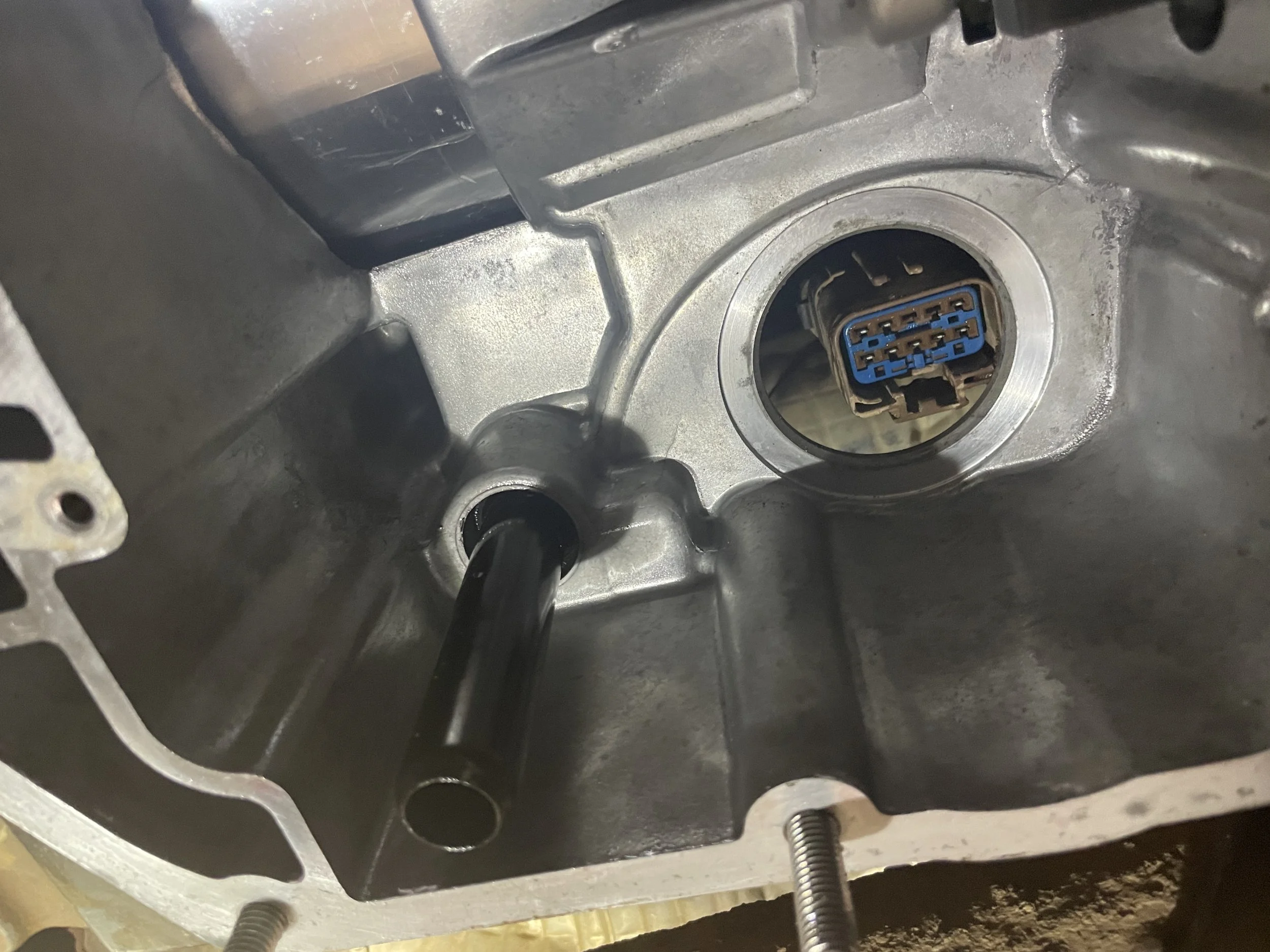
As it turns out t wasn't one of the common leaks like from the dip stick or the shift shaft seal. It was the electrical connector that sticks up through the transmission case on the driver's side.
I was hoping the pan drip was blowing around when driving but nope - that wet spot is from where that green plug attaches. So that meant dropping the pan again, as well as the shift solenoid assembly above the filter.
Here it is on the bench. The bench is a 94 F150 hood (still attached to a F150).
The offending seal is the brown one with kind of a cone shape (blue line). I could see someone else tried to fix the leak with grey sealer - probably Threebond like I use, but for hard mating surfaces, not rubber to aluminum. That seal is really a collar and slides off the connector base easy enough. I scrubbed it very well with Dawn in the kitchen sink - my wife loves that. It was filthy and had sand grit in it which isn't ideal in an oil filled component. But I didn't see any residue on the assembly where it would collect, so I think the grit was just enough to cause the leak.
I used black RTV and put a narrow bead around the tip of the cone as well as the top of the opening in the transmission, shown here -
I don't like using RTV on a rubber seal. It should seal on it's own. But in this case I reasoned that a little near the top wouldn't hurt and it would mostly get pushed up and out as I replaced the solenoid assembly. And that's exactly what it did - there was a little built up on the outside of the transmission by the connector base, which I left as is.
I plugged all the electronics back in and reconnected the shift linkage. I added about 6 quarts of ATF and took it for a spin. No engine light - a good start. It went into reverse just fine, and the little drive around the block gave me enough confidence to take the Jeep on a Costco run with the wife. It shifted great, and went in and out of OD as expected. Why wouldn't it you ask? Good question. There are two accumulator pistons that drop out when you lower the solenoid assembly.
Those things. See how one is missing a spring?
From the factory they have two springs each - an inner and an outer. But one of mine was missing the inner spring. I was pretty sure I didn't lose it as it's somewhat trapped in the outer spring. And I was very careful when removing the solenoid assembly. There are a few things you have to do before lowering that. If you don't, it won't come all the way out. Those two things are make sure ALL connectors are disconnected. I didn't realize there was another 10 pin connector on the passenger side. It goes to the solenoid itself with the green gasket pictured above. The other thing is you have to rotate the shift shaft past 1st gear. That retracts an arm that will hang up if it's just left in Park or any other gear.
But back to the springs. I looked EVEYWHERE in my garage and I will say, it's a very clean garage - not a lot of places for a spring to hide. I looked them up online and I saw some debate on whether to even use the springs or not. I know nothing about that, but I reasoned that maybe there was a reason it was missing a spring. Another factor is it's a Jasper transmission with about 40K miles on it, so I couldn't truly say it is a stock transmission other than it no doubt is refurbished from stock. So I called a transmission shop and they were super helpful. The guy told me that if it didn't have one chances are excellent someone calibrated the transmission to that spring strength and if I just tossed a purchased inner spring at it, it may not work. Great. So which one had two and which one had one?? Fortunately, there were witness marks on the aluminum base for the solenoid assembly. I could clearly see that one side had the inner spring. The other side had a screw, so I had to deduce that it very well may not have had an inner spring, but the other one definitely did. So I put it back together that way. And it works! Exactly as it did before, so hopefully my deductive reasoning skills are better than my ability to lose an inner spring that I never found.