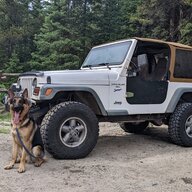
Novak Conversions Jeep Wrangler TJ engine mounts

Nashville TJ's Build - Continued

I'm heading out to Sand Hollow with the boys in May. And what can't you do without at Sand Hollow in May?

Tons?

No.

Fodeez?

No.

Hemi?

No.

A/C?

:unsure:

'Xactly.

I figured I'd better test it out after the long winter, so after polishing off the trailer mod yesterday I took it out for a spin, and sure enough - no A/C.

:oops:

Quick check, and I had not just low pressure in the system, but no pressure in the system. I run die in the system so finding leaks is usually easy under ultraviolet light. The only place I saw a bunch of die was the Low Pressure Shrader valve. Great. Easy fix. Swapped out the valve and hooked up my gauges and vacuum pump.

No joy. After pulling 30 Hq on the pump and shutting it down - it dropped to 0 in about 5 minutes. So, big leak somewhere.

:mad:

So, off to find a big leak. To do this on a discharged A/C system, what I do is attach the compressor, put in 50 psi of air, go to town with a spray bottle of soapy water, and look for bubbles. And, I found them...

The first was right in my face - the Low Pressure switch on the accumulator. Easy fix with two new o-rings.

View attachment 672863

The next was less obvious, and I had to remove the accumulator to see it. I didn't get a bubble shot, but the connection at the condenser basically filled that entire space with bubbles. Definitely the big leak.

View attachment 672865

Two more o-rings, and I double checked everything else. Those were the only two leaks I could identify.

So I pulled vacuum again last night, evacuated it for about an hour, shut things down and let it sit.

And this morning - still 28 Hg after 12 hours. Hopefully, that nailed it.

View attachment 672866

20 oz of R143a later, and we're back in business.

View attachment 672868

Wait, Jeeps have AC??!

Edit: I guess I can stop stressing about finishing my build before then. I'll just ride with Jeff.
 
Jeff - I assume your system uses R-134A, like the stock system? Are you aware that R-134A is in an EPA phase-out? That means EPA has started reducing the allowable production, and when that happens, prices skyrocket. Here's the phase-out schedule:
1771447661107.png


In other words, the manufacturers are already at 60% of the baseline production, and in 2029, that drops to 30%. Prices rise with each step down because units in use get older and more maintenance is required, but supply is restricted. They don't take the limit to zero, though. It stops at 85% reduction. It'll be interesting to see if they eventually do take it to zero. They did that with R-12. Nowadays, you can still find R-12, but it's either new, old stock or recycled. They haven't made any new stuff in decades.

I do my own A/C work on my cars, so I stocked up on R-134A for my cars in early 2024 and R-410A for my home system (it's on the same phase-out schedule) to insulate against these supply restrictions. I don't do work on my home system, but my home A/C guy is okay with me supplying refrigerant.

If you're not aware of this, and you don't keep a lot of refrigerant at home, you may want to stock up. When R-12 was phased out completely, the price shot up to over $100 per pound. My hope is that I bought a lifetime supply of both at $11/pound...
 
Jeff - I assume your system uses R-134A, like the stock system? Are you aware that R-134A is in an EPA phase-out? That means EPA has started reducing the allowable production, and when that happens, prices skyrocket. Here's the phase-out schedule:
View attachment 672869

In other words, the manufacturers are already at 60% of the baseline production, and in 2029, that drops to 30%. Prices rise with each step down because units in use get older and more maintenance is required, but supply is restricted. They don't take the limit to zero, though. It stops at 85% reduction. It'll be interesting to see if they eventually do take it to zero. They did that with R-12. Nowadays, you can still find R-12, but it's either new, old stock or recycled. They haven't made any new stuff in decades.

I do my own A/C work on my cars, so I stocked up on R-134A for my cars in early 2024 and R-410A for my home system (it's on the same phase-out schedule) to insulate against these supply restrictions. I don't do work on my home system, but my home A/C guy is okay with me supplying refrigerant.

If you're not aware of this, and you don't keep a lot of refrigerant at home, you may want to stock up. When R-12 was phased out completely, the price shot up to over $100 per pound. My hope is that I bought a lifetime supply of both at $11/pound...

I didn't know 134 was being eliminated, guess I need to buy some for the shelf. Are there no replacements or substitutes out? I know some in the old car world with R-12 systems will run propane.
 
  • USA Proud
Reactions: lBasket
I didn't know 134 was being eliminated, guess I need to buy some for the shelf. Are there no replacements or substitutes out? I know some in the old car world with R-12 systems will run propane.

None that I know of. It's a typical, "let's pass a law and the market will figure it out," government mandate - like our awesome gas cans we can buy now.
 
  • Sad
Reactions: BlueC
R1234 is the newest i think.

Technically, it's R1234yf, and it's slightly flammable - the first vehicle refrigerant that is. My wife's car has it, and it doesn't cool nearly as well. On a hot Texas day, it takes about 15 minutes for the temperature in a hot car to get comfortable. It's ridiculous. I bet @freedom_in_4low can add a lot more details, since he's an HVAC engineer. He's probably forgotten more than I know, as they say.

Edited to add: R1234yf is incompatible with systems designed for R134A, so it's not a substitute or direct replacement. If you want to switch from R134A, I think everything in the system needs to change.
 
Novak Conversions Jeep Wrangler TJ engine mounts