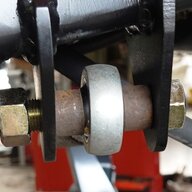
Solid round bar versus round tube

Grease hole or not the fine thread bolt has better tension ability . The base diameter of the bolt is larger with fine thread, and of course there are more thread engagement per inch . But the side-down is you can gall fine threads easier.

I'm aware.
 
Actually, the tensile load from bolt stretch is typically very small compared to the tensile strength of the bolt. In contrast, the shear stress on a bolted joint used in a single- or double-shear joint (like a control arm mount) is usually the design constraint. In practice, we rarely even considered bolt stretch in our designs. Rod bolts and head bolts being one exception, but that's because they aren't shear joints. They are loaded in tension. But, both axial tensile stress and shear stress are based on area, so removing the center is not trivial. For example, putting a 1/8" hole in a 1/2" diameter bolt reduces both the axial tensile strength and the shear strength by about 6%.

Those are similar design parameters to what racers and aircraft use. Our world is a lot different since 99% of the bolts we use are designed in tension. We don't design around the bolt losing tension and coming into shear. Our mount thicknesses are too thin, bolts are too small, threads live in the shear area, all bad stuff if the bolt loses the prescribed tension. Almost all of our stuff is based on the rules of a slip critical connection where the loss of tension is considered a failure with immediate need for returning it back to a viable state.
 
of course there are more thread engagement per inch
One of these days we need to get some smart folk in here to explain the ins and outs of thread engagement and how all of that works. I read a technical article many years ago showing how much load each thread endured in a properly tightened connection. It basically showed that very little improved after about 5 threads. This is for our typical V thread.

But, go ask the question about how much thread engagement we need and we get the most common answer being it should be 1.5x the bolt diameter. Contrary to that is none of the mainstream nuts we buy and use adhere to that rule. Then we get into the jam nuts we all use and they have even less thread engagement and even then, we have never stripped one that was graded. I've ruined some little ones doing silly stuff on sub 1/4" machine screws, but never on anything bigger.
 
  • Like
Reactions: srimes
One of these days we need to get some smart folk in here to explain the ins and outs of thread engagement and how all of that works. I read a technical article many years ago showing how much load each thread endured in a properly tightened connection. It basically showed that very little improved after about 5 threads. This is for our typical V thread.

But, go ask the question about how much thread engagement we need and we get the most common answer being it should be 1.5x the bolt diameter. Contrary to that is none of the mainstream nuts we buy and use adhere to that rule. Then we get into the jam nuts we all use and they have even less thread engagement and even then, we have never stripped one that was graded. I've ruined some little ones doing silly stuff on sub 1/4" machine screws, but never on anything bigger.

I remember at sea we bolted everything down. If you have never been in a big storm in a small ship, it can be quite a ride. Nobody wants a 300 lb radio flying across the room at them. The number and size of the bolts was a function of the weight of the device, the thickness of the attachment point, and the thickness of what we were bolting it to. The A/N-SPN-38 LORAN receiver got 4, 1" diameter bolts that were 3" long and included two flat and one split washer. All standard Navy gear came with 'bolt-down' provisions. We had to imagineer some of the commercial gear.
 
I remember at sea we bolted everything down. If you have never been in a big storm in a small ship, it can be quite a ride. Nobody wants a 300 lb radio flying across the room at them. The number and size of the bolts was a function of the weight of the device, the thickness of the attachment point, and the thickness of what we were bolting it to. The A/N-SPN-38 LORAN receiver got 4, 1" diameter bolts that were 3" long and included two flat and one split washer. All standard Navy gear came with 'bolt-down' provisions. We had to imagineer some of the commercial gear.

And yet, we bolt the engine in a TJ to the frame with 3 3/8" bolts x 1" long, no split lock washer and the mount is overhung so the leverage against the bolts is far higher than a receiver base would likely see. And, they don't fail unless they come loose.
 
little improved after about 5 threads.

I was told 6 threads growing up. It is interesting how many things we are surrounded by just work well enough without a ton of applied science.
The motor mounts are a good example. Thanks for the thread Blaine.
 
  • Like
Reactions: mrblaine
I was told 6 threads growing up. It is interesting how many things we are surrounded by just work well enough without a ton of applied science.
The motor mounts are a good example. Thanks for the thread Blaine.

What I find interesting is how much of engineering starts with a "we always did it like that, 'cause it works", then backtracking using the math, modeling, testing, etc to come up with the science of how / why it works.
 
  • Like
Reactions: freedom_in_4low
I'm acutely aware of how bolts function for the vast majority of our uses. I'd make the case that a fine thread bolt with a small hole for grease path is still stronger than the same grade and diameter in coarse thread. Someone really good with math will have to show me why I'm wrong.

I'm sorry, but even though I can math, I can't prove you wrong - because you are right (at least for Johnny Joint sized bolts):

1702745274430.webp


1702745221982.webp


I've included the Excel file I made to prove you right - it can be used to compare bolt strengths of most sizes, both with and without center holes... :)
 

Attachments

And yet, we bolt the engine in a TJ to the frame with 3 3/8" bolts x 1" long, no split lock washer and the mount is overhung so the leverage against the bolts is far higher than a receiver base would likely see. And, they don't fail unless they come loose.

It's all about the safety factor chosen. Unless it's regulated by government or a standards body, the engineer is free to use his judgment to pick a safety factor. Selecting a safety factor is an art. If the consequences are human death or injury, it'll be higher than if the consequences are just inconvenience. Also, it's very hard for an engineer to develop a load case for every possible use scenario, so the less confidence in the load case, the higher the factor of safety.
 
  • Like
Reactions: freedom_in_4low
What I find interesting is how much of engineering starts with a "we always did it like that, 'cause it works", then backtracking using the math, modeling, testing, etc to come up with the science of how / why it works.

That's mainly because many things are/were designed by non-engineers, and many times, those non-engineers do just fine. When I was a younger engineer, I was trying to design a complicated mechanism virtually in CAD. At the same time, a technician was in the shop using trial-and-error to build the same actual mechanism. Guess who got a working concept quicker? (not me) However, his concept, tweaked by an engineer (me), was a great solution! Since then, I've learned to use every tool available to me, so I often times use the other CAD, where the C stands for Cardboard. It's usually quicker, at least for me.

 
  • USA Proud
Reactions: Rickyd
It's all about the safety factor chosen. Unless it's regulated by government or a standards body, the engineer is free to use his judgment to pick a safety factor. Selecting a safety factor is an art. If the consequences are human death or injury, it'll be higher than if the consequences are just inconvenience. Also, it's very hard for an engineer to develop a load case for every possible use scenario, so the less confidence in the load case, the higher the factor of safety.

That safety factor nonsense has completely screwed up the housing industry in SoCal at least. Best we can figure is some engineer somewhere got held liable for something that failed. As a consequence of that, the amount of steel beams and columns hidden in stick framed homes skyrocketed. We still have 1000's upon 1000's of homes built with a 1 x ridge between the rafters at the peak which have endured many of our smaller earthquakes without failure and here we go, throw enough structural steel and steel bolted connections at them to build a small commercial building. Yes, I recognize the value but some of it is a bit overboard.
 
  • Like
Reactions: Ocho
What I find interesting is how much of engineering starts with a "we always did it like that, 'cause it works", then backtracking using the math, modeling, testing, etc to come up with the science of how / why it works.

It seems now we have the opposite issue , engines are engineered down to a gnats ass on the absolute minimum material to make something function , however there isn't any reserve to account for additional stresses , abuse , overheating etc...
The moment we walk away from ' cause it works' we find ourselves bathed in the German mechanical mindset of ego-stroking.

This Audi V-8 is the pinnacle example of the mindset , and the closer to home examples are how Daimler " improved " TJ's to create issues that preveously didn't exist , ( looking at you 05 , 06 TJ's ). It's a damn shame.

2j3vpcng7hx41.webp
 
  • Like
Reactions: freedom_in_4low
That's mainly because many things are/were designed by non-engineers, and many times, those non-engineers do just fine. When I was a younger engineer, I was trying to design a complicated mechanism virtually in CAD. At the same time, a technician was in the shop using trial-and-error to build the same actual mechanism. Guess who got a working concept quicker? (not me) However, his concept, tweaked by an engineer (me), was a great solution! Since then, I've learned to use every tool available to me, so I often times use the other CAD, where the C stands for Cardboard. It's usually quicker, at least for me.


Any time I start to think I know what I'm doing and get a little too big for my britches, I go read that article about the engineering they threw at the JT to solve the cooling issues they needed to in order to increase the towing capacity to the level they were after. Excellent expression of what some smart folks can do when faced with a difficult set of problems to solve.
 
Those are similar design parameters to what racers and aircraft use. Our world is a lot different since 99% of the bolts we use are designed in tension. We don't design around the bolt losing tension and coming into shear. Our mount thicknesses are too thin, bolts are too small, threads live in the shear area, all bad stuff if the bolt loses the prescribed tension. Almost all of our stuff is based on the rules of a slip critical connection where the loss of tension is considered a failure with immediate need for returning it back to a viable state.

Good point. The Jeep engineers also design like racers and aircraft designers. If that joint ever loses tension, the engineer wants to be sure it won't fail because there will be a lawsuit, and the plaintiff's attorney will argue that the engineer should have assumed that the consumer wouldn't maintain their vehicle. You probably already know this, but the shear strength of most steels is about half the tensile strength, and that's a constraint that puts shear concerns front and center in the engineer's mind.
 
  • Like
Reactions: freedom_in_4low
Good point. The Jeep engineers also design like racers and aircraft designers. If that joint ever loses tension, the engineer wants to be sure it won't fail because there will be a lawsuit, and the plaintiff's attorney will argue that the engineer should have assumed that the consumer wouldn't maintain their vehicle. You probably already know this, but the shear strength of most steels is about half the tensile strength, and that's a constraint that puts shear concerns front and center in the engineer's mind.

I should have taken some pics. A buddy brought me a Dana 44 TJ front axle to swap in. The front lower control arm bolts had been run loose for so long that they doubled the height of the slots, ruined the horseshoes for the cam washers, and they were about to wear through the end of the slot at the rear. The first thing we had to do was cut them off and replace them with new. Any way, the point of that mess is how is an engineer ever liable for that level of neglect?
 
That safety factor nonsense has completely screwed up the housing industry in SoCal at least. Best we can figure is some engineer somewhere got held liable for something that failed. As a consequence of that, the amount of steel beams and columns hidden in stick framed homes skyrocketed. We still have 1000's upon 1000's of homes built with a 1 x ridge between the rafters at the peak which have endured many of our smaller earthquakes without failure and here we go, throw enough structural steel and steel bolted connections at them to build a small commercial building. Yes, I recognize the value but some of it is a bit overboard.

No doubt. We have the same issue designing the subdivisions in which those houses are built. However, it's not always engineers causing the problem with overly-conservative safety factors. Like everything else where financial interests come into play, there are a lot of people pushing for "improvements" because they sell products related to the solution. Perhaps the steel companies or investors in those companies lobbied the International Code Council to change those standards?

There are a lot of overly-conservative engineers because they're not very bright. Some of us work hard to develop the same practical experience you have to guide us through the design process.
 
I should have taken some pics. A buddy brought me a Dana 44 TJ front axle to swap in. The front lower control arm bolts had been run loose for so long that they doubled the height of the slots, ruined the horseshoes for the cam washers, and they were about to wear through the end of the slot at the rear. The first thing we had to do was cut them off and replace them with new. Any way, the point of that mess is how is an engineer ever liable for that level of neglect?

They're not. But juries have disagreed over and over again. In my automotive engineering career, I liked the freedom of designing in-house racing vehicles because there were no lawyers advising us. On the other hand, in the production vehicle world, we had lawyers advising us. Them, and the bean-counters drove me crazy. Oh, yeah, the marketing guys were bad, too. They refused to accept that an entire vehicle could not be designed and tested in six months.
 
  • Like
Reactions: srimes
Crap - I'm supposed to be figuring out why the transmission I just rebuilt for the old Subaru won't downshift smoothly and why our dishwasher (not my wife) isn't working, and I just spent an entire Saturday morning sitting at my computer. I better put some pants on and get to work... :ROFLMAO:
 
  • Love
Reactions: ColoJeep
No doubt. We have the same issue designing the subdivisions in which those houses are built. However, it's not always engineers causing the problem with overly-conservative safety factors. Like everything else where financial interests come into play, there are a lot of people pushing for "improvements" because they sell products related to the solution. Perhaps the steel companies or investors in those companies lobbied the International Code Council to change those standards?

There are a lot of overly-conservative engineers because they're not very bright. Some of us work hard to develop the same practical experience you have to guide us through the design process.

In most situations there is WAY more individual incentive for an engineer to be conservative. Oh, the bean counters say I can save them a couple bucks if I approve this change? And what do I get for it, a smile and a thank you. But if something fails I'm professionally and in some cases personally liable. And people come with STUPID ideas all the time. It's easy to see why old engineers tend to be grumpy.
 
In most situations there is WAY more individual incentive for an engineer to be conservative.

Many times over my career, I've seen the same engineer be WAY too conservative in one situation, and then WAY not conservative enough in another, simply because he lacked either experience or intelligence to fully comprehend all the design factors and consequences.
 
  • Like
Reactions: ColoJeep and srimes