

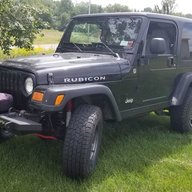
TJ rear wiggle finally solved

To help prevent the bolt from rusting in place.

And as to the science, I have to completely agree, until it dosen't work. Mr.Blaine's washer idea is nothing short of brilliant. And his theory on the thinning bracket is highly likely to be true.
But if the bolt (regardless of size) holds the control arm in position then why are there so many hogged out brackets or bolts worn down to half their diameter, not just in this location, but in so many places that this design is used? Life is not always what science says it should be.
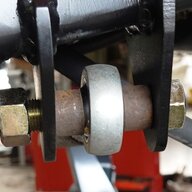
 
Maybe my mind is fried...incant see anything about the nubs inside the bushing

Why are there little nubs inside the control arm bushing... versus having the bolt diameter and control arm bushing inside diameter machined normally.... For instance like a track bar bushing.
The nubs are just to center the bolt so the ends of the bolt sleeve have the best chance of making contact evenly around the hole in the mount sides.
 
The nubs are just to center the bolt so the ends of the bolt sleeve have the best chance of making contact evenly around the hole in the mount sides.
Thank you.
 
To help prevent the bolt from rusting in place.

And as to the science, I have to completely agree, until it dosen't work. Mr.Blaine's washer idea is nothing short of brilliant. And his theory on the thinning bracket is highly likely to be true.
But if the bolt (regardless of size) holds the control arm in position then why are there so many hogged out brackets or bolts worn down to half their diameter, not just in this location, but in so many places that this design is used? Life is not always what science says it should be.
Science dictates that in order for the slip critical connection to work properly the fastener has to achieve and maintain the proper amount of stretch to clamp the sides of the mount to the end of the bolt sleeve.

The only reason it doesn't work is when the fastener is improperly used, under or over torqued. If it is under torqued, there isn't enough clamping force to stabilize the connection. If it is over torqued, the fastener moves out of elastic deformation into plastic deformation and it is then no longer able to clamp the sides of the mount against the bolt sleeve.

If you pay attention, it almost always goes the same way. Hey ya'll, I found that my track bar bolt was loose and I tightened the crap out of it. Now it is moving again. They ruined the bolt by over stretching it and now it can't do its job because it just keeps stretching without springing back to provide the clamping force needed to prevent the bolt sleeve from moving.

Lack of understanding doesn't change the science and how bolts work in slip critical connections.
 
  • Like
Reactions: Tob
To help prevent the bolt from rusting in place.

And as to the science, I have to completely agree, until it dosen't work. Mr.Blaine's washer idea is nothing short of brilliant. And his theory on the thinning bracket is highly likely to be true.
But if the bolt (regardless of size) holds the control arm in position then why are there so many hogged out brackets or bolts worn down to half their diameter, not just in this location, but in so many places that this design is used? Life is not always what science says it should be.
Simple question. How many floating brake rotors have you seen with slotted or elongated holes from moving back and forth from being loose? (TJ has floating rotors, so that style)

The answer with rare exception is very few but the lug studs are not a tight fit in the holes, the rotor depends 100% on the clamping force from the rim after the lug nuts are tightened to stop the rotor from moving around.

The reason is while folks are not as enthusiastic about maintaining the correct bits on the rest of the fasteners on their rigs, they tend to be pretty attentive to not letting the wheels fall off.
 
  • Like
Reactions: Tob
