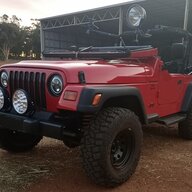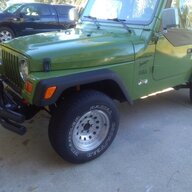
05 TJ getting 7 mpg

Also with the conversations, I've done them right on paper. I just used mpg because I know most of you are yanks and I didn't want any confusion, but I think I may of made it more confusing haha.

Maybe you have a different throttle body than me? Mine unbolted with two machine screws and came off. Opposite of the throttle cables.

Yes, it bolts on with 2 screws, but the electrical contacts are sealed inside of it.
 
Did you test your old one at all? I just tested mine today and the voltage seemed to increase smoothly upwards, but I was only getting 3.78v at WOT, and I think it should be closer 4.6. Hoping that's my culprit, new sensor gets here tomorrow.
How do you test this? Just using ohms and checking the difference between throttle position?
 
Yes, it should be a smooth sweep in ohms as you rotate it. If you have an OBDII reader, it shows it in percent instead of ohms.
 
How do you test this? Just using ohms and checking the difference between throttle position?
There's a 3 pin connector for the TPS. A 5v input signal, ground and an output signal wire that varies voltage, but should read somewhere around .5v at idle. Mine was .61v. Attach one lead of the multimeter to a ground on the jeep, there's probably a ring terminal ground fastened on to the firewall close by. Get two small pieces of wire and strip both ends a bit. Twist one end so it's small enough you can backprobe the connector on the TPS. Stick the first one in the ground wire and stick the second one in until you find the output signal wire. Do all of this with key on engine off.

Then slowly increase the throttle while watching the voltage on the output wire. Should be a nice even increase up to WOT, no big drops or jumps. An analog meter would be better, but I used a digital just fine.
 
  • Like
Reactions: Potomus Pete
There's a 3 pin connector for the TPS. A 5v input signal, ground and an output signal wire that varies voltage, but should read somewhere around .5v at idle. Mine was .61v. Attach one lead of the multimeter to a ground on the jeep, there's probably a ring terminal ground fastened on to the firewall close by. Get two small pieces of wire and strip both ends a bit. Twist one end so it's small enough you can backprobe the connector on the TPS. Stick the first one in the ground wire and stick the second one in until you find the output signal wire. Do all of this with key on engine off.

Then slowly increase the throttle while watching the voltage on the output wire. Should be a nice even increase up to WOT, no big drops or jumps. An analog meter would be better, but I used a digital just fine.
I'm not really familiar with what the tps sensor does. I understand it reads the throttle position, is this sensor what supplies info (voltage) to the injectors?
 
same situation here : I discovered a cracked exhaust header and a cracked inlet manifold. Fixed one / replaced the other (both easy jobs) and mileage has almost doubled overnight.
 
Just as I suspected my problem was the throttle Position sensor. Finally my TJ is acting normal, and I can drive it like I want. I'v been on eggshells for weeks.
 
Just as I suspected my problem was the throttle Position sensor. Finally my TJ is acting normal, and I can drive it like I want. I'v been on eggshells for weeks.
Just got my new one in, and it definitely feels a lot more responsive and normal now. Still topping out at 72mph and 3400 rpm full throttle though. Gonna do a fuel pressure test next...
 
I know the OP has resolved the issue, but after reading through the posts and seeing others having MPG issues, it made me question if the fuel itself may be at least partially to blame. The way they are always dicking around with additives and such, it would not surprise me if the fuel was being made less combustible, and thus impacting the efficiency of our ICE's in an effort to convert us to newer "renewable" fuel sources.
I'll take my conspiracy theory hat off now... :ROFLMAO:
 
  • Haha
Reactions: rasband
I know the OP said he replaced his O2 sensors but they're what I would always suspect first after a sudden dramatic mpg loss. I wouldn't blame the TPS.
I'd expect a bad idle or some dead spots with a bad TPS. Has the OP checked that the throttle linkage isn't out of adjustment? Is full throttle really full throttle?
 
I'm not really familiar with what the tps sensor does. I understand it reads the throttle position, is this sensor what supplies info (voltage) to the injectors?
The PCM reads the voltage to determine the throttle position. The PCM uses the throttle position, MAP sensor value, O2 sensors and temp sensors to determine injector pulsing.
 
I know the OP has resolved the issue, but after reading through the posts and seeing others having MPG issues, it made me question if the fuel itself may be at least partially to blame. The way they are always dicking around with additives and such, it would not surprise me if the fuel was being made less combustible, and thus impacting the efficiency of our ICE's in an effort to convert us to newer "renewable" fuel sources.
I'll take my conspiracy theory hat off now... :ROFLMAO:
I'm the OP, my issue definitely isn't solved haha. Getting there tho. I'm going to replace the TPS sensor. It's 19 years old. Won't hurt to replace it anyways. I reset the PCM as stated in some other threads and it seems to improved fuel economy for now. I filled up one tank with shell Vpower premium and a Lucas injector cleaner to see if I can clean the lines and injector out. Once this tank is empty I will be going back to the regular low grade the FSM recommends.

I'd expect a bad idle or some dead spots with a bad TPS. Has the OP checked that the throttle linkage isn't out of adjustment? Is full throttle really full throttle?
The jeep runs and idles fine, lots of power on the highway and around town, no sputtering or hesitation. Just burning through a quarter tank every 30kms.

I didn't think there was a way to adjust the throttle cable on this. We tried using a zip tie as a spacer, that just made it idle way higher, so we removed it.
 
You're absolutely certain you installed the right p/n's for the upstream O2 sensors and they were Mopar/NGK/NTK?

And too high of an axle gear ratio will definitely decrease mpg. My TJ was lugging with 4.88 gears and 35" tires with my 42RLE transmission and getting <12 mpg. Mpg went up to 14.6 after regearing to 5.38.
 
  • Like
Reactions: MikeE024